Writer’s Advice Series
Kurt Vonnegut: The 16 Rules for Writing Fiction
Great rules for writing fiction, stories, anecdotes, or Medium posts!

Check out these great rules for writing fiction from one of the top novelists ever to write a book. These are great rules for writers, novelists, short story writers, speakers telling stories, or bloggers writing anecdotes.
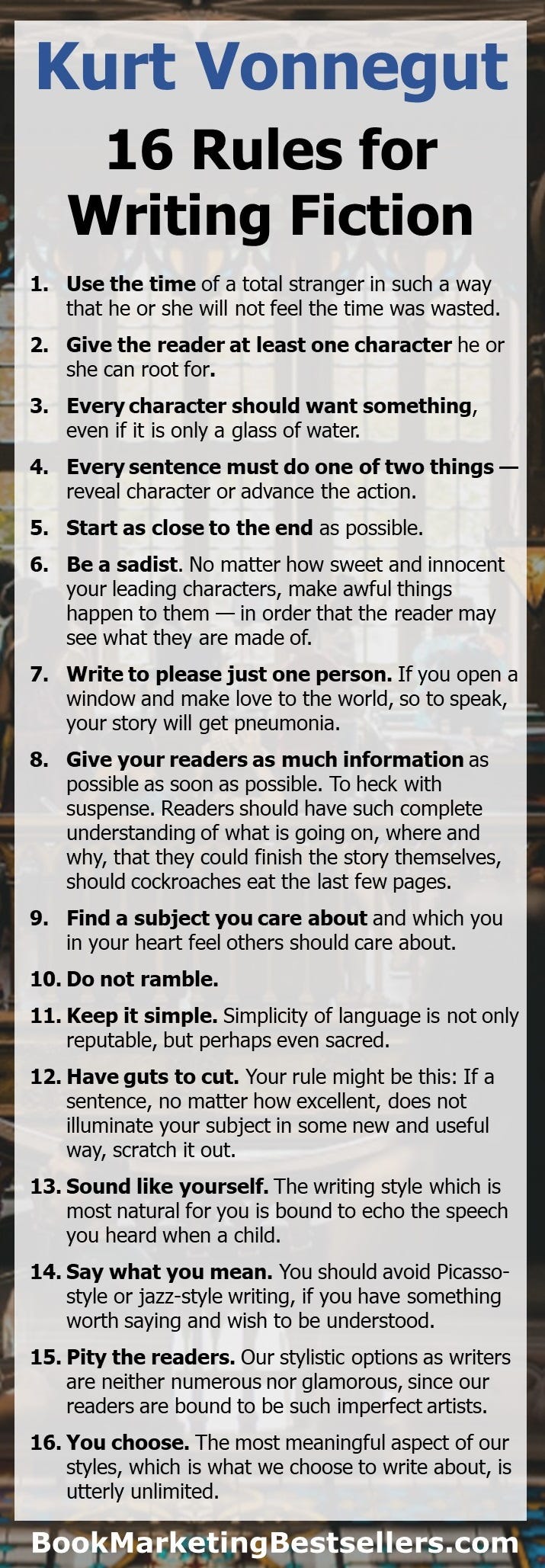
1. Use the time of a total stranger in such a way that he or she will not feel the time was wasted.
2. Give the reader at least one character he or she can root for.
3. Every character should want something, even if it is only a glass of water.
4. Every sentence must do one of two things — reveal character or advance the action.
5. Start as close to the end as possible.
6. Be a sadist. No matter how sweet and innocent your leading characters, make awful things happen to them — in order that the reader may see what they are made of.
7. Write to please just one person. If you open a window and make love to the world, so to speak, your story will get pneumonia.
8. Give your readers as much information as possible as soon as possible. To heck with suspense. Readers should have such complete understanding of what is going on, where and why, that they could finish the story themselves, should cockroaches eat the last few pages.
9. Find a subject you care about and which you in your heart feel others should care about.
10. Do not ramble.
11. Keep it simple. Simplicity of language is not only reputable, but perhaps even sacred.
12. Have guts to cut. Your rule might be this: If a sentence, no matter how excellent, does not illuminate your subject in some new and useful way, scratch it out.
13. Sound like yourself. The writing style which is most natural for you is bound to echo the speech you heard when a child.
14. Say what you mean. You should avoid Picasso-style or jazz-style writing, if you have something worth saying and wish to be understood.
15. Pity the readers. Our stylistic options as writers are neither numerous nor glamorous, since our readers are bound to be such imperfect artists.
16. You choose. The most meaningful aspect of our styles, which is what we choose to write about, is utterly unlimited.
Sources (Amazon discovery links): Bagombo Snuff Box: Uncollected Short and Palm Sunday by Kurt Vonnegut, Jr.


