avatarJohn Kremer

Summary

The web content discusses the art of storytelling, drawing on insights from Andrew Stanton's Ted talk and highlighting the importance of emotional connection, conflict, and wonder in crafting compelling narratives.

Abstract

The provided web content delves into the essence of effective storytelling, referencing Andrew Stanton's Ted talk where he emphasizes the power of stories to evoke empathy and understanding. Stanton, acclaimed for his work on films like "Toy Story" and "Finding Nemo," suggests that good stories should engage the audience by making them care, creating honest conflict, and allowing them to connect the dots. The article also touches on the significance of change and anticipation in maintaining audience interest, and the value of drawing from personal experiences to invoke wonder and truth. Additionally, it offers a collection of storytelling guidelines and encourages writers to overcome fear and writer's block to create impactful narratives.

Opinions

  • Storytelling is akin to joke telling, where the storyteller must know their punch line to effectively engage the audience.
  • A well-told story should have a strong theme running throughout and should make the audience care about the characters and their journey.
  • Conflict is a crucial element in storytelling, as it creates doubt about the outcome and maintains the audience's interest.
  • Storytelling guidelines are important, but they are not rigid rules; they serve as a framework for crafting narratives.
  • Personal experiences are valuable sources for storytelling, as they allow writers to capture genuine emotions and express core values.
  • The best stories are those that can invoke a sense of wonder in the audience, encouraging them to surrender to the narrative.
  • Change is fundamental in storytelling, reflecting the dynamic nature of life and preventing stories from becoming stagnant.
  • Pixar's storytelling rules, such as avoiding songs, "I Want" moments, and love stories, are presented

Storytelling Tips Series

The Power of Storytelling

Listen in as Andrew Stanton shares the power of storytelling via a Ted talk

Here are a few of the points Andrew Stanton, screenwriter of Toy Story, Finding Nemo, WALL-E, Finding Dory, and John Carter, made on telling stories during a 2012 Ted talk. His points are worth paying attention to if you want to write better books, create more interesting blog posts, write better Medium posts, speak with more impact, tell better stories, and produce better news releases.

TV host Mr. Rogers carried this quote from a social worker: “Frankly, there isn’t anyone you couldn’t learn to love once you’ve heard their story.”

Storytelling is joke telling. It’s knowing your punch line.

Stories deepen our understanding of who we are as human beings.

Stories allow us to experience our similarities.

Stories should make us care.

Don’t give your audience 4. Give them 2 + 2. Let them work to complete the story.

All well-drawn characters have a spine.

We’re all learning all the time.

That’s why change is fundamental in story. If things go static, stories die because life is never static.

Drama is anticipation mingled with uncertainty. — William Archer

Storytelling is joke telling. It’s knowing your punch line.

Have you created honest conflict that creates doubt on what the outcome might be?

Pixar rules: No songs. No I Want moment. No happy village. No love story.

You can build a better story.

Storytelling has guidelines, no hard fast rules.

A strong theme is always running through a well-told story.

The secret sauce: Can you invoke wonder?

Have your readers surrender to wonder.

The best stories infuse wonder.

The first story lesson I ever learned: Use what you know. Draw from it.

Capture the truth from your experiences, expressing values you feel deep in your core.
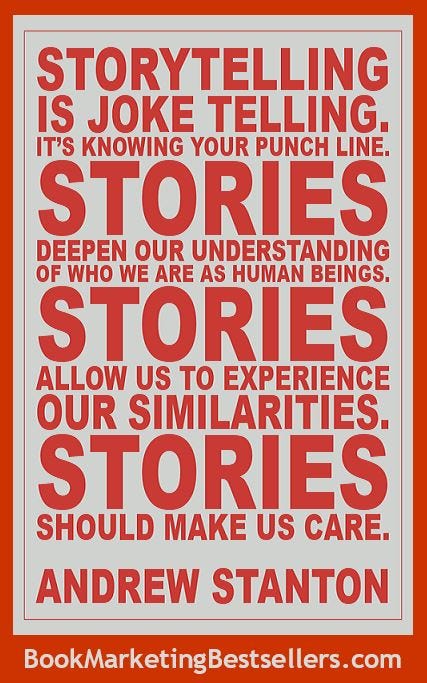
Graphic created by John Kremer using TypeSlab
Storytelling
Storytelling 101
Writing Tips
Tedtalks
Andrew Stanton
Recommended from ReadMedium