
Writers: How To Use Twitter To Your Advantage
It takes a while to understand what is going on. I will share my learning through this story.

If you write actively, you need to have exposure to Twitter. This has nothing to do with tweeting your work excessively. It is necessary to promote our work, and I have to say that success on Twitter requires more than that. The purpose of this story is to share what worked for me today and what did not.
I did not crack the Twitter code at the very beginning. I treated it like the “Forward” button in emails. I simply forwarded my stories en masse, hoping that random people on the platform will pick up my tweet and read my work.
I guess you could guess how that went. I created a ton of content, but the viewership and readership of my stories did not increase substantially. And so, I decided to find out what works.
There are 4 ways that I know (as of today) that work on this bird-chirping platform. I will elaborate on them below.
Engage with Fellow Writers and Editors.
Engaging with the writer’s community from Medium works. Think of it as a form of network leverage.
Writers are busy people. So are editors. I suspect, and this is my guess, that Twitter is their choice of social media because it does not take much effort to create a tweet. One sentence is all we need to push the tweet button. Clip our stories on that tweet, and off it goes, carrying our work to the people we know at the speed of light.
Many of us love to have our work retweeted or our tweets commented upon. We can do the same for our writer’s community. Retweet their work, and engage in their tweets.
They will reciprocate.
One more point.
Do you highlight your favorite writer’s work? That’s great. How about tweeting your highlights? That way, your favorite author will get direct feedback from you based on sentences that resonated with you.
Find and Use the Right Hashtags — Especially the Trending Ones.
Hashtags represent trends. It shows us what’s hot and what’s not. Using trending hashtags increases the visibility of our tweets.
The screenshot below shows how to use a hashtag and the hashtags to use.
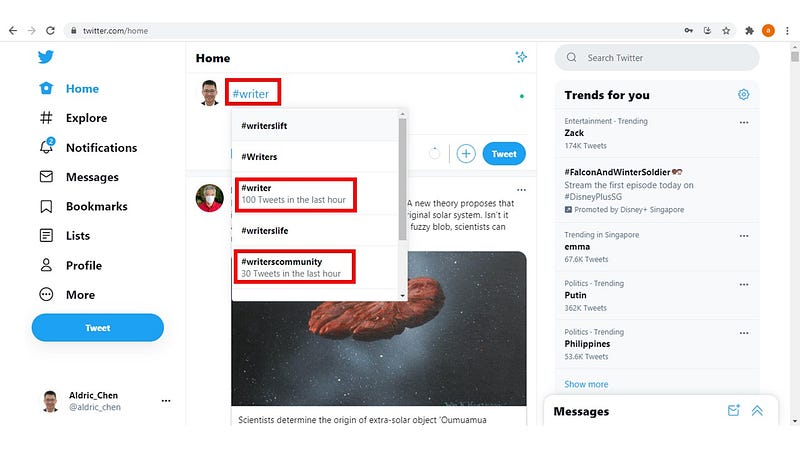
Take, for instance, a tweet that is created to engage with the writer’s community. You can do the following: -
- Type “#” in the Tweet.
- Type “Writer” immediately after the “#” symbol.
- Wait for a drop-down list to appear.
- When it does, it shows you the list of hashtags with the word “Writer” in it.
- Look for those hashtags that come with a commentary, such as 100 Tweets in the last hour.
- Select that hashtag.
- Tweet.
This little trick separates the tweets that have responses versus those that go nowhere.
Make sure to use the trending hashtags!
Who is There?
Many writers are active on Twitter. This is a sub-set of those I know: -
Dr Mehmet Yildiz, Thewriteyard, Anangsha Alammyan, Tom Handy, Kevin Lee, Lucy Dan 蛋小姐 (she/her/她), Dr. Christine Bradstreet, Lanu Pitan, Shreya Badonia, Tom Kuegler, Matt Lillywhite, Derick David.
I engage with many of them and their tweets. I would comment and retweet. Of course, I cannot be scrolling through my post-feed all the time. I do it when I am on the platform.
You can do that too.
Many writers write, publish, and forget it. However, getting our work out to a broader audience is the business of writing.
Fellow writers and editors on Twitter understand that. They will help you with your tweets.
First, you got to tweet.
What Works.
I am presenting my learning journey in this segment, and please feel free to experiment with them. Use those that work for you, and feel free to discard those that do not.
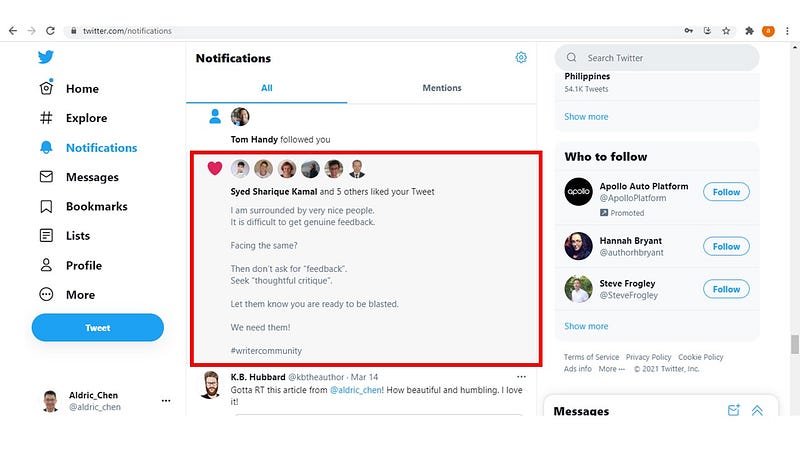
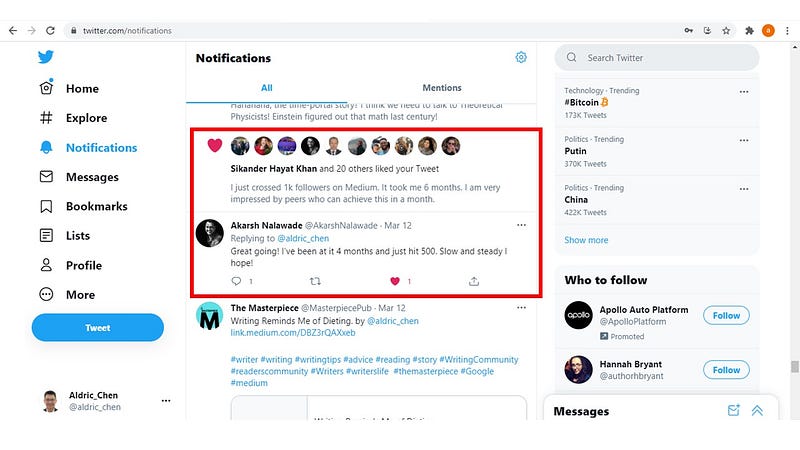
This is my list of what works: -
- Milestone celebration tweets like How I Gained 1000 Followers.
- What we go through as writers, such as writer’s block, idea bankruptcy and etc.
- Daily life, such as juggling between writing and milking a cow.
You can refer to the screenshots below.
My Takeaway.
Twitter is one social media platform that writers are in. It is where our network is. Therefore, we have to make that effort to be present and to be connected.
This is my thinking. We can grow our business as writers if we do the following: -
- Engage with fellow writers and editors.
- Find and use the trending hashtags.
- Connect with writers who are active users of Twitter.
- Experiment actively to find out what works for us and whatnot.
Of course, these are my learning lessons so far. There will be more as I engage with the platform over time.
What are your learning lessons on Twitter?
Aldric
About the Author:
As a content contributor, I write my observations from daily life and my business exposure.
Because our life experience is the bedrock of our unique perspectives.