
Write for Better Marketing
Our submission guidelines: What we’re looking for, how to craft your stories, and what we accept for publication
Better Marketing is on hiatus until January 1, 2024. We’ll resume publishing pieces on January 2nd. Feel free to submit your pieces over this break, but our review time will be extended over this break. Thank you.
[Last updated November 2023]

Thanks for your interest in writing for Better Marketing! We’re always looking for new and interesting articles about marketing, business, and creativity.
Please read this guide before submitting an article. It includes an overview of our topic areas, what types of articles we’re looking for, what we’re not looking for, and how to submit an article.
Refer to the Better Marketing style guide for details on how to format and edit your piece before submitting.
IN THIS GUIDE:How to Submit an Article
Diversity & inclusion
CTA guidelinesWhat We’re Looking For
Article types we publish
Topic areas we cover
Topic areas and article types to avoidWhy Wasn’t My Story Submission Accepted?
How to Submit an Article
For Better Marketing authors: Please submit via the Medium submission feature.
For new authors: Please submit through this form. This allows us to add you as a writer to Better Marketing. Once you’re added, you’ll be able to follow the normal submission process for us to review your story.
Please note that publishing with us in the past does not guarantee that your work will be published in the future. We review each submission independently.
If you don’t hear back from us in five business days, please assume we’ve passed on your submission. (We don’t work on weekends). We receive a large volume of submissions each day, and while we try to respond to all submissions, we are unable to reply to everyone.
NOTE: If you believe your submission is particularly urgent or timely, for example when dealing with social media trends or extremely time-sensitive news, please add “URGENT” to the front of your title. We will expedite the review of the piece.
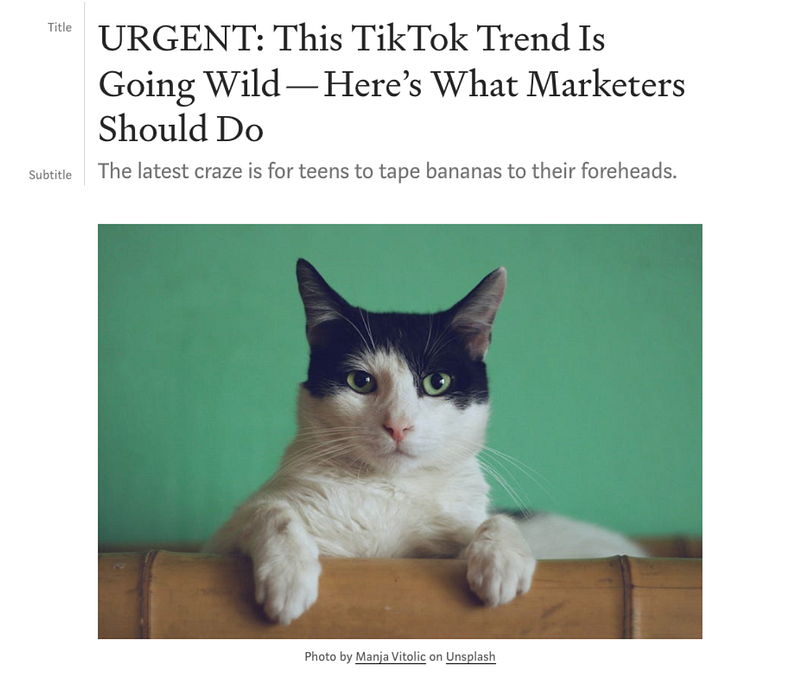
This is only for pieces that are truly time-sensitive. Anyone abusing this will be removed as a Better Marketing writer.
Diversity and inclusion
We encourage submissions from underrepresented groups in the marketing and creative industry. We strive to be an inclusive publication where everyone feels welcome to read, write, teach, and learn from others. Our goal is to elevate the most innovative voices and ideas in the field of marketing.
Calls to Action (CTAs)
Better Marketing writers may include one short CTA at the end of each article, such as a personal newsletter subscription link, a link to one social media account, or (for republished work) a link to your originally published article.
CTAs should be relevant to the article topic and help the reader to learn more, or to help them discover more of your writing. We also do not allow bio paragraphs at the end of articles (that’s what your profile is for!).
Articles submitted to the publication may have a CTA for the Better Marketing newsletter Marketing Memo added to the end.
Affiliate Link
We allow minimal relevant affiliate links in articles, and they must be disclosed at the top of the article. Excessive affiliate links will cause pieces to be rejected.
A Note About AI-Generated Content
We follow Medium’s Distribution Standards overall, and support their stance that Medium is a place for human storytelling. You can read Medium’s stance on AI here for more information, but the key takeaway is this:
We are a home for human writing, full stop.
The responsible use of AI-assistive technology is allowed, but to promote transparency, and help set reader expectations, we require content created with AI assistance to be clearly labeled as such.
Please be sure you follow this guideline in articles submitted to Better Marketing.
What We’re Looking For
We accept tutorials, how-tos, advice on how to manage other aspects of your life as a marketer, as well as tool reviews, case studies, and high-level strategy tips.
Here’s more specific information about what we’re looking for this month:
Article types we publish (and would like to see more of)
- Marketing case studies. Case studies and analysis of real-world examples are great, especially if they’re detailed, unique, and teach the reader something new or unexpected. Bonus points if you’re writing about a case study that you have firsthand experience of.
- Accounts of your real, lived, personal experience in marketing. Then, tell us how readers can apply what you’ve learned. We want to hear about the years you spent inside a mascot suit — and what marketers should take away from your experience.
- Tutorials and how-tos. Even better than explaining how you think something works is walking us through how you actually did it. This is the gold standard at Better Marketing: experience-backed tutorials. Include real results, easy-to-follow instructions, and empathetic fallbacks in case of failure.
- Thoughtful pieces about ethical questions in marketing. Why are skis sold by gender? How do you market the idea of ending systemic racism?
- Illustrated guides, cartoons, custom drawings. Articles that break the “traditional” format of a Medium article, and that surprise and delight the reader. Here’s an example: An illustrated guide about talent vs. deliberate practice.
- New ideas and underrepresented voices in marketing. Our publication is not an echo chamber. We welcome new writers from all backgrounds, ages, and places.
- Timely articles about current trends. We want to hear about the space where marketing and present-day issues meet. Our preference is towards more evergreen articles, so we may be more selective about what we publish in this category, but we want to know why we should skip the latest social media platform or how traditional marketing is at the heart of the latest viral trends.
Here are some examples of our “best in class,” stories that were all hand-picked for a Boost on Medium:
Topic areas we cover
- Marketing
- Social media
- Creative inspiration
- Paid advertising
- Branding
- Logo design
- Psychology (as it relates to marketing)
- Ethics (as it relates to marketing)
- Resources to achieve specific marketing goals
- SEO
- Copywriting
- Marketing data analytics
- Book publishing
- Writing
Topic areas to avoid (either because we’ve covered them extensively already, or because we don’t publish them)
- “Medium meta” (articles about writing on Medium)
- Non-specific writing advice
- Self-improvement articles
- Lists of non-marketing resources
- Working from home advice
- Articles about startup culture or entrepreneurship
- We see a lot of stories about the same major brands (Apple, Coca-Cola, Tesla), so we’re likely to be more selective with those articles
We’re not saying we’ll automatically reject anything that falls into the categories above, but we will be extremely selective about new articles.
Why Wasn’t My Story Submission Accepted?
At Better Marketing, we receive an overwhelming number of submissions per month. Here are the most frequent reasons that we reject articles. We’re happy to provide feedback on article rejections, but we can’t promise that we’ll have time to respond to all requests.
1. Your article isn’t about marketing (in some way)
A publication about everything is a publication about nothing. Your article should be connected to something marketing-related, and/or related to one of the topics we cover. That sounds simple, but we get a lot of submissions that have nothing to do with marketing.
2. We’ve covered the topic extensively, or in a similar way, before
We’re looking for new articles and new ideas. If your submission feels like we’ve read it before, or it’s not adding anything new to the conversation, we won’t publish it. A quick keyword search on our publication can help you determine what we’ve covered.
Please do not pitch us copycat articles, or articles solely based on what’s popular in our publication. (For example, just because an article about Burger King’s marketing tactics is popular, that doesn’t mean you should pitch us 20 subsequent articles all about Burger King.) Be a leader, not a follower, and write about what you care about, not what you see others writing about!
3. You’re writing for the purpose of self-promotion
All articles in Better Marketing are part of the Medium Partner Program. The article is the product. People are paying $5/month to read articles inside Medium’s paywall. That means they’re not here to go elsewhere, and they don’t want to wade through a thinly disguised pitch fest in exchange for some potentially valuable information. Hence, our promotion policies are strict.
Don’t include any affiliate links to books, courses, or anything else you or someone else is selling. We know how to recognize them, and we will either remove them or replace them with non-affiliate versions.
Per Medium’s best practices: “Avoid CTAs. Readers tell us that they find repeated calls to action — to sign up for a newsletter, to clap — annoying.”
It is okay to reference your other work in your article where relevant, but if we see excessive link-spamming to your blog or other articles, we’ll ask you to tone down the number of links in your piece.
4. Your article was plagiarized
We do not accept, tolerate, or condone plagiarism at Better Marketing. If you don’t give credit where it’s due, you’re stealing it.
It’s very easy to give credit and, contrary to what repeat plagiarizers believe, it does not make you look like less of an original thinker. On the contrary, it makes you look like someone who knows how to assemble a new idea based on multiple sources.
When in doubt, give credit. Give more than you think you need to, and you’ll be on the safe side. Plagiarism is one of the most common reasons we remove authors from our publication and prohibit them from publishing with us in. We have a one-strike policy here. If you plagiarize, we’ll ban you.
5. Does it answer both the “how” and the “why”?
Here’s how Niklas Göke, former editor of Better Marketing, explains this point:
Let’s say you and I are getting lunch. You’ve looked at the menu and decided to get pancakes. Your mouth is watering. The waiter comes, but I tell him off and say: “Let me tell you why you should have the bean salad.”
Then, I start rattling off the benefits of bean salad. It has protein. It’s good for your gut. It’s healthier than pancakes. On and on. Within two minutes, you’re ready to punch me in the face. No one is changing their mind — and we’re still not eating.
This is what you are doing to your reader when you write a post called “7 Reasons Why You Should Try Affiliate Marketing.”
We reject posts that argue to do something without showing how to do it. If everyone already agrees you should be doing something, you’re not doing us a favor by telling us we should “get in on it.”
6. Is the advice too generic?
“Be unique.” “Know your audience.” “Add value.” “Wake up early.” “Follow your dreams.” “Be authentic.” “Share stories.”
If your advice sounds more like a fortune cookie note than an action plan, that’s a red flag. This advice can be good, but it needs to be followed up with detailed instructions, evidence-backed research, and useful advice (again, the why and the how.)
This is especially true with advice about writing (yes, Stephen King’s On Writing is really good, I know!) — our rejection rate is a bit higher because we get a lot of generic writing advice. If you’re writing about writing, make extra sure that you’re sharing an idea that’s new or different.
7. Are you a human person?
We’re looking for authentic articles from real people. This means that we publish articles from individuals, rather than from company accounts or corporate brands on Medium. There may be some exceptions to this, but your article content quality has to be high (and not self-promotional).
In addition to this point: Are you who you say you are? While we understand that there are legitimate reasons for writing under a pen name, your profile should not be misleading or misrepresentative of your identity.
8. Are you doing something that feels dishonest or disingenuous to promote your articles?
If we think you’re gaming the system or doing something that doesn’t feel okay to us, we reserve the right to reject your article and/or to pull past and future articles from our publication.
Thank you for reading, and I hope this guide is helpful! Following these guidelines will increase your chances of becoming a writer for Better Marketing. If you have a question or a comment, feel free to leave a note on this article.
(P.S., a special thanks to Niklas Göke and Brittany Jezouit, the former editors of Better Marketing, who wrote and updated the original submission guide from which this guide was adapted).


