
Why Are Skis Sold by Gender?
Unnecessarily gendered outdoor gear promotes inequality and exclusion
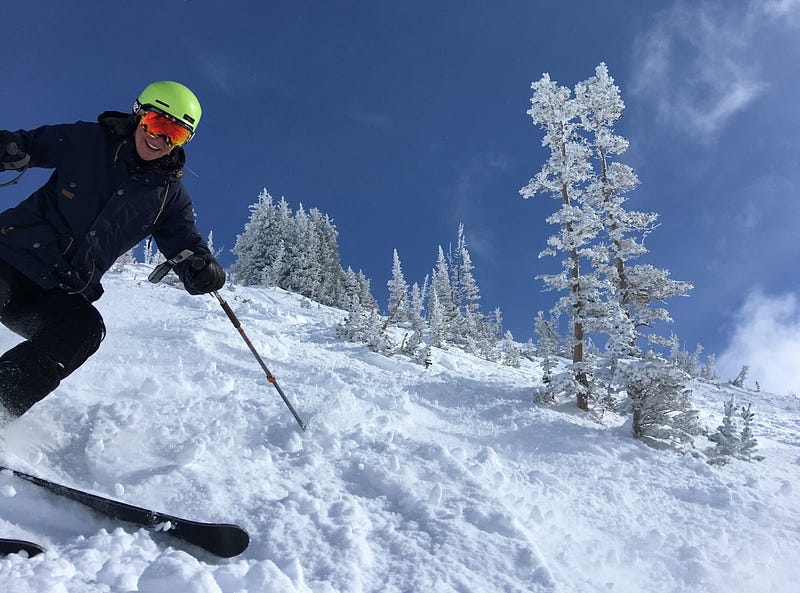
Skis don't need to be gendered, and yet they are made and sold that way and it is an example of how bias and inequality are perpetuated by the outdoor industry.
While procrastinating and dreaming of snow, I recently found myself browsing skis on the REI outlet webpage. Scrolling through I saw a couple of pairs of brand new, non-mounted skis listed as men’s and women’s. This led me to wonder: What makes men's skis specifically male? Besides stereotypically gendered graphics, darker colors for men, lighter colors for women, is there anything about the technical specifications? How they were made? Or how they performed that was inherently male? Nope, there is not.
Skis are skis, y’all.
Some board research on relatively equivalent male and female ski models reveals no clear differences besides the graphics. Each ski model has a set of tech specs that define it, length, width, shape, stiffness, all of these aspects range across the skis marketed to both genders.
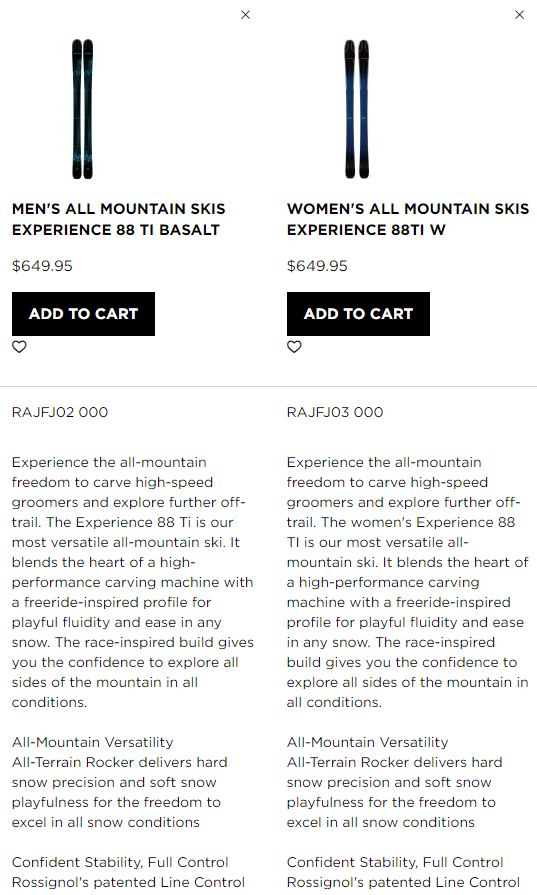
Using the compare feature on the Rossignol website, I chuckled to find that the top men’s and women’s all-mountain skis have literally verbatim product descriptions, they are word for word identical. The colors were similar, both black and blue. The only difference is women’s skis ranged from 153 to 173 cm in length, while men's ranged from 166 to 187 — catering to the height differences between men and women, but excluding the needs of tall women and short men. Looking at the range of skis available, the Rossignol was selling a “men’s” ski 92 mm underfoot but not offering a “women’s” equivalent. This could be interpreted as a suggestion that women aren’t capable of handling a wider underfoot ski? Seems silly since width underfoot is really about snow conditions and 92 mm is narrower than most people ride on a powder day in Utah, regardless of gender.
Skis are functionally identical, so why not just make a single line of skis with a variety of graphics?
It would be much more useful if skis were marketed for the size and ability of the skier. It would be so helpful if skis could be searched and sorted by length, width underfoot, sidecut, and stiffness. All this information is listed, so why classify by gender first? For me personally, graphics are the last thing I consider when buying skis. It would be very cool if I could find the specs you wanted then choose your color. Until then, I’m going to keep buying “men’s” skis because they tend to come in more varieties and larger quantities are manufactured, which means they are more often on sale or available used.
The fact that “women’s” skis have the same technical specifications as “men’s” skis suggests that skis don’t need to be gendered. Anatomical differences in shoulder width, the center of gravity, hip-width, foot-width, etc. don’t factor into ski design. Matching the right skis to each skier depends on their size strength and ability, unique to each individual person, regardless of gender. Maybe some do, but I’ve never been to a demo shop that carries “women’s” skis. Rental shops give everyone the same skis.
Societally, there is the assumption that women weigh less and are less strong than men. While this may be true as a gross generalization, does it apply enough to skiing to merit different ski models? No. Companies are selling the same exact skis to both groups. Moreover, many expert women skiers are strong and consequently heavy, further blurring this distinction.
We know that “separate but equal” doesn’t work, so why do we sell skis this way?
Additionally, classifying skis as male vs. female unnecessarily excludes those who are binary and gender non-conforming. Variable, gender-neutral aesthetics would help us move away from the toxic blue vs. pink, dark vs. light gender color stereotypes.
More irksome, the “men’s” skis were all listed first on the product page before the “women’s” skis on both the REI and Rossignol websites. This is the way it is with every piece of equipment. While subtle, this reinforces the false notion that men come first in skiing and in outdoor activities in general. It may seem like whining but these microaggressions add up over time, silently reinforcing the idea that women are second class, perpetuating this falsehood among all genders.
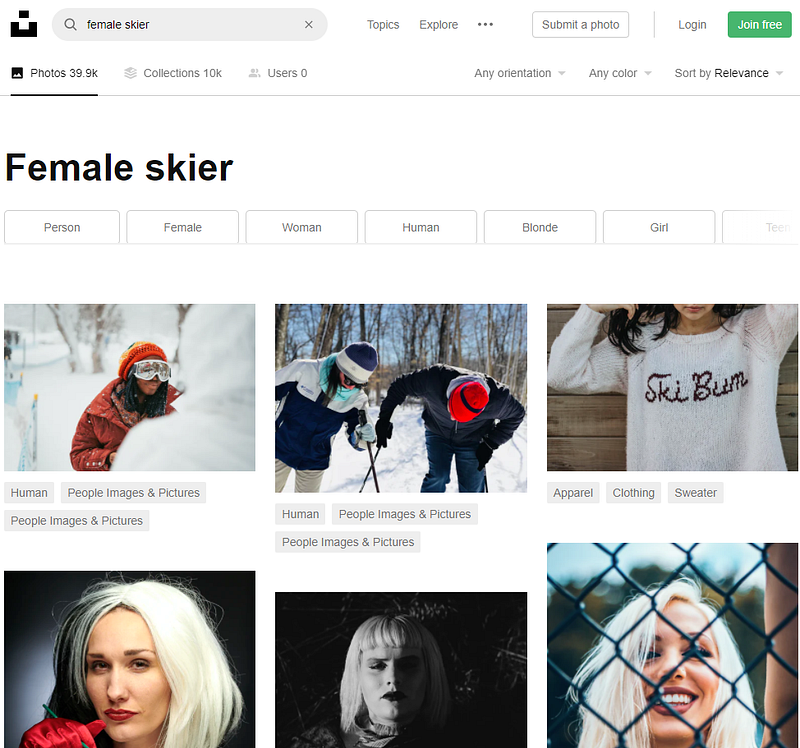
Searches for female skier and woman skier on Unsplash only came up with two photos before turning into unrelated headshots, one of which was a man helping a woman put on her skis. Eye roll. Sigh. While Unsplash is obviously not the forefront of skiing images, it is a pointed example of underrepresentation and the perpetuation of bias. Women are highly underrepresented in mainstream skiing publications, although it is slowly getting better.
Gender bias in skiing isn't just limited to gear, the gender pay gap in skiing is widely recognized despite recent changes. Snowboarding is no different. Snowboards are similarly unnecessarily gendered and professional snowboarding has a similar gender pay gap.
Thinking about gendered skis also raises the question: How many other types of gear are unnecessarily gendered and how can we make gear more equitable overall?
While we’re on the subject of gender, it would be really nice for gear brands to design women’s apparel to accommodate a variety of body types, particularly more muscular body types. Many women who like to get outside are pretty strong. Why not carry a couple of different versions (slim, regular, strong) of common sizes?
I dream of being able to buy pants in size 6-strong.
We adapted to make wide and narrow shoes; there is no reason ski pants and hiking pants can’t simultaneously accommodate wide thighs and slim waists. The idea of “regular” is problematic in and of itself because it is just a construct developed by the fashion industry encouraging everyone to fit into an arbitrary and stereotypical build (which is arguably a form of white supremacy).
Let’s make jackets and shirts that fit climbers' shoulders and lats. Let’s make ski boots designed for women with narrow feet but muscular calves catering to a range of skiing abilities with stiffer flex options.
We need more women designing gear, doing market research, and making business decisions so that women’s gear will be treated with the attention it deserves. Better designs are good business, I know I keep my gear forever because it is very difficult to find replacements that fit right.
Having more variety in sizes and shapes would help accommodate other types of body shapes and variations not currently being catered to.
This idea isn't new, many before have identified this problem and taken action. Over the last few years, some companies have popped up specifically designing clothes for athletic builds. Title Nine is a great example of this for outdoor gear. It would also be great to have sizing options within the brands that are already established. For example, I don’t buy Prana pants or Arcteryx jackets because they never fit right. It would be really nice to see this more versatile sizing become mainstream with more options on common websites like REI and Backcountry.com.
This year many brands have spoken out against inequality, committing to make the outdoors a more equitable space. In addition to the important focus on racism and financial accessibility, let’s also address the ingrained and subtle ways that the outdoor industry perpetuates gender inequality and toxic stereotypes about body image.
These daily microaggressions matter and they add up over time. Not having gear that fits right deters women from getting outside. Being listed second on every single gear website reinforces tacit notions that you’re a second class participant in outdoor activities.
The good news is, with some concerted effort by leading brands and marketers, there is the opportunity to make the outdoors more equitable and welcoming to all.


