[World Spotlight] About the 2024 Taiwan Elections & Global Commodities Markets Outlook
The Impact of the Taiwan Elections and Global Commodities Markets on World Affairs

Welcoming you into the geopolitics of 2024 with this latest announcement about the elections in Taiwan over the weekend: the Democratic Progressive Party (DPP) won another term, putting it power for another four years. However, the DPP lost its majority over the legslative body in Taiwan. This means that the DPP’s power over the laws will be affected by other parties’ legislative concerns.
The new Taiwanese president will be Lai Ching-te (賴清德) who is known for taking the same stance as the current leader Tsai Ing-wen. Under the DPP, the leaders seek to keep Taiwan’s democratic institutions intact, with minimal influence from the People’s Rebulic of China (PRC) who has ramped up the rhetoric on Taiwan’s political status under Xi Jinping.
According to official election results, Lai Chine-te and running mate Hsiao Bi-khim won the votes by 40% with 5, 586, 019 voters choosing the DDP for another four-year term. There will be a lot of changes from 2024–2028. I am already anticipating what this will mean for the South China Sea and other disputes in the Asia-Pacific region.
Explore more news stories and research updates about the 2024 Taiwan Elections and Global Commodities Markets from the publication Areas & Producers below.

Is the South China Sea dispute a higher priority for US-China relations than Taiwan?
Everyone should be focused on the elections in Taiwan this weekend. From a geo-political perspective, the US has been patiently waiting to flex its muscles in the maritime domain and the latest incidents in the Red Sea posed the perfect opportunity.
The US seeks to establish a maritime strategy based on a concept called networking of alliances. This is also relevant to the Indo-Pacific strategy, which is a much broader defense and security cooperation framework that intends to deter China’s rise in the Pacific and Indian oceans. This is also a method to deter China’s behavior in the South China Sea dispute.
I am a loyal follower of Geopolitical Futures and its diverse team of writers, analysts and forecasters.
George Friedman is founder of Geopolitical Futures and author of many books on geopolitics. This latest writing by Friedman about The Philippines, China and the South China Sea is insightful and a little controversial. Have a look at it here.
Now, here are my thoughts about the article.
“[Ferdinand Marcos Jr.] has pursued a much more pro-U.S. foreign policy, one best exemplified by an agreement this year that allows Washington to establish military bases in the country. Add to this the fact that Australia, also a U.S. ally, signed a similar agreement with Papua New Guinea, and China is left looking at a potential wall stretching from the Aleutian Islands to Japan to Australia built for no other reason than to contain its expansion, armed with entrenched artillery and missiles and several ports of call.”
Recent events are foretelling for the US’ and Australia’s Indo-Pacific strategy. When compared to India, Japan and the other Southeast Asian countries, Australia appears to be the most overlooked country in this new era of the Indo-Pacific. But the renewed defense and security engagement betweens Australia and Papua New Guinea reveal how serious countries are vieweing the China military threat as a mutual security concern in the wider region. Countries like The Philippines and Papua New Guniea are not that concerned with geopolitical risk, as say Australia, India and Japan would be in this case, but the fears of an expanding Chinese military presence has set off all of the alarm bells across the Pacific and Indian Oceans. And that’s where everyone stands in the South China Sea today.
“Chinese President Xi Jinping had many reasons to speak with U.S. President Joe Biden in California earlier this year, and one of them surely included ways to limit the threat of a potential U.S. blockade. Whatever was or was not agreed to in California clearly did not satisfy China, which has begun a campaign designed to seduce Manila and discourage it from honoring its military agreement with the U.S.”
Friedman is referring to the US-China meeting in San Francisco which took place in November 2023 on the sidelines of the APEC Summit. You can read all about the events in the link above. I wasn’t hearing much talk about the Taiwan elections during the time of the Xi-Biden meeting, which tells me that the South China Sea dispute is a higher priority for the two countries’ military relations. It’s significant that after the meeting Xi Jinping decided to restore military communication between the two countries, which he directly severed after Nancy Pelosi visited Taiwan in 2022.
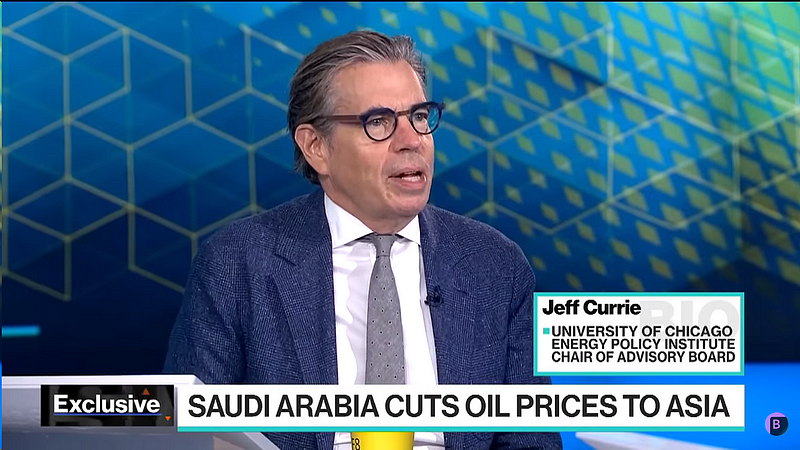
Goldman Sachs Commodities Veteran Jeff Currie Talks 2024 Outlook For Global Markets
Jeff Currie is a former Goldman Sachs Head of Commodities Research and is Chair of the Advisory Board for the University of Chicago’s Energy Policy Institute. He is also regularly featured in interviews for CNBC and Bloomberg about the global commodities markets and geopolitical risk.
In a recent interview with Bloomberg Television, Currie discussed the potential supply and demand volatility facing global commodities prices, particularly oil and copper, as the world heads into 2024 facing a sharp rise in international conflicts and geopolitical tensions.
In response to what 2024 is looking like for global commodities, Currie said:
“The set up we have going into 2024 is classic end-of-cycle which is stating that you always want to own commodities. Inventories are low, number one. Spare capacity outside of oil is exhausted and most of that spare capacity in oil resides in Saudi Arabia and UAE. And demand is at record levels.”
The situation for global commodities is closely linked to future trends in international affairs. Commodities are global in nature; they are bought and sold between companies on an international exchange platform. But since the Covid-19 pandemic governments that control vast reserves of natural resources have stepped up efforts to nationalize them.
And now with the escalation of the Middle East war between Israel and Hamas, the geopolitical risk took a step higher than it already had been ever since Russia’s invasion of Ukraine in 2022.
Jeff Currie also explains China’s role in the near-term volatility of global commodities markets:
“China, you can’t deflate and deleverage at the same time — it’s impossible — because you’re fighting yourself for doing that — so they have to begin to reflate: a lot of the disinflation being exported around the world is coming out of China.”
This [World Spotlight] is part of [The Weekend Brief] newsletter by Areas & Producers: A weekend guide to international issues and global markets.
By signing up for [The Weekend Brief], readers would receive all of the weekly content and updates from Areas & Producers on the subjects of World, Business, Tech, Mining, Energy, Food, EVs and AI. Sign up for the newsletter and instantly receive the content, to the e-mail inbox provided, every Saturday and Sunday.