
Women Who Marry Younger Men Die Sooner Than Women in Same Age Relationships — Here Is Why
Men who marry younger women live longer lives than men in same-age relationships, and women who marry younger men live shorter lives than women in same-age relationships, but why?

It’s popular to say that, on a relative level, women who marry men the same age as them live longest, followed by men who marry women younger than them. It’s also popular to say that women who marry men younger than them live the shortest lives — relatively speaking.
The below infographic perhaps best shows this, where a woman who marries a younger man has an expected lifespan that is 20 percent less than a woman who marries a man the same age as her, whereas a man who marries a younger woman lives 11 percent longer than a man who marries a woman the same age.
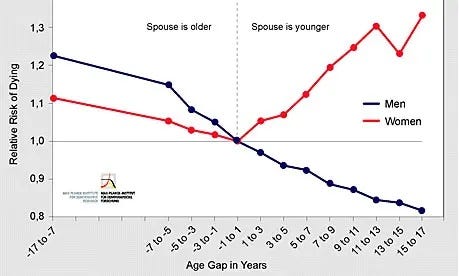
This begs the question of why a woman who marries a younger man is more likely to die sooner than a woman who marries a man the same age.
Why popular culture thinks that older women who date younger men die sooner
First things first, it needs to be noted that the younger man in a relationship with an older woman is also more likely to die sooner than if he had married a woman the same age or younger than him. This seems to imply that an older woman with a younger man knocks years off the lives of both.
The male partner dying younger could be partially put down to the fact that, as the man is younger, it increases the chances that he will outlive his wife — being widowed takes years off your life.
This reality — that men typically die 5 to 10 years younger than women — makes a man marrying an older woman more likely to be widowed than men dating women the same age and especially men dating younger women, and the widow factor does play a part in mortality rates.
However, clearly something more is going on as an older woman marrying a younger man has less chance of being widowed than women marrying men the same age or men older than them, and the widow factor isn’t likely to account for all of why the younger partner dies younger either.
So what is going on? Some argue it is down to the wide maturity gaps in these types of relationships. To explain, it’s widely known that women develop faster than men, and the gap this creates in personal development place and life place in many ways endures across our entire lifespans. As such, an older woman with a younger man further exacerbates this what many term maturity gap between men and women.
Maturity gaps, or as I prefer to call them, life place gaps do put more stress on relationships, and stress can cause early death.
Considering this, it may be logical to assume this is why men and women in these types of relationships die younger i.e. the typically greater life place gap leads to greater stress.
But despite this making sense on some levels, it is far too simplistic. Factors that are far more important and explain far more why both parties are more likely to die sooner exist. To understand them, we have to look at all the other age-gap relationships.
Age gaps in men’s favour appear to lead to men living longer lives than if they had married a partner their own age — but all is not what it seems
If a man marries a younger woman, the evidence seems to show that he will live a few years longer than if he had married somebody his own age.
The common explanation of why is that this is to do with women’s greater ability to look after men and women’s greater social networks which benefits men. However, whereas that may play a part, I’m extremely sceptical as this sounds like more one of those arguments that come from the extreme feminist side which try to purport that men need women more than women need men, which is rubbish, we both need each other just the same.
For example, the flipside of the latter argument is that men tend to be very good at boosting hobbies in women due to men’s typically greater interest in “things”, so whereas women tend to be better at bringing connections to men due to a typically greater interest in people, men tend to be better at bringing hobbies to women due to their typically greater interest in things.
Of course, it is not a perfect science, and it often works the other way along with everywhere in between, but in my experience, these factors tend to combine to help men and women equally help each other live better lives — regardless of age differences.
As such, the most likely true answer is nothing to do with any of the latter and instead is linked to stress which is caused by other factors.
Stress is a killer but age gaps don’t per se create stress or cure it — it’s more complex than that
The more stress a person has over their lifetime the more likely they are to die, the less stress, the better chance they have of living a long life. Men who marry younger women in my experience tend to lead less stressful lives on average than other men, but not per se because they marry younger women.
To explain, firstly, men who marry younger women typically have money, and money — regardless of whether you have a partner — leads to less stress, especially in men. Secondly, men who marry younger women are typically more emotionally in tune with their partners and vice versa — no matter how hard we try to spin it, the life place gap between men and women is real, the older man with the younger woman is a great way to close this gap — this leads to less stressful relationships.
So, it is not the age gap per se that most likely leads to the longer expected lifespans in these men, a more likely explanation is that men who marry younger women typically have money, which allows them a greater chance of finding and marrying a partner they are on the same wavelength as i.e. the men and the women they get with can be choosy. Inevitably, money and a happy relationship lead to a longer expected lifespan.
That means what the data shows is likely not that men who marry younger women live longer, but that men who have money tend to be better able to find a happy relationship, and money added to a happy relationship in men tends to lead to an overall less stressful life.
However, that does not explain why the younger women who marry older men tend to die sooner than if they had married someone the same age, so what gives, are they likely to be less happy? No is the answer, the most likely reason this happens is that happy relationships, when they end through a person being widowed, take years off the life of the one that remains.
This matters because women who marry older men tend to get widowed younger than women who marry men the same age, as such, this likely explains the difference in mortality rate between these two parties.
Yup, the widow factor plays a big part in mortality rates. For example, it is also likely why a man who marries someone the same age as him doesn’t live as long as a man who marries someone younger i.e. he is more likely to be widowed.
That means overall, it’s likely there’s no real difference in terms of likely happiness when it comes to a woman marrying an older person versus a person the same age, the same with a man marrying a younger woman or a woman the same age.
What matters is whether the person makes them happy, the fact that being widowed delivers such a blow to life expectancy in same-age relationships and relationships where the man is older likely shows both are equally as happy and as such successful as the other overall.
However, none of this explains why older women who marry younger men lead to both parties dying younger than in any other form of relationship, though it does imply that happiness is important. But does that mean men and women when the woman is older tend to have less happy relationships?
Why age gaps in women’s favour appear to lead to them living shorter lives
The straight answer is nobody really knows, but I’m going to offer my experiences in noting the differences between women who tend to date younger men versus women who tend to date men the same age or older.
Firstly, something very apparent that I have noticed is that women who date and marry younger men tend to be carrying a lot more historical emotional relationship baggage — in my experience, far more so than the average woman.
Why this is, I don’t know, and I can only offer my own experiences as proof that this may be the case, as there is no research on it, so take it with a pinch of salt. But emotional baggage, especially of the relationship kind, can take years from our lives so if it is true, it could be a factor in the shorter lifespan expectancy.
On top of that, like said earlier, due to men typically maturing slower than women, age gaps in women’s favour can put a lot more strain on both partners. But it is not just about mental differences, the time a woman goes through menopause works best with an older man and second best with a man the same age, but when it comes to younger men, it can create real problems.
For example, men’s peak fertility is in their 30s, as such their sex drives tend to still be quite high even as they move into their 40s and 50s. When going through menopause, having to deal with a man with a younger sex drive can put a lot of pressure on women — a lot more than the opposite way around. I’ve come across this frequently when dealing with women married to younger men, but have seen it less so with others — especially women married to older men.
So, women who marry men the same age or older tend to have sex drives far more in tune with their partners than the other way around — at least that’s what I have typically found from working with couples but also from reading endless research over the years.
The additional stress factors do not stop there, women who marry younger men in my experience typically have more wealth than their partner. Even though it shouldn’t, this puts further strain on the relationship for reasons that likely don’t need to be explained i.e. it can fuel societal feelings of inadequacy in the male partners due to the fact society teaches that men should be the providers, it also can fuel feelings of societal inadequacy in the female partners due to their partners earning less than them.
On top of that — yep, there are still more stress factors — it’s widely documented and backed up by repeated evidence that women who have wealth even on a low level suffer more mental health problems than women who have none.
I know, it seems crazy, but oddly it’s true, women in poverty suffer fewer mental health problems than women who are not in poverty, and the women who suffer the most mental health problems are women in the middle and upper-class wealth levels brackets — for those who want more on this subject, the best discussion I’ve seen on this peculiarity is in the book Tribe.
My theory for this peculiarity is it’s because when men chase money it is because it helps them build connections, especially of the romantic kind, but when women pursue it, it tends to be more to escape the need for connections. So, it’s likely not the money itself that damages the mental health of women with wealth, it’s more likely the reason that they felt the need to chase money so aggressively in the first place.
Returning to the point, women who marry younger men in my experience tend to have at least some level of wealth and to be more determined to grow it or at least retain it than on average I see in other women. As personal wealth in women tends to correlate with more mental health problems, this adds another stress factor to the women who embark on relationships with younger men.
On the flipside, personal wealth in men tends to lower mental health problems, but lack of wealth in men tends to increase them. In my experience, I’ve noted that men who tend to date and marry older women are typically lower earners, not always, but more so on average than in same-age relationships and especially in relationships where the man is older (again, this is just in my experience so don’t take it as gospel as there is no data on this available).
All of these mentioned factors combine to lead to a lot of stress, which correlates with my experience of women who date younger men, they tend to be a lot more stressed, have a lot more historical emotional baggage, and suffer a lot more mental health problems. The men who date older women tend to be the same. However, I do not relate any of those reasons to their partners per se — and especially not their ages.
As such, in my experience, the reason that older women who date younger men and younger men who date older women tend to die younger, is likely because they simply lead more stressful lives. Perhaps it is the stress of their lives that brings them together, and perhaps together they bring each other peace from that stress.
Of course, not all age gap relationships where the woman is older will be like this, but it’s my belief that the data is capturing the fact that the men and women in age gap relationships in the woman’s favour typically have and continue to lead overall more stressful lives, perhaps because the relationships require more work, perhaps because of societal persecution, but more likely simply because they have lived and continue to live for other reasons more stressful lives full stop.
Final words
Data is fickle, and very rarely tells the story it appears to. But considering that we drill it into women that they should marry a person the same age, and drill it into men that they should marry a younger person, is it really surprising that those in relationships where the age favours the woman on average do not live as long? Based on our educations, a man who is winning will always marry a younger woman, and a woman who is winning will always marry a man the same age.
What this inevitably does is turn older women into castaways, which is what the majority of men who do not have wealth are treated as — a category that younger men are especially likely to fall into. As such, what we are likely seeing in this data is that older women are treated as castaways along with men who do not have wealth, who are mostly younger, which is perhaps why they are dating each other, because they can connect over the societal persecution against them.
That means what relationship age gap data shows is that the age of your partner is irrelevant to your life expectancy, what matters to your life expectancy is how successful you are in life, the irony is, how successful you are in life seems to influence the likely age your partner will be.
That’s why in my view, if you want to live longer, forget about age gaps, so younger, older, same age, whatever, it doesn’t matter, just try to find a person that makes you happy and if you manage to find one that does, marry them. The reason, outside of that, it’s a crapshoot.
Thanks for reading! If you enjoyed this, you may also enjoy the following:


