
Woad
A primer on a primary color
Today’s New York Times Spelling Bee letters:
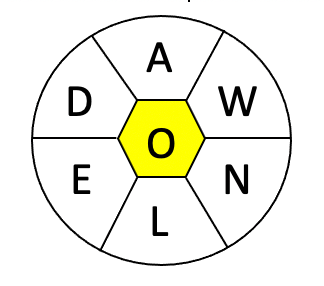
A, D, E, L, N, W, and center O (all words must include O).
Merriam-Webster says…
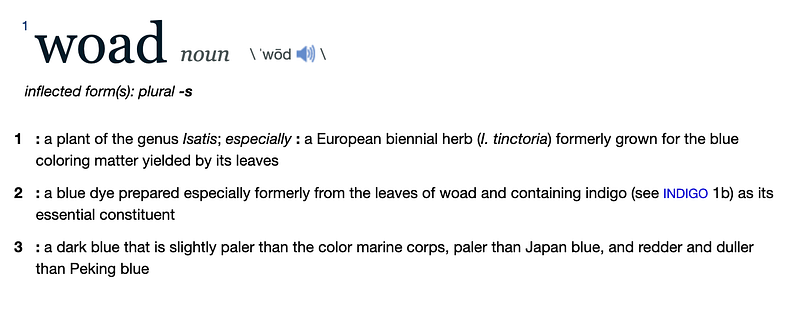
Silly little dictionary! Don’t you know woad can’t possibly be a word if the New York Times says it ain’t?
For further fascinating facts, check out the Spelling Bee Master.
What’s your favorite g.n.a.w. from today’s puzzle?
My Two Cents
Sometimes I’m flabbergasted by some of the words the Spelling Bee game leaves out. I’ve seen them include some “WTF is this?” words many times, terms so weird I thought they had made them up just to aggravate us regular solvers. Those words are so odd that I can’t think of one to give as an example.
However… woad was not included in today’s puzzle!
And yet, it’s something that has been used for millennia across different cultures in Europe, Britain, Africa, and Asia. It appears in tapestries and was referenced by Chaucer. It was still bought and sold around the globe until after World War I.
“So why was woad not accepted by the editors of the puzzle?”, you ask with feigned outrage.
“And why has Avi not even told us what the heck woad is”, you also ask, this time with real outrage.
[Private note not to be seen by Medium readers: keep stringing them along so they scroll down reeeeeeal slow. Delete before publishing.]
Anyway, ahem… you are absolutely right, my dear logophiles. As they say in journalism, if it bleeds, it leads. And this woad guy certainly bleeds. So, without further ado…
Isatis tinctoria
Also known as Asp of Jerusalem, glastum, dyer’s woad, or simply… woad. It’s a plant. No, not a spy. This type of plant:
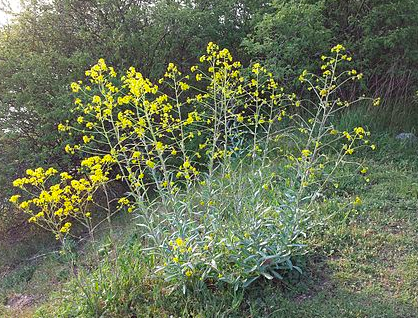
This species belonging to the same family as the mustard and capers is native to a big chunk of the Asian continent, including Siberia. Today it’s also found in Europe and the western part of North America.
The big deal-io with this plant is that it was the Source of indigo pigment in Europe and Asia for thousands of years. The word woad comes from Middle English wod, from Old English wād; similar to the Old High German weit, which mysteriously seems to come from the Latin vitrum, a term used for glass. I therefore conclude that Latin glass must have been blue.
Chaucer talks about woad (as “wood”) in his 14th century poem “The Former Age”:
No mader, welde, or wood no litestere Ne knew; the flees was of his former hewe
The above Middle English phrase translates roughly as “Why the #$@&%* won’t these red, yellow, and blue stains come off my brand-new tablecloth?!”
You’ll notice I included “red” and “yellow” in my freewheeling translation. That’s because mad(d)er and weld(e) in Chaucer’s parlance are references to two other plants that also produce dyes: red and yellow, respectively.
So now you know. Before Crayola, people had to make labor-intensive pigments from plants. Once they had yellow, red, and blue dyes, they could mix them up to create exotic colors such as Jazzberry Jam, Fuchsia, and Razzmatazz.
After being harvested, woad leaves would be made into a paste by a horse-driven mill. The paste would be packed by hand into balls and left to dry until they hardened. These balls were considered very valuable and were practical to transport and trade.
Once they were ready to be used, the balls were broken up into a powder, sprinkled with water, and fermented. When the fermented woad was dry, it was placed in barrels. The dyer would then pour hot water on them and also add urine. This mixture would ferment an additional time before the cloth would be dyed.
Yes. You read correctly. People were literally coloring their shirts and pants with piss. And blue dye from woad, of course. But also piss.
Some sad history
Sad because I’m talking something blue. A blue dye. (Cue groans and eye rolls from readers.)
Also, sad because woad dye stopped being used almost a hundred years ago, thanks to advanced chemistry.
Before that, woad was widely known and used. For example:
- Woad seeds have been found in Neolithic excavations.
- Egyptians used it to dye the cloth wrappings of mummies.
- A dye known as סטיס (satis, like the name of the plant) in Aramaic is mentioned in the Babylonian Talmud.
- Julius Caesar reported that the Britanni (ancient Brits) used to stain their skin blue with vitrum (glass, as we mentioned before), the domestic name for the woad plant.
- England, Germany, Italy, France all cultivated woad in medieval times.
- The Chinese used it in medicinal tea for colds and tonsillitis.
It’s also not famous at all for being used in a semi-known series of European tapestries called The Hunt of the Unicorn, that are now hanging at The Cloisters in New York City.
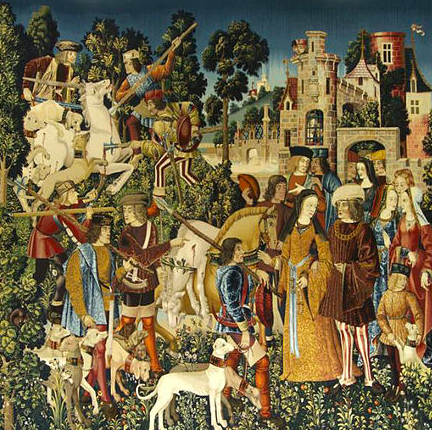
Notice the exquisite and delicate dye work done in weld, madder, and woad. This took only 583 years to complete. Just kidding… I think.
With the dawn of the 20th century, some mean chemist figured out how to synthetically make blue pigment. The woad and indigo plant industries simply collapsed, with the last commercial harvest occurring in 1932. However, all is not lost. Today, small amounts of woad are harvested in France and Great Britain to supply the needs of craft dyers. And in the UK, woad is now being used in cartridges for inkjet printers.
Long live the woad!
Except that… the editors of the Spelling Bee saw it and said: “Gee, Not A Word”.
Check out my previous entry on words that g.n.a.w. at you: