
Loggia
An actor or a balcony? How about both.
Today’s New York Times Spelling Bee letters:
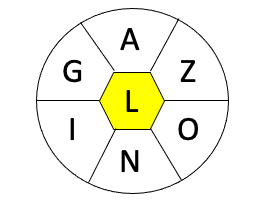
A, G, I, N, O, Z, and center L (all words must include L).
Merriam-Webster says…
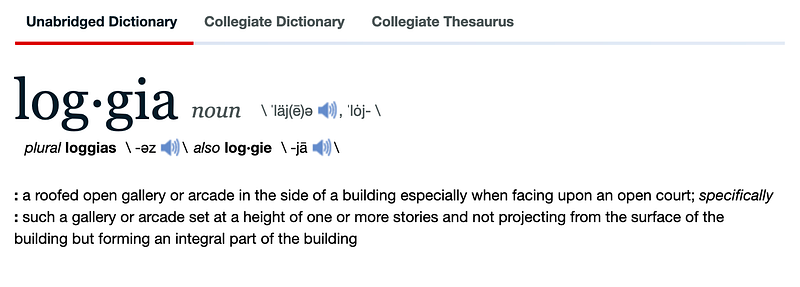
Silly little dictionary! Don’t you know loggia can’t possibly be a word if the New York Times says it ain’t?
For further fascinating facts, check out the Spelling Bee Master.
What’s your favorite g.n.a.w. from today’s puzzle?
My Two Cents
Today I was very much tempted to pick the word galgo. If you’re not familiar with the word, you probably don’t speak Spanish or Korean. The Korean galgo, or yang-go, is an hour-glassed shape drum. A traditional musical instrument, this drum can now be seen in some of the South Korean Army’s military musical performances. In Spanish, galgo is a word sometimes used to refer to any greyhound, although technically-speaking, it refers to the Spanish sighthound breed used for racing and rabbit hunting.
But I ran into a problem. Galgo does not appear in the dictionary. I checked Merriam-Webster, the Oxford Learners Dictionary, Collins, and dictionary.com, which is based on content from the Random House Unabridged Dictionary, American Heritage Dictionary and a few others.
Nothing. Or, as we say in Spanish, nada. And in Korean: 아무것도.
I can’t very well poke fun at the editors of the Spelling Bee if the word I’m ranting about is not actually in any dictionary. So, if any of my readers works for a dictionary or knows someone who does, please convince them to include galgo as an entry, even if it’s just for the drum. I can work around that to include the dog breed.
The original analog arcade
The first use of the word loggia dates to around 1735 or 1745, in Italy. The term was borrowed from the French term loge, which has many meanings, among them “lodge” and “space or cavity”.
As the dictionary explains, a loggia is an architectural feature of a building that can be on the ground floor or further up. It’s usually exposed to the elements on one side and is supported by a series of columns or arches, known as an arcade.
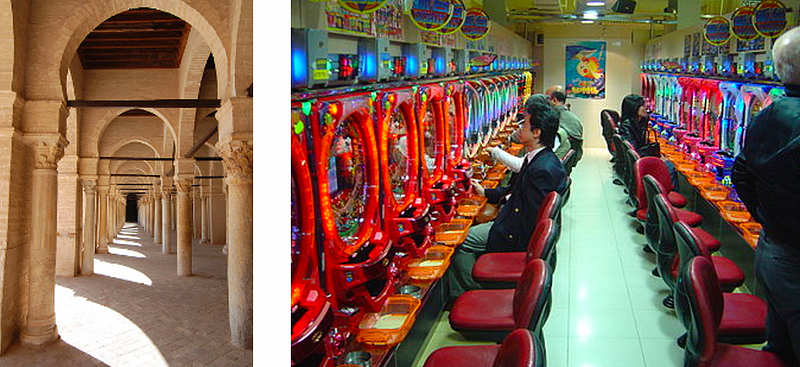
That would be the one on the left, NOT the one on the right.
These arcades were sometimes used as a venue for bazaars in ancient times. Later, as loggias, they became outdoor places to sit and lounge and enjoy a coffee or tea with friends. Although they are similar to porticos, loggias typically are not considered porches that lead to the entrance of a building. Also, loggias can be set on upper floors, while porticos are typically on the ground floor. In certain regions of Italy, for example, loggias are actually built as tiny houses on the roofs of residences.
If you travel around Europe, you’ll probably encounter loggias as the structures under which some cafés have their outdoor seating. They seem to be less common in the U.S., although several university campuses, such as Stanford’s and Carnegie Mellon’s, have them.
The famous Chester Rows in Chester, England, and the Sydney Opera House in Australia also have loggias.
What the world no longer has, however, is…
Robert Loggia
You know who I’m talking about. He appeared in a gazillion movies, TV shows, and in three video games. (I’m not kidding about the video games.)
He’s the actor whose facial expression always told you exactly what he thought about you. For example:

Loggia passed away in December of 2015, but not before accruing more than 230 credits as an actor on the big and small screens. He appeared in such movies as The Greatest Story Ever Told, Revenge of the Pink Panther, An Officer and a Gentleman, Scarface, Prizzi’s Honor, Independence Day, Lost Highway, Return to Me, and Tim and Eric’s Billion Dollar Movie.
In television he had a ton of guest appearances on different and varied shows, starting in 1959. Some of his later roles were shows like Mancuso, FBI; Malcolm in the Middle; The Sopranos; Men of a Certain Age; and, of course, Family Guy.
Incredibly enough, Robert Loggia did not appear in a single episode of Law & Order or any of its 67 spinoffs. That somehow sounds… illegal.
I think of him mostly as the “mean grandfather” who tries to steal away Sylvester Stallone’s kid in Over the Top. I don’t know why I have a soft spot for that movie; maybe because Golan-Globus flicks were such a big part of my “filmdom” in the 1980s.
And who doesn’t remember that classic scene with him and Tom Hanks in Big? Chopsticks, anyone?
Now, I don’t expect the Spelling Bee to include the names of people, even if they are awesome actors like Robert Loggia. Proper nouns are against the rules.
However, one would reasonably think the word loggia would be accepted.
But the editors of the Spelling Bee proclaimed: “Gee, Not A Word”.
Check out my previous entry on words that g.n.a.w. at you:


