
Indagating
There’s a detective in da house!
Today’s New York Times Spelling Bee letters:
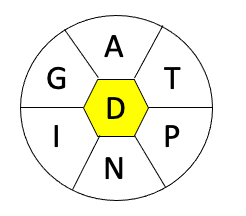
A, G, I, N, P, T, and center D (all words must include D).
Merriam-Webster says…
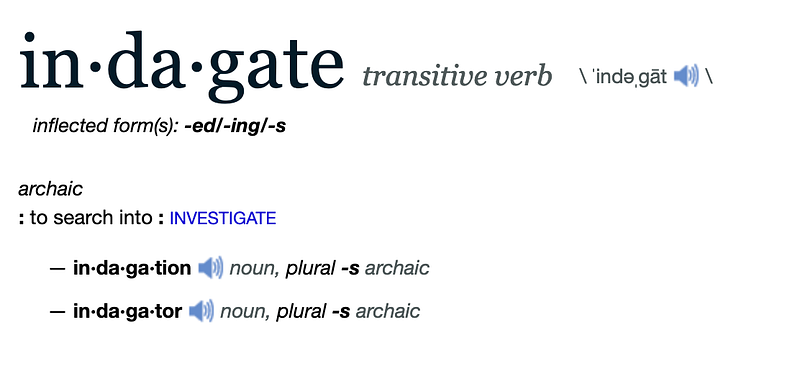
Silly little dictionary! Don’t you know indagating can’t possibly be a word if the New York Times says it ain’t?
For further fascinating facts, check out the Spelling Bee Master.
What’s your favorite g.n.a.w. from today’s puzzle?
My Two Cents
I am tweaking some details about this column. I’ve added the circle with letters that puzzle solvers see when they play Spelling Bee. I think it will help readers (especially new readers) visualize how the game works and perhaps even “see” some words that can be used. In the actual game, there is a button that allows you to “spin” the outer letters around the center letter. Believe it or not, changing the configuration can actually help one come up with new words.
I also subscribed to Merriam Webster’s unabridged dictionary, which eliminates ads and includes more features. I figure since I use their product so often, I might as well pitch in. I decided to post the definition screenshot from that version, which I think has a cleaner look.
Boy detective
When I was growing up, one of the many things I wanted to be (aside from astronaut, writer, rock star, baseball pitcher, veterinarian, surrealist painter, movie director, comedian, photographer, chemist — I think I was switching careers on a monthly basis) was a detective. Not just any detective.
A private detective.
I hadn’t yet read anything written by Raymond Chandler or even seen the 1980s Mike Hammer TV show, but I had encountered one of my childhood heroes: Encyclopedia Brown.
I’m not talking about a thick, chestnut-colored tome full of information. That would be a brown encyclopedia. This is whom I mean:
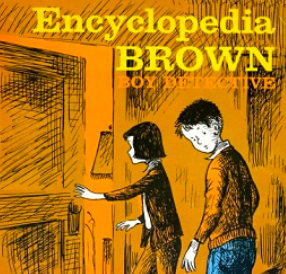
The unfortunate choice of font color for the subtitle almost camouflages completely, but it reads “boy detective”.
Leroy “Encyclopedia” Brown was about my age (4th grade, I think), had a slight build and wore glasses. And was incredibly astute. I was in 4th grade, had just been prescribed glasses, and thought myself to be quite astute. Though clearly not as humble as my fictional hero.
The girl in the above image is Brown’s best friend and indagating partner, Sally Kimball. She was a tough-as-nails, strong willed bruiser. Obviously I had a crush on her. I think the combination of Sally Kimball, Pippi Longstocking, The Bionic Woman, and Charlie’s Angels made me forever be attracted to strong, smart women.
The other main character is the bad kid Bugs Meany, who always tries to fool Encyclopedia but is eternally thwarted by the boy detective and his female sidekick, of whom Bugs is terrified. The stories involve Brown solving cases for the neighborhood kids, and even occasionally helping his dad, who is a cop.
Inspired by the books written by Donald J. Sobol, I decided to open up my own detective agency with my younger brother. The problem was, we lived in the very urban city of Caracas, Venezuela and not in a gentle suburb somewhere in fictional America. There were no neighborhood kids willing to pay me a quarter to figure out how the local meanie had tricked them. And my sidekick wasn’t nearly as attractive as my literary crush.
The kids in my building could have been potential clients, except we ended up recruiting them to expand our indagating business into a spy agency. But that’s a story for another day.
In·da·gate
There is no “E” in today’s Spelling Bee puzzle. However, I assume that because indagating was not accepted, neither would indagate have been had there been an “E”.
The word comes from the Latin indagatus, the past participle of indagare, from indago, meaning “examination, investigation” or “act of enclosing or surrounding”. This in turn derives from the Old Latin indu, “in” or “within” and the Latin word agere, meaning “to drive (cattle), be in motion, do, perform, transact.”
So, “transact within”. Look inside. Investigate. Indagate!
Indagating!
As a Spanish-speaker, I instinctively recognize a lot of words in English that sound like cognates but may be unfamiliar to many monolingual English-speakers. Sometimes, based on that fact and on a hunch, I try a certain word to see the Spelling Bee puzzle accepts it. When it’s rejected, I’ll look up the term to check if perhaps I simply made it up.
Well, I certainly didn’t this time! In fact, the word had been in use since 1623, according to my friends at Merriam-Webster. I found another interesting tidbit when I looked up the Spanish equivalent (indagar) in the dictionary of the Real Academia Española. There it says that the Latin origin is simply indagare, a word that means “to track” and refers specifically to tracking done by hunting dogs. So, in a sense, bloodhounds are the Sam Spades of the canine world.
And despite all this trove of trivia… the editors of the Spelling Bee saw the word indagating and proclaimed: “Gee, Not A Word”.
Check out my previous entry on words that g.n.a.w. at you: