
Atlatl
Learn how to throw a spear like a true Aztec pro
Today’s New York Times Spelling Bee letters: A, D, I, L, V, Y, and center T (all words must include T).
Merriam-Webster says…
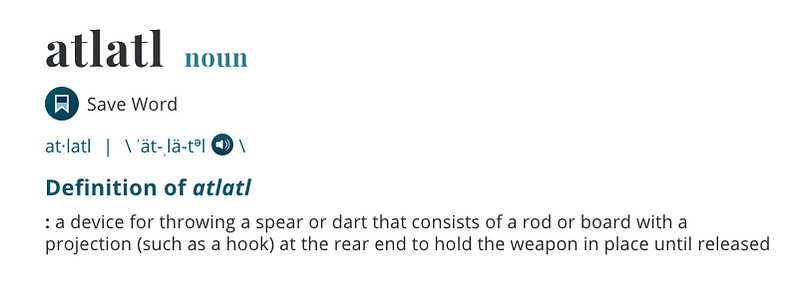
Silly little dictionary! Don’t you know atlatl can’t possibly be a word if the New York Times says it ain’t?
For further fascinating facts, check out the Spelling Bee Master.
What’s your favorite g.n.a.w. from today’s puzzle?
My Two Cents
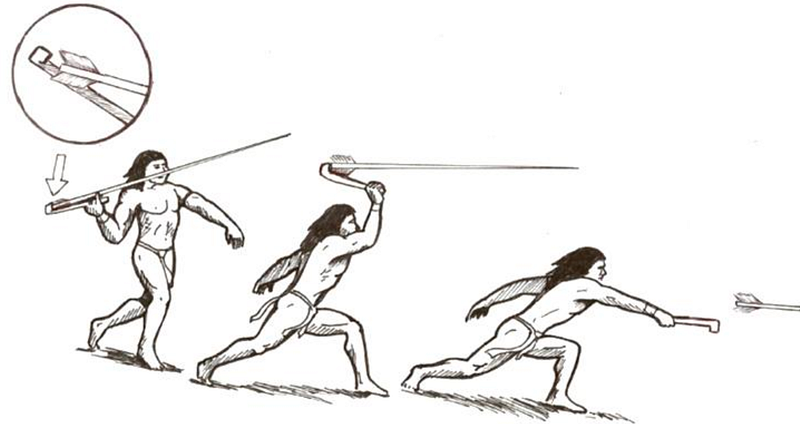
Maybe using the photo that illustrates how to throw a spear wasn’t such a good idea. Readers will see it and think, “Okay, I’ve just learned how to do it by looking at the picture. Why do I need to continue reading?”
Please do. Please continue reading. Pretty please?
I promise we’ll learn something new or interesting today.
Like, for example, atlatl.
If you’re a Star Wars fan like I am, the first thing that ran through your mind may have been this:

And if you’ve never heard of or seen Star Wars… welcome to planet Earth. We hope your stay here is fun and relaxing. Also, the above iron quadrupeds are called AT-ATs. They made their first appearance in the best film of the movie franchise, The Empire Strikes Back.
When I was young, I thought the name came from the awkward and inefficient way in which they advanced: at… at… at… at… at…
Turns out that AT-AT is an acronym for All Terrain Armored Transport. It’s design was inspired by an extinct humongous rhinoceros called Paraceratherium:

Um, anyway… AT-ATs are definitely not atlatls. The only thing they have in common is that they are both weapons. One is a streamlined, efficient killing machine… and the other is an AT-AT. Ha, ha, ha. Take that, you cumbersome, sloth-like, rusting hunk of crap.
A streamlined, efficient killing machine
In reality, an atlatl is not a spear. It’s a spear-thrower or, in other words, a tool that gives humans more leverage when throwing a spear or a javelin or any other long piercing object at people on the opposite side of your political spectrum. (But please don’t do that.)
If you’ve ever seen a Jai alai wicker device or a modern ball thrower used to play with fetch with dogs, then you can picture an atlatl. And if you haven’t seen either of those two things, I’ll copy and paste it here for you:

The atlatl is held in one hand, near the end farthest from the cup. The upper arm is flung forward, acting as a lever. Thus, the atlatl becomes a streamlined, fast-moving extension of the arm, which increases the lever’s length. And it’s this extra length which produces more force to the throw. This gives the spear much more energy and speed, allowing it to cover longer distances.
It’s believed spear throwers were already in use by humans Upper Paleolithic, more or less 30,000 years ago. However, the earliest confirmed dating of atlatls found in France indicates that they were made about 21,000 to 17,000 years ago.
The ancient Greeks and Romans used similar tools to the atlatl. They were called ankules or amentums, and were thong or loops made of leather. Other cultures have similar spear-throwing devices, too. For example, some Australian Aborigines use the woomera, which is made of wood.
In the United States, the word atlatl is now used by today’s fans of spear throwing. This has now become a trend, like ax-throwing did several years ago. In fact, there’s even a World Atlatl Association that organizes spear-throwing events.
Now, at this point you’re probably wondering where the word atlatl originated from. You’re not? Oh, well, I’ll tell you anyway.
Nahuatl
Nahuatl pronunciation is term usually used to describe a group of languages currently spoken by over 1.5 million Nahua peoples. Most of them live in Central Mexico and parts of Central America. It was the language of the ancient Aztecs, whose empire covered those areas.
Before the Spanish conquistadors came over and made a mess of their civilization, the Aztecs had popularized their dialect of Nahuatl all over their expanding empire. So, it was sort of the “English” of that time and place.
Today the term “Nahuatl” embodies a bunch of closely related dialects. The Mexican Instituto Nacional de Lenguas Indígenas (National Institute of Indigenous Languages) recognizes 30 individual varieties within the “language group” labeled Nahuatl.
In Nahuatl, atlatl means “extended arm”. Which makes sense, except the syllable or suffix atl can also mean something else.
Although you may not realize it, you probably use Nahuatl on a daily basis. Some of its vocabulary was picked up by Spanish-speakers and eventually made its way into our ever-growing English language. These loanwords include avocado, chayote, chili, chipotle, chocolate, coyote, peyote, tomato, and the star of today’s column, atlatl.
Notice anything interesting about the word tomato? No. Um, that’s my fault. I forgot to include the word the Nahuatl used for the large, sweet, red fruit they cultivated: xictomatl. Yeah, with -atl at the end.
In turn, xictomatl can be broken down into xictli, which means “navel”; tomohuac, which means “fat”; and -atl, which means “water”. So… the meaning of tomato according to the Aztecs was “navel of fat water”. That’s still better than AT-AT.
Why does -atl mean “water” but -atlatl mean “extended arm”? I’m not sure, even though I tried and tried to find out. Perhaps they come from different varieties of Nahuatl. That makes a lot of sense to me, but if anyone out there knows for sure, I’ll welcome an explanation in the comments section.
Today the Mexicans have two names for the fruit. In the North it’s called tomate (tomato), but in Central and Southern Mexico it’s referred to as jitomate, which sounds closer to the original Nahuatl word. Many people call it that to differentiate it from the green tomato variety, which is also known as tomatillo. (This fruit is not an unripe red tomato, however.)
In any case, if you want to talk about tomatos or AT-ATs, feel free to do so. But don’t say atlatl in front of the editors of the Spelling Bee. They saw it and proclaimed: “Gee, Not A Word”.
Check out my previous entry on words that g.n.a.w. at you:


