
Without Debate, Conformist Politicians Ramp Up The New Cold War
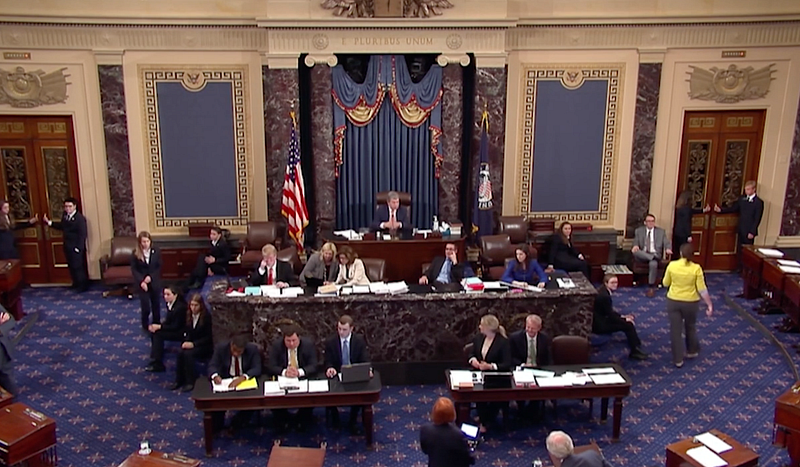
On July 27, the Senate was wracked by familiar partisan polarization over healthcare policy. But earlier that day, in a display of heartwarming cross-party comity, differences were put aside and legislative accord was achieved. Senators across the spectrum rejoiced in their ability to come together and near-unanimously (98–2) levy sanctions against Russia, Iran, and North Korea. Bernie Sanders voted No, but rushed to clarify before anyone drew any improper conclusions that he was absolutely not against sanctioning Russia or North Korea, and that his objection was solely to do with Iran. Only Rand Paul seemed to take an all-encompassing stance against sanctions.
In a floor speech touting the inspiring bipartisan achievement, Chuck Schumer made a very revealing statement. He affirmed that the idea for Russia sanctions had originated with John McCain and Lindsay Graham, and that the Senate’s uniform embrace of their priorities represented an amazing triumph for that august body:
SCHUMER: I wish to thank my colleagues. At the top of the list are Senators McCain and Graham, who early on had the idea to do this. Their strength against transgressions against this country is wonderful.
Absent from any of the discussion regarding this sanctions bill was even a modicum of debate as to whether 1) Complete bipartisan coalescence around the priorities of McCain and Graham ought to be lauded as good, rather than viewed with extreme suspicion 2) Sanctions are effective instruments of US power, and whether their application here is warranted 3) The levying of these sanctions could yield unintended consequences and needlessly inflame tensions, such as with — say — a nuclear-armed power.
One reason why dissent was so non-existent is most certainly due to the present political climate; any Democrat who voted against sanctions would’ve been immediately denounced by liberal and centrist media as a craven Putin abettor, which by extension somehow makes them a Trump Defender™. It’s seen as politically untenable for Democrats to do anything which even has the remote potential to be construed as in any way “pro-Trump,” and as such real debate over the use of US power is hopelessly constricted. Likewise, any Republican who voted against the bill would’ve been slammed as Covering For Trump, the worst offense anyone could ever commit, even if their reason for voting against the bill had less to do with Trump personally and more to do with skepticism that an unthinking march toward increased hostilities with Russia is advisable.
Earlier in the week, the House voted near-unanimously in favor of the sanctions package, with not a single Democrat voting against. Once again, it was left to a handful of heterodox Republicans to voice concerns about the utility or practicality of bolstering the US sanctions regime, encapsulated in the form of a bill melodramatically entitled the Countering America’s Adversaries Through Sanctions Act. Based on the near-total lack of disagreement, you’d almost think that US sanctions have a proven track record of unvarnished efficacy, rather than a very predictable record of backfiring and creating adverse, unintended consequences. (The European Union, which opposes the Russia sanctions, warned of exactly that: unintended consequences.)
There is an additional irony to how all this proceeded, in that Congress seldom ever moves to meaningfully limit the President’s powers in the foreign policy arena — see the blocking of Rep. Barbara Lee’s AUMF repeal amendment earlier in July — but on this rare occasion, when they have in fact limited the president’s powers, the impact is to constrain his ability to use non-military options to address problems, and effectively force him to take a more belligerent posture. Should this bill formally become law, Trump (or any future president) would be barred from modifying the expanded and codified Russia sanctions regime without approval from Congress.
Democrats and allied media organs who cheered the passage of the sanctions bill have worked every step of the way to prevent Trump from achieving anything resembling diplomatic accord with Russia; they invariably view such efforts through the lens of nefarious “collusion” plots and the other offshoots of the “Russian interference” narrative that have utterly consumed domestic US discourse for over a year. It’s odd: in other circumstances, most are happy to concede that domestic dynamics tend to have a significant impact on the conduct of US foreign policy, but Democrats and all those who have been banging this drum seem oblivious that their narrative-mongering is having a tangible impact on worsening bilateral relations between the world’s two leading nuclear powers.
That the domestic politics of a state influence its conduct of foreign affairs is taken as an uncontroversial axiom in international-relations theory, but, for whatever reason, that axiom is either denied or ignored when it comes to current US posturing toward Russia. There is no awareness that the frenzy that’s been raging month after month is having demonstrably deleterious effects.
Unsurprisingly, Russia has retaliated via the expulsion of American diplomats, confirming that the US has slipped into a Cold War-esque tit-for-tat. There’s been vanishingly little debate among politicians or Thought Leaders about the wisdom of entering into a New Cold War, and that stems in part from the stifling conformity this issue inevitably engenders — which was on display in Congress last week and is observable every single day in establishment media. There are many reasons to oppose the lurch into a New Cold War, but one of them is that such conflicts tend to oppressively restrict the contours of acceptable political opinion, leading to lazy thinking and the adoption of bad policy without debate.