
Russia-Obsessed Media Ignores Barbara Lee’s Bipartisan Effort To End Perpetual War
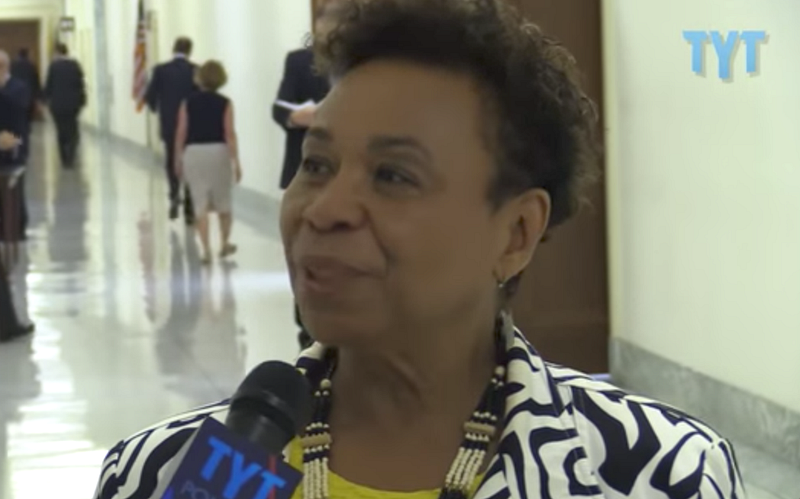
This past week, Rep. Barbara Lee’s initiative to curtail President Trump’s war-making powers was abruptly derailed by the House Leadership under Paul Ryan. In a different type of media climate, it’s not hard to imagine how such a story would’ve been headline news, dominating the week’s political discussion and engendering widespread public debate. Instead, it got minimal attention. You have not seen Barbara Lee blanketing the TV airwaves; you haven’t seen a vociferous effort on the part of Democrats and allied interest groups to rally to her cause. The media is constantly suffuse with furor, but not over this.
It’s worth considering why. Perhaps, in a political environment less transfixed by the fleeting issues of the day — Trump tweeted this, Jared Kushner excreted that — Lee’s effort would’ve occasioned more sustained coverage. Perhaps in a political environment where the United States’ over-extended empire was higher on the agenda, there would’ve been a greater awareness of Lee’s efforts. Instead… crickets.
Recall: Lee was the sole member of Congress to vote against the initial Authorization for Use of Force resolution in 2001, days after 9/11. She was viciously attacked for it at the time, but her warnings proved almost eerily prophetic. What’s amazing is, even stridently pro-military Republicans now acknowledge her foresight. Here’s an excerpt from my recent interview with Rep. Scott Taylor of Virginia, a freshman GOP congressman and former Navy SEAL who served in Iraq, and who backed Lee’s AUMF repeal amendment in committee on June 29.
MT: Barbara Lee, as you undoubtedly know, was the lone dissenting vote when the Congress near-unanimously passed the initial resolution, and at the time she was warning that although obviously we want to seek reasonable retribution for the events of 9/11, that this resolution actually had the effect of granting the executive branch a “blank check” to wage war virtually anywhere in the world. Looking back, do you think she was prescient?
TAYLOR: In some respects, sure… Again, I don’t agree with her on a lot of things. I may not agree with her if there’s a debate in where we go with the next AUMF, depending on what the executive asks for... I may disagree with her on the ultimate outcome. But I do agree with her that we need to have a debate now.
On paper, the AUMF repeal issue many not seem especially dramatic or exciting, but that’s just a function of media priorities. There were ways to make this story very interesting, and to fold it into a compelling narrative tailor-made for cable TV or whatever other multimedia format people care to utilize. Just think — Barbara Lee, the sole vote against the original AUMF resolution in 2001, finally vindicated after 16 long years; Republicans rising to her defense, including Iraq War veterans who believed that their active-duty military constituents were owed a long-overdue debate; Republican leadership thwarts its rank-and-file. It would really not have been difficult to present this as a scintillating story, if the media had the interest to do so.
Part of why the recent AUMF developments received such meager attention, perhaps, is because Lee stressed that the issue was more about a structural problem implicating the entire political system, than anything narrowly to do with Trump. Presidents in both parties have now used the AUMF to justify as many as 40 military actions, which is indicative of a systemic malady that can’t be attributed solely to Trump — as such, the issue gets less public attention and attracts less outcry than it otherwise might if some salacious Trump-specific angle could be highlighted.
When I asked Lee whether concerns about Trump’s “temperament” may have impelled her Republican colleagues to consider constraining his war-making powers, she responded:
LEE: I think it’s important that members of Congress really understand that we have a constitutional responsibility to represent the people of our districts and the country, and that on issues of war and peace, that’s our job, and we haven’t been doing our job…
The first thing we have to do is realize that we have to do our job, and that regardless of who the president is — Congress has to assert its responsibility. This was true under President Bush, President Obama, and now President Trump.
Note that she was decidedly not making it narrowly about Trump — which may even have been a slight tactical mistake, seeing as Democrats would probably be more likely to get vocally on board with AUMF repeal if it could be folded into a #Resistance-oriented narrative. While Lee didn’t exactly go there (to her credit) there was a way for Trump-hostile media to take up this issue and sound the activist blowhorns, but they chose not to. They could’ve depicted it as an urgently necessary initiative to limit Madman Trump’s ability to wage war, and that likely would’ve galvanized Democratic grassroots energy. But because there was no juicy, ready-made Trump-related soundbite to affix to this story — Trump hadn’t tweeted about it, Sean Spicer couldn’t be hectored about it — the #Resistance opted to ignore. And now the amendment’s dead.
This is doubly galling, because given that Lee’s amendment had attracted strong bipartisan support — it was adopted in committee over the objections of the presiding GOP chair, Rep. Kay Granger — it’s very possible that a sustained pressure campaign could’ve forced Republican Leadership’s hand. Republican members’ support for the amendment could’ve been used as leverage to impress upon Paul Ryan that it would be politically unwise for him to kill the measure. Sympathetic conservative media could’ve been enlisted in the effort. But… it didn’t happen.
Even if you think that the ongoing Trump/Russia saga is the most important story since the birth of Christ, it’s impossible to deny that its centrality in the media ecosystem day after day has the effect of drowning out other issues which warrant serious attention.
David Bromwich is absolutely correct to observe that the tenor of American media since January 20 is “growing shriller and more indiscriminate.” It’s also grown more superficial. Last week the average news consumer was vastly more likely to hear about the departure of Sean Spicer — a trivial non-story relevant only to palace drama-obsessed politicos and Saturday Night Live liberals — than about the AUMF amendment. Whatever that says about the country’s media climate, it’s not good.
With that, here’s another excerpt of the exchange I had with Lee — who, it should be noted, is not an especially visible face within the Democratic congressional caucus despite her unmatched fortitude.
MT: What should we take away from that just in terms of moral courage, or being willing to take unpopular positions even when you are being vilified?
LEE: Well, it’s very important that members of Congress and elected officials especially understand that in moments of crisis, and danger, and national security threats, and emergencies, that perhaps we should not go with the flow. That we should step back for a minute, as I said on the floor, and really look at the circumstances and be rational in our approach, and really come up with an appropriate response. And that is difficult, but we were elected to do our job. And that’s why this repeal measure is so important. Because we’ve been missing in action for 16 years, so we need to do our job. And sometimes it’s difficult, but that’s why we’re here.