
With The Wisdom Of The I Ching To The Right Decision
More Than Just Flipping Coins
Currently, I am facing a tough decision: Do I stay in my current place of residence or do I move abroad. Both options have advantages and disadvantages. Neither is better than the other. You can decide in many ways: With criteria that you weight and rate, based on your values, or even by flipping a coin. In my article “Make Hard Decisions Easy With Moving Motivators” I describe how to approach a decision using values. However, this method was not enough for me to make a final decision.
A few days ago, I remembered the “I Ching — the Book of Changes”. The first time I held it in my hands was more than 30 years ago. My fascination for the book has not diminished over the years, but there were always phases when it fell into oblivion. All the better, it has now come back to me and is helping me make a decision.
The I Ching
The I Ching authors are Fu Hi, King Wen, the Duke of Jou, and Kungtse. Fu Hi is a mythical figure. The fact that he is named as on of the authors indicates that it is assumed that the I Ching content is older than all other historical records. It also fits that the signs described in the I Ching have names, which do not occur otherwise in the Chinese language.
The I Ching describes eight signs, which are combined and result in 64 hexagrams by combination. There are several translations of the I Ching. Very authentic, clear, and short is the following edition, which I use: “The I Ching or Book of Changes” by Hellmut Wilhelm, C. G. Jung, Richard Wilhelm Cary F. Baynes.
The use of the book
The I Ching has always been used as an oracle book. Initially, a solid stroke __ was interpreted as a “Yes” and a broken stroke _ _ as a “No”. Three strokes were layered on top of each other to differentiate the interpretation further. That resulted in eight possible combinations. Two of these eight signs were then combined so that 64 hexagrams were obtained.
The basic idea, which is the foundation of the book, is the idea of transformation. Used as an oracle, one receives a hexagram (six lines) for the present. Regarding this initial situation, one can read the related text in the book. Lines can be changeable. By transforming these, one receives a new hexagram, which describes the future.
The I Ging texts describe ways of acting, which are helpful in the individual situation. The questioning of the oracle is traditionally done with yarrow sticks or by throwing coins.
How can I use the oracle?
A simple method is tossing coins. It would be best if you think sufficiently about your question because only then will you recognize the answers in the I Ching texts.
You need the following:
- 3 coins
- Paper and pen
- I Ching text (e.g., the book mentioned above)
- Question (thought out and written down)
Tossing coins: First, define which combination of coins should represent which type of stroke ( __ or _ _). If you get the same side three times, it means a line that transforms.
Example:
- Head — Head — Number: __
- Number — Number — Head: _ _
- Head — Head — Head: __ x
- Number — Number — Number: _ _ x
Have pen and paper ready. Think about your question and write it down. It must be an open question. Good question phrases are, for example: “How does my life turn out if I…” “What does my life look like if I…”
Then flip the three coins six times. After each toss, draw the line that was thrown. The hexagram builds up from the bottom. The first toss gives the bottom line, the second toss gives the second line from the bottom, and so on. After the six throws, you have the first hexagram. Look in the I Ching to find out which one it is.
If you have changing lines (the line where you have thrown heads or numbers three times), draw next to it the sign with changing lines from a “__”-line to a “_ _”-line and vice versa. Find out also this sign with the help of the book.
Now you can read the texts about your hexagrams and the transformed lines. If it is about a decision, you can also repeat the process for your decision options. First, toss the coins six times for your first option, and then throw them six times for your second option.
I recommend using coins and the book. By tossing them, writing them down, and locking them up, you gain time to think. That has a beneficial effect on the interpretation of the texts. In this way, one comes closer to the solution. There are also online offers that take over the coins’ tossing, the creation of the hexagrams, and the picking out of the texts. If you want to try it out, search for “I Ching online” in a search engine.
Use Case: How I consulted the I Xing
Let’s look again at my decision above, about which I consulted the I Ching.
I formulated two questions:
- “How will my life develop if I stay in Germany?”
- “How will my life develop if I move to Sweden?”
Then I flipped the coins for question 1.
Result:
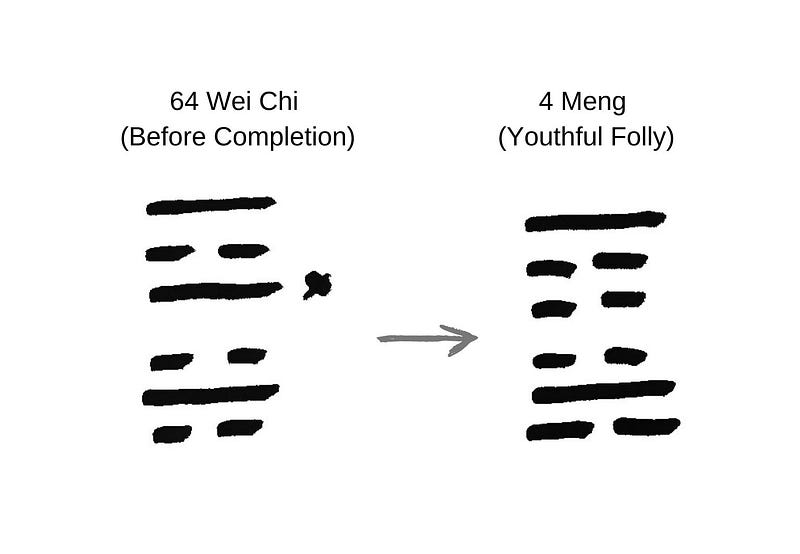
Present situation (64 — Wei Chi): The transition from disorder to order is not yet complete. Conditions are complex; the world is in confusion. To make a change possible, one must proceed cautiously and carefully.
The changing line 4: People forget quickly about shocks that reveal internal damage to society. It looks like everything is fine, but such events are a severe warning that must not be neglected.
Future situation (4 — Meng): Standing still in front of a dangerous abyss is a symbol of youth foolishness. To overcome youthful folly, one must set out on the path. There is a chance of success. Perseverance is important.
Then I flipped the coins for question 2.
Result:
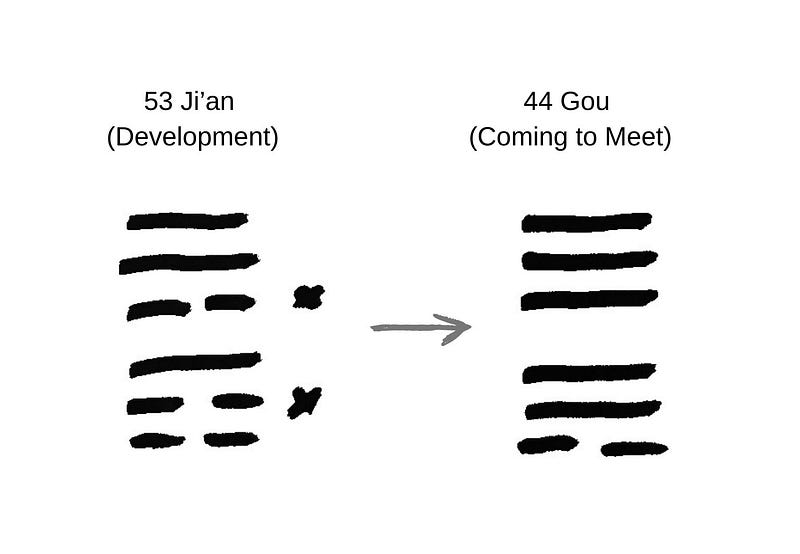
Present situation (53 — Ji’an): It is not advisable to proceed hastily; developments must be awaited. Persistence is important. It’s like marriage: formalities have to be taken care of, the relationship takes shape slowly.
The changing lines 2 and 4: It is essential to be wise and yielding. Then, in the midst of danger, you can find a safe place where you can live. Success is emerging; one has found one’s place in changed circumstances. The transition must be completed. In the end, everything turns out well.
Future situation (44 — Gou): The sign points to a situation where the dark principle secretly and unexpectedly forces its way back into life after it has been eliminated. It is crucial to fight against the dark in time. The sovereign is distant from the people but sets them in motion by his commands and expressions of will.
Conclusion
I have enjoyed studying the I Ching and think it is helpful. Unfortunately, both options of my decision do not seem optimal in the light of the I Ching. However, I am amazed at how relevant to the current situation the ancient texts are. Reading and thinking about them has inspired me.
What are your experiences with the I Ching?


