
Make Hard Decisions Easy With ‘Moving Motivators’
Sometimes we are faced with two options that are of equal interest — assessing our values can help us make a decision that we’ll still agree with in the future

I am currently facing a decision: Move abroad or continue living where I am. It is a difficult decision. And I did what I always do in such cases:
- Created a spreadsheet.
- Defined criteria.
- Assigned a weighting for the criteria.
- Evaluated the criteria for both options.
There was a winning option, but it was very close. And that close result is also what left me undecided because I’m not 100% convinced of the winning option. So much is also in favor of the alternative. After evaluating the spreadsheet, I’m just as smart as I was before. So how can I come to a decision?
Easy and hard decisions
Some light was shed on this by a talk I watched today by Ruth Chang. She explains what easy decisions are, what hard decisions are, and what possibilities lie in hard decisions.
When you have two options and one is clearly better than the other, the decision is easy. You choose the better one. But if you have two equally good options, you face a hard decision. Not all aspects of the two options have to be equally good. Some are better with one, some with the other. Overall, however, both options are equally good.
But instead of getting in a bad mood because you can’t decide, it makes sense to look at the positive side of difficult decisions: They offer the potential to shape one’s own life. For example, if you decide to study economics, your life will be different after and even during your studies than if you decide to study medicine.
Use your values as a guiding star
Instead of getting bogged down in criteria and evaluation, you should ask yourself: “What kind of person do I want to be? What values do I want to live by?” At that moment, you no longer depend on which option is better. Instead, you decide which reasons for each option are more important to you. And you do this by determining who you would rather be.
Let’s look again at the above options “study economics” and “study medicine”. The list of criteria you evaluate would perhaps include “salary”, “job opportunities”, “duration of studies”, “cost of studies”, etc.
One criterion turns out better for one option, another for the other. If both options are equally good, the decision becomes hard.
Another approach is to ask yourself where you see yourself. How does it feel if you see yourself, for example, as a rural doctor in your own practice? How does it feel when you see yourself as a management consultant working for large corporations and continuously on business trips? Who do you want to be, and which values can you live with which option?
There are many values. I like to work with the values of the Moving Motivators:
- Curiosity: I love to experiment and try something new.
- Honor: My values are represented in my work and life.
- Acceptance: I am, and what I do is accepted by other people.
- Mastery: My work and life are challenging, promotes my skills but feasible.
- Power: I can influence the outcome and my environment.
- Freedom: I am independent and can decide how I live my life.
- Relatedness: I have good relations.
- Order: My living and working environment is stable and safe.
- Goal: What I do matches my goals.
- Status: I have a good position, and people recognize me.
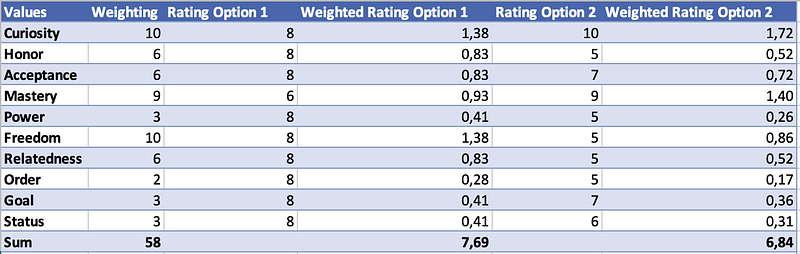
To make a decision evaluate your values concerning the options. Feel inside yourself what it would be like if you realized each option. It would be best if you imagined what your life would be like after realizing the option. Weight the values from 1 (not important) to 10 (very important) and then rate the options based on the values from 1 (I can’t live this value at all) to 10 (the option is perfectly aligned with this value). Calculate the weighted rating for your options.
An evaluation table for the values could then look like this:
Conclusion
For my decision above, I’m still processing my values but here’s what I’ve learned so far:
- It is essential to have a clear vision of your options.
- It is vital to be clear about your values.
Both aspects are clearer to me now and will help me make the right decision.
Next time you are faced with a hard decision, try this approach. It will help you to gain more clarity and find your way.