
WRITING | LIFE | LOVE
Will You Still Be a Writer After the Pandemic?
Even if you stop writing, Anton Chekhov’s checklist might make you a better person and also improve your love life.

Everybody wants to get into the act.
That was the famous catchphrase of longtime showman Jimmy Durante. But if he were alive today, Durante might instead say, “Everybody needs to get into the act.”
With 11 million people still unemployed because of the pandemic, lots of folks have been searching for a payday on social-media platforms lately. Desperate to replace the steady income of the nine-to-five or the dodgy earnings of the gig economy, more than a few have become ‘writers.’
They hear that Kim Kardashian makes more money from a single Instagram post than she does during an entire season of Keeping up with the Kardashians. They read stories about influencers who rake in enough bitcoin to buy sprawling mansions. Even failed influencers can get into the act. One even picked up a six-figure publishing contract for ratting out a popular influencer she helped promote.
There’s gold in them there hills, it seems. And even if you don’t make a big killing, maybe you can at least pay the rent. Surely the odds are better than waiting for Congress to pass another stimulus package.
Especially if you know a thing or two about marketing. Because let’s face it, a lot of what passes for writing these days is really marketing. Ten things you can do to make your post go viral. Five tricks for turning your Instagram into cash. How to make a killing with only 200 words a day. How I made $10 thousand my first day on social media.
If any of this works for you while you’re trying to keep body and soul together during this particularly soulless season, then more power to you.
But after the pandemic is over, will you continue to be a writer? Will you have uncovered the secret that keeps writers writing no matter what? Will you want to spend the rest of your life in pursuit of great stories that can only be told by you?
If so, Anton Chekhov has a 5-point checklist for you.
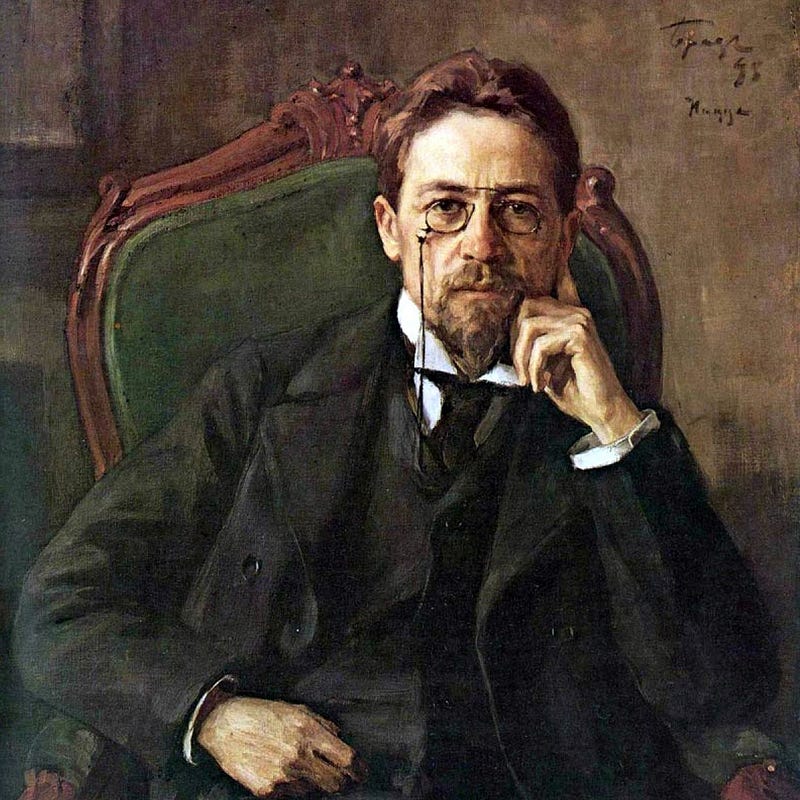
As you may know, Chekhov was the son of an abusive grocer whose family had fallen on hard times in 19th-century Russia. He began writing stories to help support his family and to pay his way through medical school.
But he got so good at storytelling, we remember him more today for his writing than the doctoring he practiced most of his life. Medicine, he said, is my lawful wife — writing is my mistress.
That mistress was awfully good to him. She made him the author of numerous short stories and four classic plays. Proof that what you practice, you get good at. Even if it’s metaphoric adultery.
Chekhov’s stories don’t make a lot of noise — except of course when someone fires a gun as in The Seagull and Three Sisters.
His stories reach down into the quiet, sad places of the human heart and show you what’s lurking there. They look at longing, loss, anticipation, heartbreak, and failed ambition. The real stuff of everyday life. Sometimes they make you laugh. Chekhov had a terrific sense of humor.
Although he would eventually abandon short stories for the theater, his plays continue to be performed in our own time. Fortunately, his collaboration at the Moscow Art Theatre with method-acting creator and director Konstantin Stanislavsky, yielded a five-point checklist for creating great stories, from which every writer can benefit.
I wrote it down while taking a course at Stanford University taught by the director of the creative-writing program there, an author of several books and a former editor at The Atlantic. Hands-down one of the best courses I have ever taken. Fortunately, I held onto my notes. Which is why I’m able to share Chekhov’s checklist with you here.
For every character in the story, you must be able to answer the following five questions:
1. Who is he?
2. What does he want?
3. Why does he want it?
4. What is he willing to do to get it?
5. What is his relationship to the other characters in the story? (e.g., Who’s with him and who’s against him?)
The rest of the recipe is simple: Put the answers to these five questions into the same mixing bowl — and stir. The story will tell itself.
Misery
“Why are Chekhov’s stories great?” I once asked a creative-writing professor in San Francisco.
“Because they make you cry,” she said.
The class discussion that day was about a little story called “Misery.” It takes place on a single night in the life of an old man named Iona, a sledge-driver who has just learned that his son is dead.
It is very cold. He sits in the snow waiting for a fare while his heart overflows with misery, which —
…tears his heart more cruelly than ever. With a look of anxiety and suffering Iona’s eyes stray restlessly among the crowds moving to and fro on both sides of the street: can he not find among those thousands someone who will listen to him? But the crowds flit by heedless of him and his misery. . . . His misery is immense, beyond all bounds. If Iona’s heart were to burst and his misery to flow out, it would flood the whole world, it seems, but yet it is not seen. It has found a hiding-place in such an insignificant shell that one would not have found it with a candle by daylight.
The old man picks up four passengers during the night and tries to tell each one what happened. But not one of them shows the least bit of interest or empathy. Later, he tries to tell two strangers on separate occasions to no avail. In the end, he winds up having to tell his horse about it.
Even in the late 19th century, when no one even dreamed of a smartphone, people were too busy with their own concerns to be present for another human being. To take time to listen. To notice that he might be suffering.
In a way, Chekhov’s old sledge-driver is a lot like the deaf, dumb, and blind kid in the rock opera Tommy. The one who sings, See me, feel me, heal me.
My Editor’s Love Life
Years ago, I worked in a publishing house as an assistant to an acquisitions editor, who told me one day that she’d decided to marry the architect she’d been dating. When I asked what sealed the deal, she said:
“Whenever we’re having lunch or dinner together, and I start to speak about something important to me — my thoughts or feelings — he puts down his knife and fork and gives me his full attention. I’ve never known anyone else who does that.”
In his quiet little short story, Chekhov shows us the cruelty of indifference, of withholding attention from those who ask for just a little of it. And he does it without one instance of preaching. He just lays out the whole thing without judgment or comment and lets us see the situation for ourselves.
What you discover if you pick up his early stories is that he wasn’t always such a master. Many of them are little more than vignettes. Because Anton Chekhov was once a beginner, too. Trying to make ends meet during difficult times.
Just like you and me.
If for some reason, you discover that you don’t want to be a writer when the pandemic is over, good for you. It means you’ve dodged a bullet. The writer’s life doesn’t ask for much — it asks for everything.
But if you practice the craft only as long as it takes to put frijoles on the table, it might help your writing and your pocketbook if you consider Chekhov’s checklist. You may never need it to construct a novel or play. However, it might prove useful in helping you to become the kind of person upon whom nothing is lost.
Someone who notices things. Like motivation, pain, the elephant in the room. The kind of person who can look at his fellow human being and say, I see you.
©2020 Andrew Jazprose HIll. All Rights Reserved
Originally published at https://www.jazprose.com on November 10, 2020.
Thanks for taking the time to read this piece. If you’ve found anything of interest in it, you might want to check out a couple of my other recent pieces.