
Why You Should Try Slow Reading
Stop trying to consume words and enjoy them
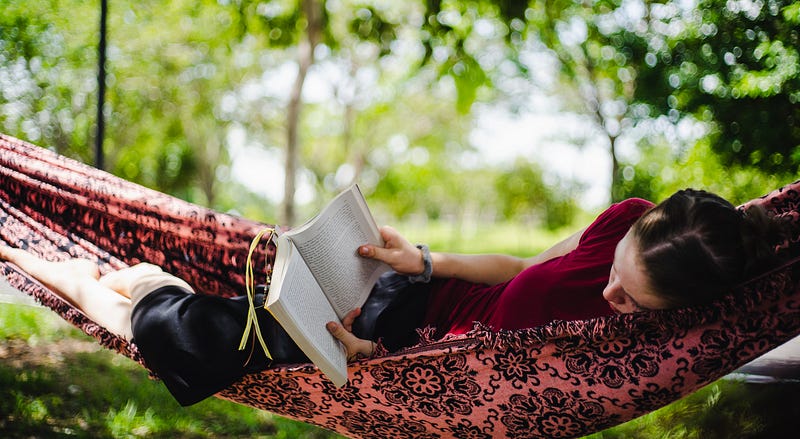
Reading purely for enjoyment, absorbing and savoring words seems to be being replaced with a need to simply consume information. On an increasing number of websites, there are estimates of how long a piece will take you to read. Book summary apps are immensely popular. I keep reading articles about ‘How I read x number of books a year/month/week’.
It is good to read but it should be fun or enjoyable at least some of the time. If you are challenging yourself to read a book a week it is unlikely you will opt for longer works such as War and Peace, Catch 22, Pillars of the Earth, Dune,or Lord of the Rings. They might derail the challenge after all. Which is a shame.
I get it, we are all in a hurry and there’s a vast mass of things to read. The internet is full of information and reading bitesize morsels of knowledge means you can keep on top all the other things that fill up your life. People skim or just don’t bother — TL:DR.
If you primarily read shorter non-fiction books purely to learn, then fair play. I read them too. But do you enjoy it? Quite a lot of the time, if I was reading a book on, say, productivity or how to invest in the stock market and there was an option to download it Matrix-style directly to my brain, I would go for it. It would free up my time to immerse myself in something I actually enjoyed reading.
What is ‘Slow Reading’?
I know I am at risk of sounding patronising here and one look at a bookshop, online book store, or bestseller list, shows that people reading at a reasonable pace, purely for pleasure, is still popular. And that is what slow reading essentially is.
Slow reading means taking your time, turning off all notifications, and just enjoying the words, the story, the characters.
I have a degree in English Literature and write for a living, so I am probably more invested in people taking the time to read what is written. But there is a deep joy to be had from blocking everything out and sinking into a book. Famous authors deserve to be read and not skimmed or summarized. An incredible character, story arc or turn of phrase is designed to be taken slowly, absorbed and enjoyed.
Technology has changed reading
Thanks to technology, access to writing has never been more ubiquitous. As of July 2020, there are 4.57 billion active users on the internet. There is more reading and writing going on than ever before. But the kind of reading going on is different.
This is not a bad thing. Writing on the internet tends to be more immediate and interactive. You may be reading this within an hour of my writing it. Books, on the other hand, have more a gap between when they were written and when they are read. Self-publishing has shortened that gap for some but it is still there.
Online writing also tends to be shorter and encourages opinion and conversation. You may even comment on this article, for example (please be nice). It can be kind of fun and feels less passive. But internet articles can often treat words and writing as either information to be commented on or simply the start of a conversation. And it is frequently an argumentative and combative conversation. Some places, like Medium, have nice and supportive comments but this is not always the case (even on Medium).
Why is slow reading so good?
Reading slowly is fun. It is why some people, like myself, get excited when we realize we have some time to spare and are in the middle of a really good book. It is also incredibly beneficial — it can increase creativity, inform, soothe anxiety and aid mental health. That’s not an opinion, it’s a scientific fact. Reading can extend your life.
It doesn’t just have to be fiction. I do read mostly fiction but when I switch to non-fiction I still prefer a good writer, so I can enjoy the process. Books by authors such as Stephen Fry, Bill Bryson or Yuval Noah Harari can be every bit as joyous to read as a fiction novel. The point is slowing down and enjoying the words.
It sometimes seems odd that in an age where mindfulness and contemplation are all the rage, it doesn’t seem to apply as much to writing. ‘How I read 10 mindfulness books a month’ is kind of ironic.
While a decent novel can inform and educate, it is not necessarily designed to have a takeaway message or be mined for information. It is an exposure to beautiful and/or well-written language and a look into another person’s mind. Getting immersed and lost in a good book is ridiculously satisfying.
Aren’t people already slow reading?
Yes, they are. And it obviously doesn’t have to be one or the other. If I was saying that then this piece would be contradictory at best or just downright hypocritical. I just want to nudge the compass back a little.
At no point do I think short, interactive internet-based snippets of information will replace longer books read for pleasure. As I mentioned before, bookshops online and offline are doing well. These two things can co-exist and find an equilibrium. I have previously written about this battle with technology in regards to purely the publishing world.
What I am trying to encourage has already happened with television. When I was young, there was a concern about shortening attention spans. When multiple TV channels started springing up everyone thought the future would be dominated by loud, attention-grabbing shows to the detriment of all else.
Then came shows like the Sopranos, The Wire, and Game of Thrones. People proved they do enjoy something longer with more depth. Box sets and bingeing on Netflix is the TV equivalent of slow reading.
Thanks to Covid, there has been a surge in reading. The fact that books have been getting longer shows there is still a strong demand for a good book.
So while I don’t think there is any danger of literature dying out any time soon thanks to listicles posted on Reddit, I do feel obliged to remind busy people to take some time out to read purely for pleasure. Not as a challenge and not to imbibe knowledge, just for fun.
I have a lot of friends who confess that they haven’t read a good book in ages. To them and everyone else:
Find the time, find a good book and get lost in it. It’s time well spent.