
Why You May Benefit From Writing a Memoir
It will rock your world. In a good way.
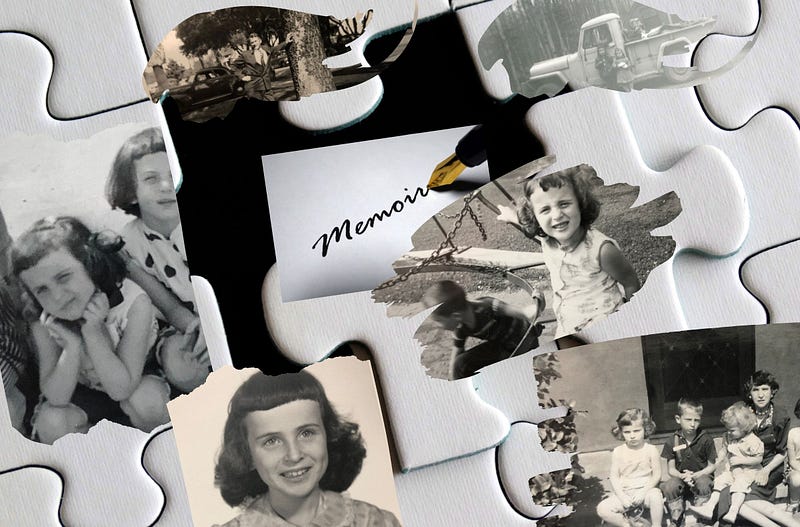
I wish I’d known how life-changing writing my memoir could be. I might have tried it sooner—but then again, I might not have been ready.
It’s been tough, no doubt about it.
When I began, possibly confusing autobiography and memoir, I planned to start with my earliest memories and conclude with leaving Alaska at 17.
But then I began reading memoirs, books about memoir writing, and listening to the plethora of talented teachers sharing their memoir writing expertise online.
Structure, point-of-view (POV), narrative, scenes, and most demanding of all—reflection.
Reflection is what you learned from what you went through.
That’s the pithy reminder from one of my most helpful virtual mentors, Marion Roach Smith. She can make complicated processes understandable with easy-to-remember images such as, What is Memoir? It’s a Three-Legged Stool That Holds Up Your Story.
So, if the point of writing a memoir is to discover what I learned…whew!
My plan to end the book when I was a naive teenager seemed unlikely since I knew jack shit at 17. Of course, we don’t have to nail the meaning of life before writing about it, but I wasn’t satisfied with ending there.
I began digging. Excavating, really.
Thanks to the hard work of my older sister, I had the fantastic resource of about 1,000 typewritten pages she’d transcribed of letters and journals my mother left behind when she died. My sister spent years deciphering faded handwriting, trying to discover a reason for our mother’s descent into chaos.
She documented her conclusions in this book, Story Without Words: How Did Child Abuse Break My Mother?
I’d avoided reading my mother’s words for years.
The idea was too painful, and I just was not ready. In addition, I’d already made up my mind about who my mother was and why. She was the villain of my childhood, and my father was the hero. I had no need for more than that.
But I realized my past was part of my present. Both good and bad, along with terrifying emotions and pleasant ones, interact to create who we become.
Then, as we mature, we add to the mixture, stirring and considering.
Traumatic memories are branded into our hearts and brains. I suppose fear and pain were methods meant to protect our ancient ancestors from venturing alone too far from the cave or eating poisonous plants.
But still, negative memories tend to be what we more easily remember.
But, what I like about myself came from my childhood, too.
That includes a love of nature shaped by growing up on our Alaskan homestead and a can-do spirit learned from my city-slicker parents. Unfortunately, they perhaps foolishly attempted that project with little experience and even less money. Hmm—I remember doing that myself.
Three of my siblings and I have all owned bookstores, reflecting a love of books encouraged by a lack of electricity, hence television, and the role model of our father who loved to read.
And all six of us, never, never, never give up—whatever the odds.
So, as the saying goes, I couldn’t throw the baby out with the bathwater. I’d need to consider a lot more than just the negatives.
And, what the heck?! Now that I have adult children, that’s sure what I hope they do. I messed up plenty, innocently unaware of what I did not know, at 19, when my first son was born.
My sisters and I resolved to “never be a mother like our own”. And none of us intentionally hurt our kids, I’m relieved to say.
Thankfully, none of us have struggled with severe untreated mental illness as our mother did. And we’ve had the support of our siblings, which our parents didn’t have.
But that doesn’t mean I didn’t hurt my children, lacked wisdom, or was just plain dumb at times!
Life was tough—but oh, so worth it.
I’m two and a half years into my memoir writing project, and I have no idea when I’ll be done. First, I drafted 80,000 words, and then my whole POV shifted because I had changed.
Not only do I now have many unanswered questions and see my father as a flawed hero, I unexpectedly gained compassion for my mother. Of course, I can never excuse her unrelenting abuse of my older sister or the emotional damage the rest of us suffered. Still, a sliver, just a sliver of light, is illuminating my understanding.
Towards the end of my mother’s life, all I asked of her was to acknowledge she’d made mistakes.
Her answer? “I never did anything any other normal mother wouldn’t have done.”
It was so far from the truth there was no bridge to cross.
For the last ten years of her life, I felt as though my mother had already died. I never saw her or spoke to her again. When she finally left this life, worried, I asked my therapist why I felt no sadness.
She said I’d already grieved. But in some ways, I hadn’t.
I was still carrying the pain of my childhood with me, though I would have denied it. Instead, it seeped out of me like death, from time to time, much as I tried to ignore it.
Finally, this writing journey has brought me face-to-face with the past. That includes my childhood, yes, and my adult life to the present. Honestly, the pain that welled up from time to time is nearly gone.
From rage, fear, and sorrow to joy, release, and freedom—man, I’ve felt it all.
But, it has been so worth it.
And I’ve got a coaching call coming up with Marion Roach Smith. So I’ve been waiting until I had the three legs of my memoir stool constructed—what she also calls our algorithm.
Paraphrased, Smith says our story should be “about x (what I learned) from y (what I went through) as told in a z(book)”. The x is supposed to be something universal that resonates with many people. The y is deeply personal.
We also need an argument, a statement that we can attempt to prove.
It may shift again, but I think I’m getting closer.
My argument: I believe all childhoods have strengths and weaknesses, just as all people do. The challenge is to learn from the negatives and build on the strengths to become our authentic selves.
My algorithm: It’s about x (gaining freedom to be myself by understanding the legacy of the past) from y (writing about my childhood homesteading with a mentally ill mother in Alaska and my adult reactions) as told in a z (book-length memoir).
I love to share my unique childhood, especially the stories about my siblings and Alaska, and I’ve had a rewarding life. It’s great if others enjoy my stories or learn from what I’ve experienced.
But the most significant achievement has been what I now understand as that elusive reflection. That’s the deep stuff. If I wasn’t free before, why not? And what was the legacy of my childhood? Did it become my children’s heritage, too?
And being willing to admit I no longer want to be exactly as I was before. And who is this new me? And what’s she going to do with the rest of her life?
You know—the good stuff.
And I don’t have to publish my book or share it with the world for it to have been so worth it. So if my kids or grandchildren want to know more about the old lady, at least they can.
Recently I came upon this article.
When we express our inner experience, we let the thoughts, feelings, and sensations take shape, process, and integrate.
Journaling, drawing, dancing, singing, screaming, venting, writing, visualization, and more are ways we can express what we are experiencing with our words, movements, and imagination.
This process helps us make sense and meaning of our experience, stringing pieces together, weaving with other threads, and making the quilt of our life story. —3 Essential Strategies for Integrating Life Experiences
And I’ll end with the author’s words which sum up my thoughts so well. Many of you are here on The Memoirist because you’re processing, grieving, and wanting to share with loved ones. Please keep on writing, y’all.
When you read a memoir, do you want to see photos of the people in the book? Get a free photo book here if you’d like to see vintage photographs of the folks in Cindy’s stories.


