avatarClaire Splan

Free AI web copilot to create summaries, insights and extended knowledge, download it at here

4219

Abstract

, which suggests that the technique is a better fit for visual and non-linear thinkers.</p><h1 id="3c53">Advantages</h1><p id="2173">No matter what kind of thinker you are, you may find that mind mapping will hold some advantages that work for you.</p><h2 id="4279">More creative brainstorming</h2><p id="176a">Mind mapping can appeal to some as a looser, more freewheeling approach to thinking through a project. By not getting bogged down by establishing a linear order right from the start, you can let your ideas run out in multiple directions and worry about sorting and ordering them later.</p><figure id="ca8a"><img src="https://cdn-images-1.readmedium.com/v2/resize:fit:800/1*OVEneEAyrguyuwv1yBVbQA.png"><figcaption>Image by <a href="https://pixabay.com/users/MoteOo-466065/?utm_source=link-attribution&amp;utm_medium=referral&amp;utm_campaign=image&amp;utm_content=1458409">Mote Oo Education</a> from <a href="https://pixabay.com/?utm_source=link-attribution&amp;utm_medium=referral&amp;utm_campaign=image&amp;utm_content=1458409">Pixabay</a></figcaption></figure><h2 id="d6fd">Visual tool</h2><p id="c7ef">Some people find that plugging images into their mind maps instead of just using words can further stimulate their creativity. Anything from stick figures and scribbled drawings to photos cut from a magazine can help you see your story ideas more clearly and imaginatively.</p><h2 id="6ae4">Clarifying relationships between ideas</h2><p id="83ba">One of the biggest benefits of mind mapping over outlining is that it helps to note and clarify relationships between ideas, especially in more complex topics. If one sub-topic links back to two topics, you can draw lines to visually connect them so that you can remember to explain the connection in your story.</p><h1 id="d857">Avoiding some pitfalls</h1><p id="98a3">Although most people find that mind maps make writing a smoother process, there are a few problems to watch out for.</p><h2 id="6967">Over-thinking</h2><p id="196d">Because mind mapping can be such a creatively stimulating tool, there is a chance that you may go overboard and map out a topic to a more granular level than what you need. As you’re mapping out your sub-topics and sub-sub-topics, don’t forget to keep page limits or word count targets in the back of your mind. Don’t overwhelm your audience!</p><h2 id="8b06">Failing to make connections</h2><p id="b9b0">Part of the beauty of mind maps is that they show which ideas are linked together. But you have to make sure you’re establishing those links in your writing so it doesn’t come across as just a collection of disjointed thoughts. If one topic is subordinate to another, make sure the hierarchy is clear in your writing.</p><h2 id="59a7">Not leaving enough time for revision</h2><p id="85bd">This is where you show that you’re no amateur! You may have drafted some beautifully written paragraphs from all those ideas you mind mapped, but if you don’t leave yourself enough time to revise and polish the final piece, it will seem choppy and unfinished to the reader. Make sure you clearly introduce each new thought and smooth every transition from one sub-topic to another, while keeping it all linked to the main topic.</p><h1 id="b1e3">Resources</h1><h2 id="431d">Books</h2><p id="6e0c">For a more in-depth guide to mind mapping, these two books will take you all the way from dummy-hood to mastery:</p><ul><li><a href="https://bookshop.org/a/4847/9781119969150">Mind Mapping for Dummies</a> by Florian Rustler with a foreword by Tony Buzan</li><li><a href="https://bookshop.org/a/4847/9781786781413">Mind Map Mastery: The Complete Guide to Learning and Using the Most Powerful Thinking Tool in the Universe</a> by Tony Buzan</li></ul><h2 id="2a75">Software</h2><p id="3951">There are now numerous software tools for mind mapping and it’s beyond the scope of this article to go into reviewing them. However, this <a href="https://productivityland.com/best-mind-mapping-software/">article on Productivityland.com</a> looks at 21 different programs and gives good information on all of them.</p><h2 id="a104">Videos</h2><p id="c5c4">A short video tutorial may be all you need to get you going with creating your own min

Options

d maps. Check out these two:</p><ul><li><a href="https://www.youtube.com/watch?v=u5Y4pIsXTV0">How to Mind Map with Tony Buzan:</a> An overview and brief tutorial from the man who made mind maps popular. Buzan gives suggestions for how to make mind maps even more visual to make them a more effective learning tool.</li><li><a href="https://www.youtube.com/watch?v=xges9V4rLms">How to Create a Mind Map (Tutorial):</a> This tutorial by They Call Me Hoz is very simple and clear — a really good, basic introduction to mind mapping.</li></ul><h1 id="8733">Example</h1><p id="c835">Finally, just for the hell of it, I thought I’d show you the mind map I created as I was planning this article. It’s not too pretty, but it’s simple and clear and it kept me focused on exactly the information I needed to cover.</p><figure id="45b1"><img src="https://cdn-images-1.readmedium.com/v2/resize:fit:800/1*vsRjU-x9nLLnltmJWc10Eg.jpeg"><figcaption></figcaption></figure><h2 id="7874">If you liked this article, here are a few more you might be interested in:</h2><div id="8cbb" class="link-block"> <a href="https://readmedium.com/is-the-best-place-to-write-tucked-between-the-sheets-5c2ec4918109"> <div> <div> <h2>Is the Best Place to Write Tucked Between the Sheets?</h2> <div><h3>It’s not lazy to write in bed. It’s following in the tradition of some of literature’s greatest writers.</h3></div> <div><p>medium.com</p></div> </div> <div> <div style="background-image: url(https://miro.readmedium.com/v2/resize:fit:320/0*FMTsi_Dcrfzm7ayf.jpeg)"></div> </div> </div> </a> </div><div id="8e12" class="link-block"> <a href="https://writingcooperative.com/whether-your-editor-loves-you-or-hates-you-is-up-to-you-4612cce34f82"> <div> <div> <h2>Whether Your Editor Loves You or Hates You Is Up to You</h2> <div><h3>Here are 5 easy ways to make your editor your #1 fan</h3></div> <div><p>writingcooperative.com</p></div> </div> <div> <div style="background-image: url(https://miro.readmedium.com/v2/resize:fit:320/0*EcMtXGA9ZUE7qm_9)"></div> </div> </div> </a> </div><div id="a159" class="link-block"> <a href="https://medium.com/swlh/i-used-to-write-in-busy-noisy-caf%C3%A9s-now-im-writing-alone-in-silence-e32bdab9c09f"> <div> <div> <h2>I Used to Write in Busy, Noisy Cafés. Now I’m Writing Alone in Silence.</h2> <div><h3>Three aids are helping me stay productive through the quiet of the quarantine</h3></div> <div><p>medium.com</p></div> </div> <div> <div style="background-image: url(https://miro.readmedium.com/v2/resize:fit:320/1*Sy4BBUac10U_iiDn3Fr9hA.jpeg)"></div> </div> </div> </a> </div><div id="6637" class="link-block"> <a href="https://writingcooperative.com/is-it-time-for-you-to-join-a-professional-writers-association-6266868b027f"> <div> <div> <h2>Is It Time for You to Join a Professional Writers Association?</h2> <div><h3>Membership in the right writers association can take your career to the next level — if you’re ready</h3></div> <div><p>writingcooperative.com</p></div> </div> <div> <div style="background-image: url(https://miro.readmedium.com/v2/resize:fit:320/1*ZYB4MsVYlzT7cNrBtxqT3A.jpeg)"></div> </div> </div> </a> </div><p id="de82"><i>Note: This article contains some affiliate links.</i></p><p id="e810"><a href="https://clairesplan.medium.com/membership"><i>Become a member of Medium.com</i></a> <i>and you’ll get full access to every story on Medium while your membership fee directly supports <b>Claire Splan</b> and thousands of other writers creating fresh stories you’ll want to read.</i></p></article></body>

A Mind Map May Be Your Path to Better Writing

If you’re a visual or non-linear thinker, mind mapping beats outlining as a tool to plan and organize your writing

Image by Gerd Altmann from Pixabay

Back when I was a faculty adviser for a community college student newspaper, I was working with a student who consistently had a difficult time drafting focused, well-organized stories. Newswriting has a fairly straightforward structure and, more often than not, the upside-down pyramid structure is the preferred way to present news stories.

For this student — well, for a lot of students — organizing her thoughts and her notes clearly enough to work within that structure seemed almost impossible. I suggested outlining her story before she started writing but that seemed to just present another layer of the struggle for her.

I was an experienced writer by that point but not a very experienced teacher so it took me a while to grasp that the problem might be that this student just wasn’t a linear thinker. She was very bright, had a curious mind, and was driven to succeed but she just didn’t see things in a particularly ordered way.

She was frustrated. I was frustrated. And in an effort to come up with some kind of approach that would help her focus, I sat down with her and her notes and tried to sketch out a path forward for her.

I wrote the main topic of her story on a piece of paper and drew a circle around it. Then I asked her for the three or four most important points she wanted to make and wrote each of those in a circle surrounding that main topic and drew a line from the main topic to each of those circles.

We then took each of those sub-topics and broke them down into smaller points, drawing circles and lines to connect the thoughts that needed to be connected. With each circle we drew, I could see her eyes widen as the story was coming into focus.

Something was clicking for her.

She suddenly saw a roadmap for writing her story. With that roadmap in hand, she was able to take draft paragraphs for each sub-topic and then stitch the pieces together in a cohesive story.

It wasn’t perfect but the article she drafted based on the diagram we created together was a vast improvement over the stories she’d previously handed in and I could tell that she was relieved to have discovered a method that enabled her to break down a topic that seemed overwhelming into digestible chunks and begin to see how the chunks related to each other.

What is mind mapping?

I didn’t know it at the time but the diagram I sketched out with my student was in essence the technique known as mind mapping. It is a technique that has been around for a long time, even centuries in some form or another. It wasn’t popularized, however, until the 1970s when a British pop psychology writer named Tony Buzan introduced it on a BBC television show he hosted.

Since then mind mapping has been studied widely for its effectiveness in cognitive learning, memory retention, productivity, and creativity. In one notable study done in 2009 students showed improvement in writing ability when mind mapping was added to their classwork in comparison to students who had the same classwork without mind mapping.

Not everyone seems to yield the same benefits. One study has suggested that mind mapping was more effective for art and design students than it was for computer and IT students, which suggests that the technique is a better fit for visual and non-linear thinkers.

Advantages

No matter what kind of thinker you are, you may find that mind mapping will hold some advantages that work for you.

More creative brainstorming

Mind mapping can appeal to some as a looser, more freewheeling approach to thinking through a project. By not getting bogged down by establishing a linear order right from the start, you can let your ideas run out in multiple directions and worry about sorting and ordering them later.
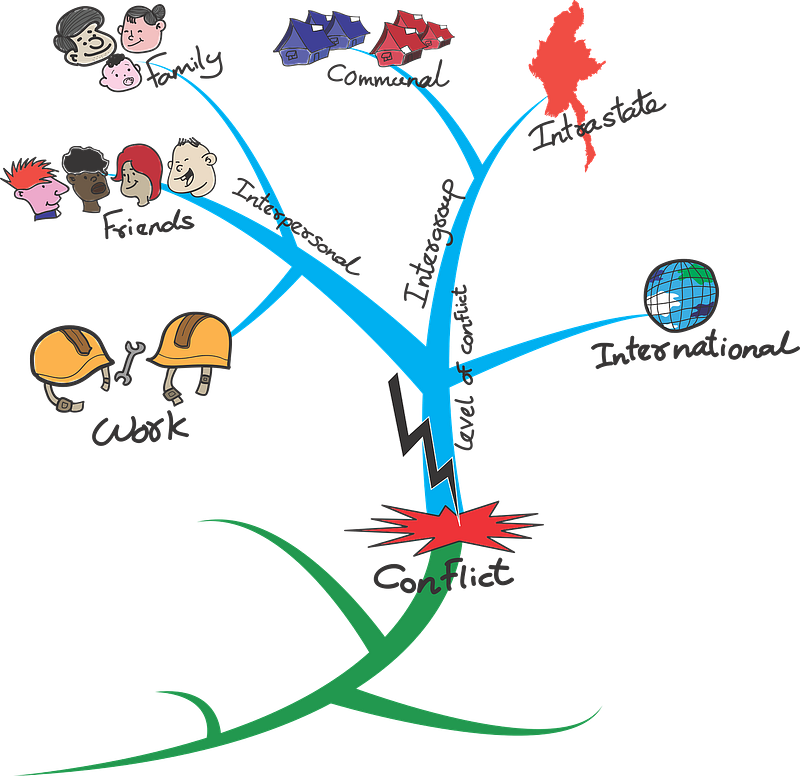
Image by Mote Oo Education from Pixabay

Visual tool

Some people find that plugging images into their mind maps instead of just using words can further stimulate their creativity. Anything from stick figures and scribbled drawings to photos cut from a magazine can help you see your story ideas more clearly and imaginatively.

Clarifying relationships between ideas

One of the biggest benefits of mind mapping over outlining is that it helps to note and clarify relationships between ideas, especially in more complex topics. If one sub-topic links back to two topics, you can draw lines to visually connect them so that you can remember to explain the connection in your story.

Avoiding some pitfalls

Although most people find that mind maps make writing a smoother process, there are a few problems to watch out for.

Over-thinking

Because mind mapping can be such a creatively stimulating tool, there is a chance that you may go overboard and map out a topic to a more granular level than what you need. As you’re mapping out your sub-topics and sub-sub-topics, don’t forget to keep page limits or word count targets in the back of your mind. Don’t overwhelm your audience!

Failing to make connections

Part of the beauty of mind maps is that they show which ideas are linked together. But you have to make sure you’re establishing those links in your writing so it doesn’t come across as just a collection of disjointed thoughts. If one topic is subordinate to another, make sure the hierarchy is clear in your writing.

Not leaving enough time for revision

This is where you show that you’re no amateur! You may have drafted some beautifully written paragraphs from all those ideas you mind mapped, but if you don’t leave yourself enough time to revise and polish the final piece, it will seem choppy and unfinished to the reader. Make sure you clearly introduce each new thought and smooth every transition from one sub-topic to another, while keeping it all linked to the main topic.

Resources

Books

For a more in-depth guide to mind mapping, these two books will take you all the way from dummy-hood to mastery:

Software

There are now numerous software tools for mind mapping and it’s beyond the scope of this article to go into reviewing them. However, this article on Productivityland.com looks at 21 different programs and gives good information on all of them.

Videos

A short video tutorial may be all you need to get you going with creating your own mind maps. Check out these two:

  • How to Mind Map with Tony Buzan: An overview and brief tutorial from the man who made mind maps popular. Buzan gives suggestions for how to make mind maps even more visual to make them a more effective learning tool.
  • How to Create a Mind Map (Tutorial): This tutorial by They Call Me Hoz is very simple and clear — a really good, basic introduction to mind mapping.

Example

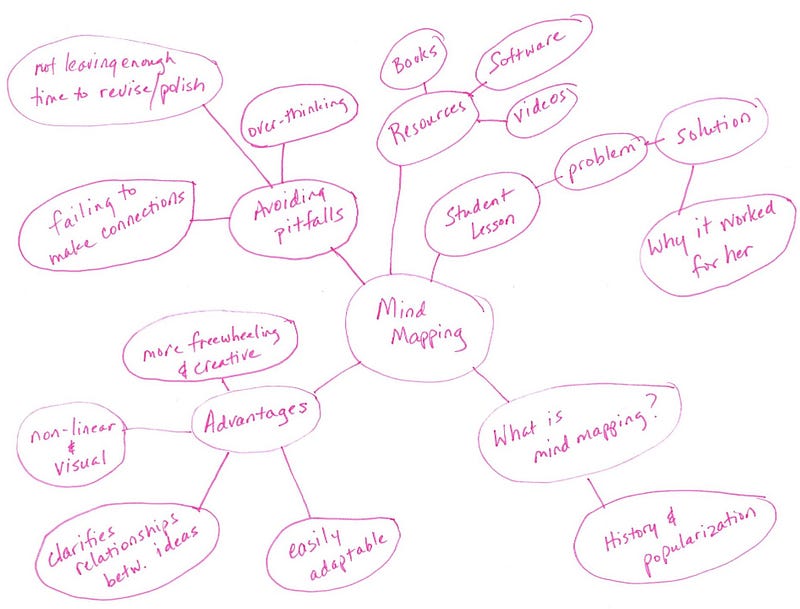
Finally, just for the hell of it, I thought I’d show you the mind map I created as I was planning this article. It’s not too pretty, but it’s simple and clear and it kept me focused on exactly the information I needed to cover.
If you liked this article, here are a few more you might be interested in:

Note: This article contains some affiliate links.

Become a member of Medium.com and you’ll get full access to every story on Medium while your membership fee directly supports Claire Splan and thousands of other writers creating fresh stories you’ll want to read.

Writing
Mind Mapping
Productivity
Creativity
Ideas
Recommended from ReadMedium