
Mature Flâneur Down Under
Why We Travel with Endangered Birds in Our Car
It started with the kiwi
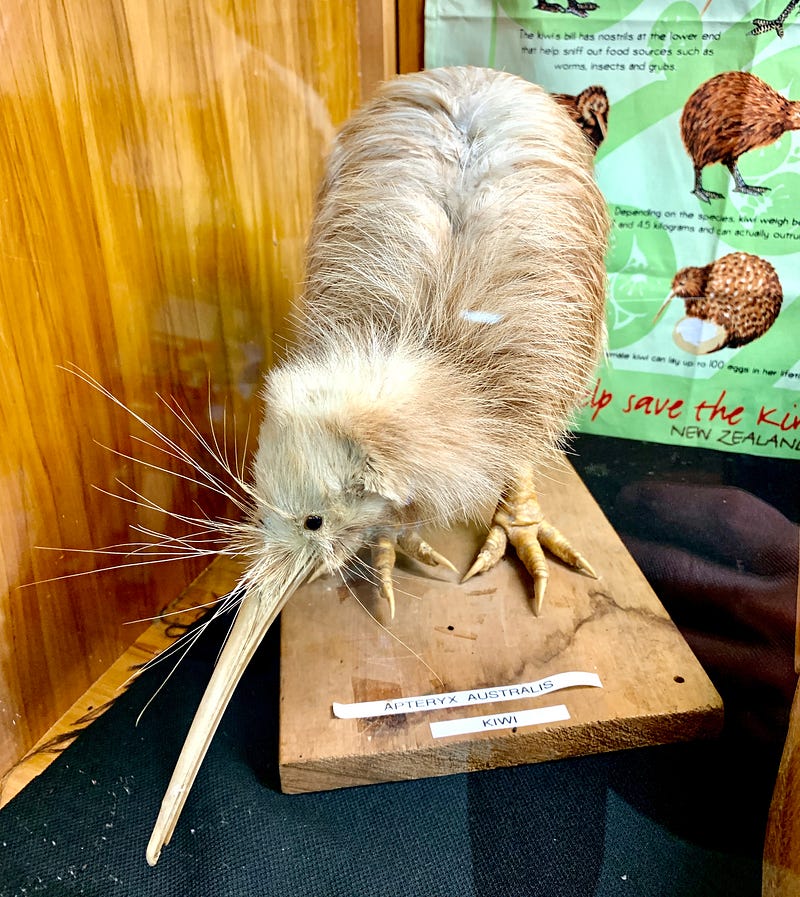
There is a perfectly rational explanation as to why we travel with endangered birds in our car. It all started with the kiwi.
Teresa (my beloved spouse) and I were enamored with kiwis from the get-go of our New Zealand trip. When we arrived in Russell, a lush, tiny town in the remote north of the North Island, we discovered kiwis lived in the brush surrounding our cottage. Every night we could hear them calling. You could say, they had us at “Ahhhhhhhah! Ahhhhhhhah! Ahhhhhhah!”
The call of the female kiwi is very like the battle cry you might unleash if you were a Viking shield maiden attacking dire enemies in combat. The shriek gets louder and rises in pitch at the end of each call. Try it right now, as loud as you can, but only if there’s nobody in earshot likely to report you to the police.
At first, it was downright freaky to hear this sound right off our deck. Once we realized what it was, and could imagine these adorable, hairy-feathered birds stalking in our grounds at night, we began to enjoy the terrifying sound — though we pitied the hapless males! If that’s the call female kiwis make when they are feeling amorous, what must they sound like when they are angry?
Teresa claimed she spotted a kiwi on the road our very first evening in Russell. I was skeptical. Kiwis are rare, and they are not the only flightless birds in Russell. Pūkeko (swamp hens) and Weka (wood hens) abound in the area, and they are about the same size as kiwis — as big as a chicken. I found those other birds were everywhere when I went for a walk at dusk.
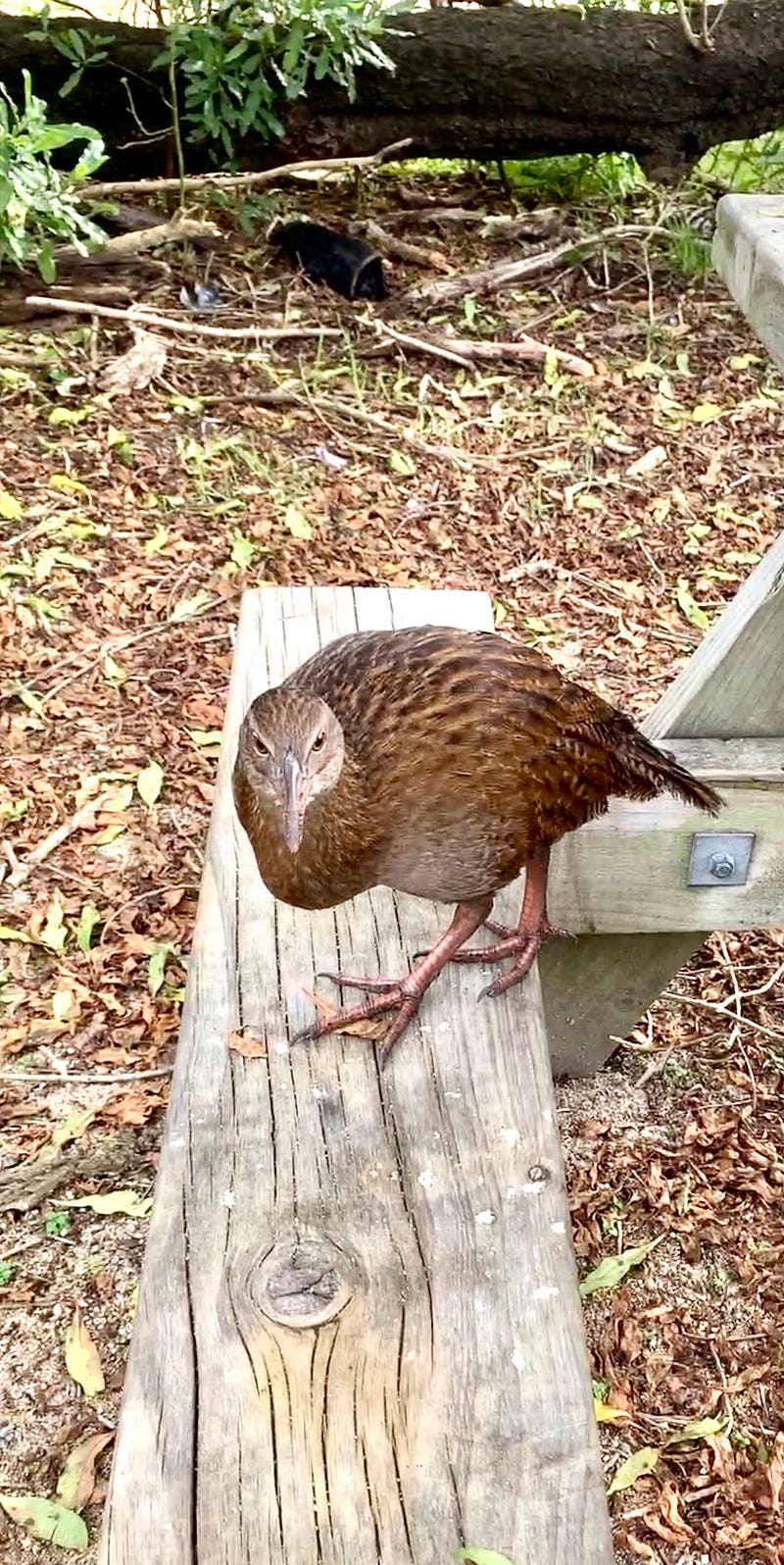
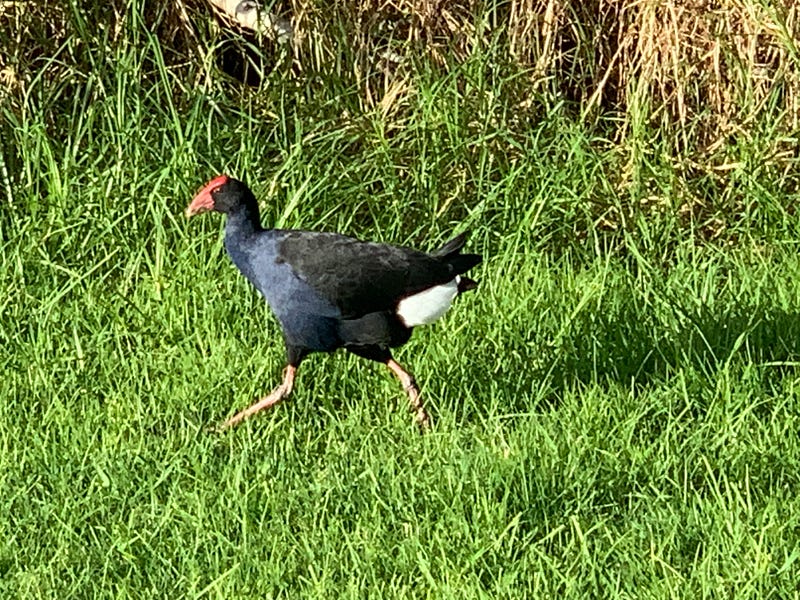
But Teresa was adamant: “It walked like a kiwi.”
“Oh, so you know how a kiwi walks?”
“They have a very distinctive walk. They scooch their butts.”
“Is that the ornithological term for it?”
Teresa tilted her head to the side, those big brown eyes flashing, and spoke to me in a tone of mild surprise.
“Tim, you mistakenly seem to think I give a rat’s ass about whether or not you believe me. I know what I saw, and I saw a kiwi. It scooched its butt.”
Did I mention that Teresa is the most self-referenced person I know? It’s part of her charm, I tell myself.
Two weeks later, in Rotorua, I visited a kiwi conservation and recovery center which features a darkened enclosure where one can view kiwis behind glass. They also run a hatching and rearing operation that cares for kiwi chicks and returns them to the wild when they are big enough to fight off predators (stoats, rats, cats, and possums only eat the eggs and chicks). A grown kiwi might look adorable, but its clawed feet and strong legs make it a fierce fighter. Kiwi egg recovery programs take eggs from the wild, raise the chicks then release them when they are big enough to fend for themselves. This boosts their odds of survival from less that 5% to 65%.
Fun Kiwi Facts:
- Kiwis lay the largest egg of all birds — proportional to their body size: about 6 times as big as a chicken egg, and one-third as big as a female kiwi. Ouch! Once she lays her massive egg, the mama kiwi’s job is done. The male kiwi does all the incubating.
- The kiwi’s egg contains almost twice as much yolk as other eggs, nuroushing the growing chicks so well that they hatch fully feathered and independent.
- Soon after hatching, the young kiwi leaves the nest. There’s virtually no parenting or protection, since the kiwi evolved in a land with no natural predators.
- Kiwi feathers are long and hair-like, and they extrude a pungent oil to cover the feathers to keep them clean as they hunt insects on the forest floor. Unfortunately, that strong smell makes them easy to find for introduced mammalian predators like stoats, cats and dogs.
Teresa declined to join me on the kiwi tour (“I don’t need to see another kiwi”), which is too bad, because she probably would have enjoyed the look on my face as I watched a little kiwi run about the dimly lit enclosure. It scooched its butt. There’s no other word to express it.
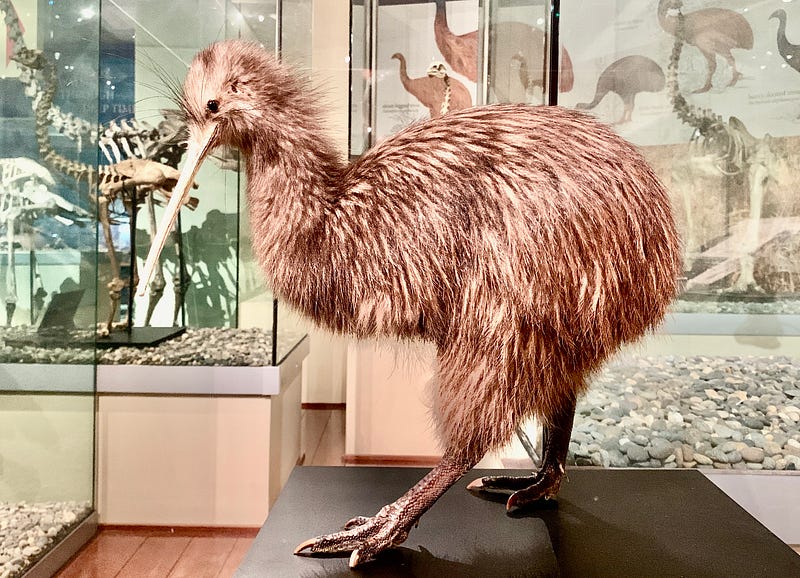
As the established kiwi expert on our team, Teresa found a way to bring her knowledge to bear as we drove across the North Island. She doesn’t like to drive on the wrong side of the road, and so she co-pilots. Part of her job is to keep me awake if I get drowsy behind the wheel. Her imitation of a female kiwi proved a highly effective technique. It jolted me upright better than a Red Bull. She would also shriek like a kiwi if we passed a road sign warning of danger ahead.
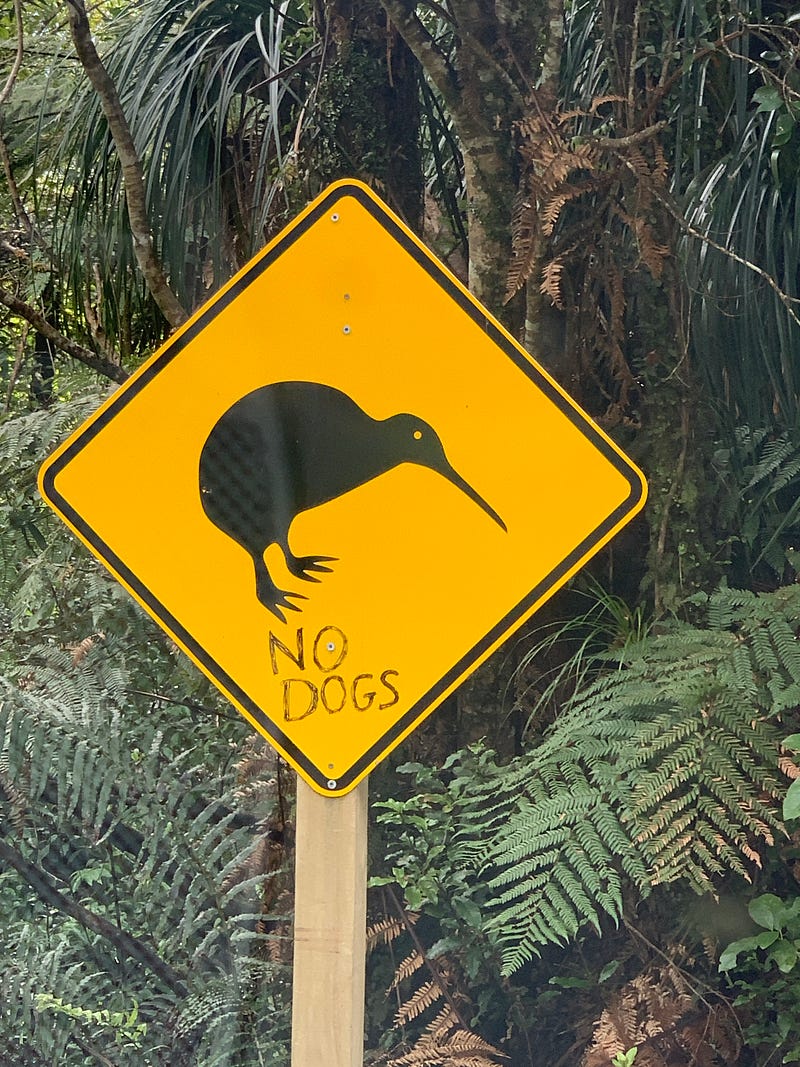
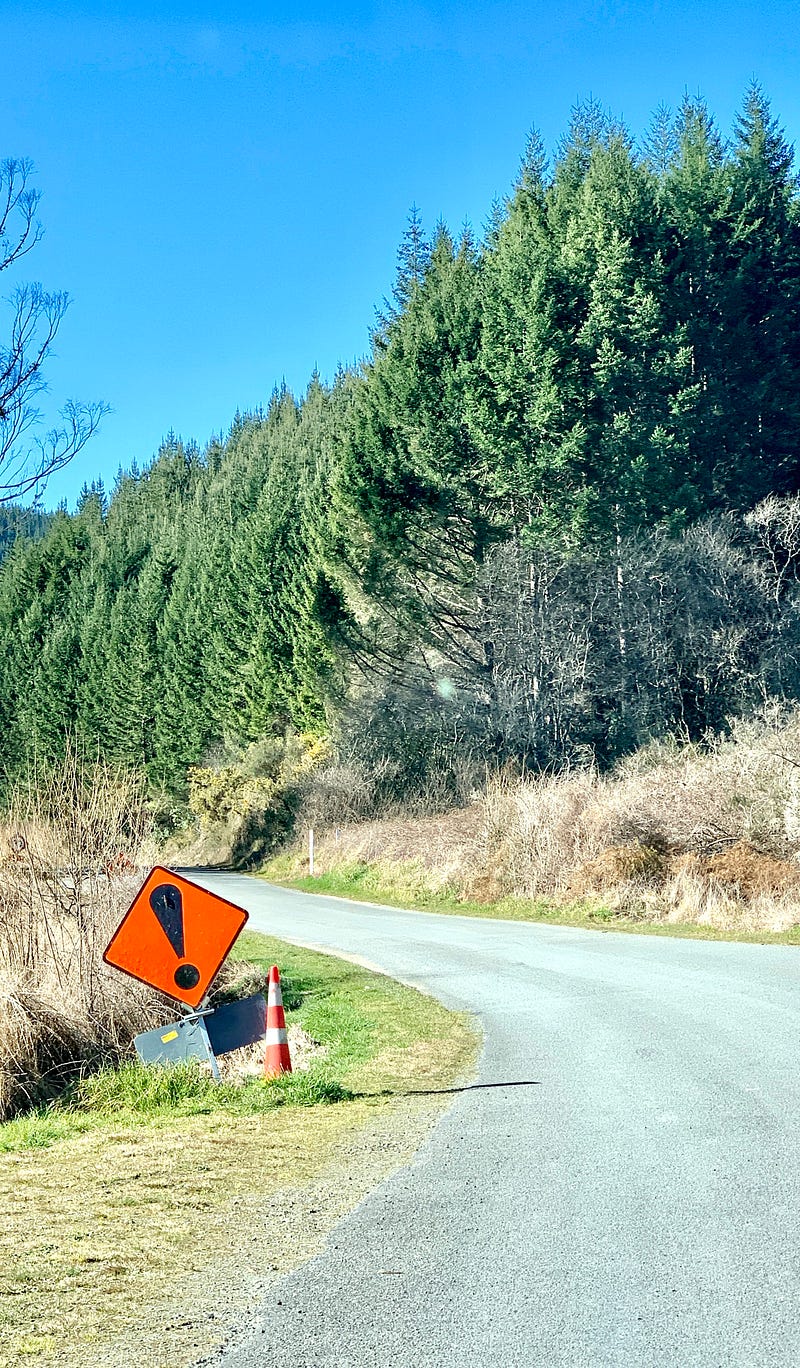
This was hilarious at first, but it really did spike my cortisol levels. It was stressing me out so much I pleaded with her to please go back to poking me in the ribs to keep me alert at the wheel. Not long after that, at a gift shop in Wellington, we found a bin full of little stuffed kiwis that shrieked if you squeezed them. It was a very chirpy, kid-friendly version of a kiwi shriek. And so we bought one and put it to work in our car. On passing a danger sign, Teresa would simply squeeze the kiwi and its happy squeak would keep me focused.
Okay, so that explains the kiwi — but what about the parrot?
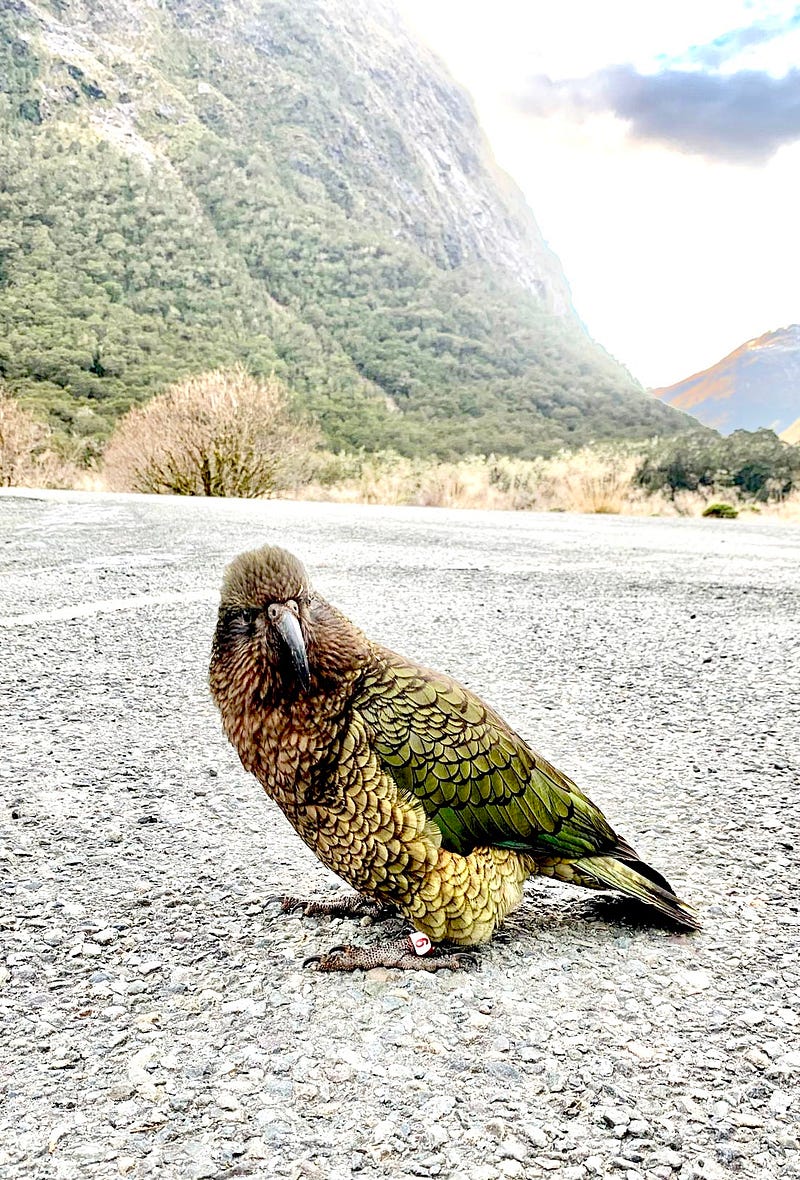
We grew quite fond of our kiwi, so fond that we felt neglectful when we left it in the car overnight. Then, at Milford Sound, we encountered our first kea. Kea are olive-brown alpine parrots as big as ravens. They are widely considered one of the most intelligent creatures in the whole animal kingdom. They are excellent problem solvers, voraciously curious, and according to researchers, have the intelligence of a four-year-old child.
They are also wantonly destructive. They’ve been known to strip the rubber edges off car windshield wipers and can destroy a running shoe in ten minutes. A kayaking guide in Milford Sound told me sometimes a dozen or more kea will descend on the kayak operations, shredding their tarps, tearing bits of gear off the boats, really just for the hell of it, like a gang of juvenile delinquents.
Fun Kea Facts:
- Experiments on kea show they are capable of solving the kinds of complex problems only great apes (like us) can manage, for example, applying principles of probability.
- Though kea can fly, they spend most of their time walking (perhaps that’s why I like them?). They also nest on the ground — this makes them easy prey for stoats and feral cats.
- There’s no accurate count of how many kea are left, because they live in wild remote habitats — dense beech forests and steep mountain slopes — where it is difficult for researchers to get to. 3,000–7,000 is the estimate.
- There used to be a bounty on them. Kea were the scourge of sheep farmers because they would sit on top of sheep and peck at the fat in their backs. Ugh. The sheep would get infections and die.
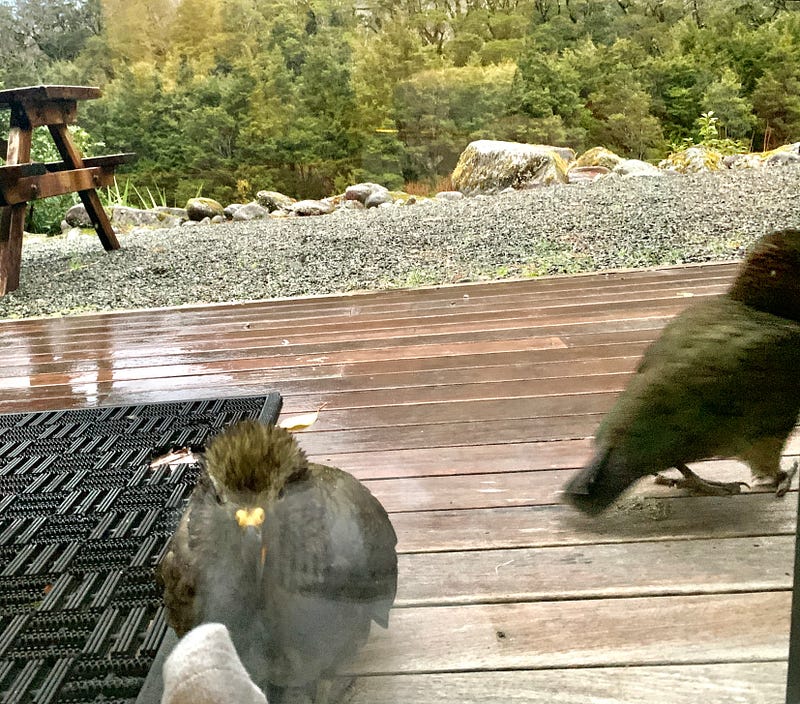
Two kea sauntered across our cottage deck in Milford Sound, coming right up the sliding glass door. I have no doubt they would have strolled right on in if the door was open. They have no fear of humans. Imagine a pair of feral four-year-olds with wire cutters for teeth peering in at you! One looked right at me and then kept tapping its beak at my foot on the other side of the glass. Did it think my white sock was food? Was it just playing a game with me? I just loved that brave and feisty little bird.
“Timothy — Do not open that sliding door!” Teresa said severely.
She seldom uses my full name, invoking childhood memories of my mother when she was severely serious and there was to be no clowning around. It’s very effective. I suggested we take the kea with us in the car to keep our kiwi company, but Teresa would not play that little game with me. The kea soon got bored and wandered off to join its mate.
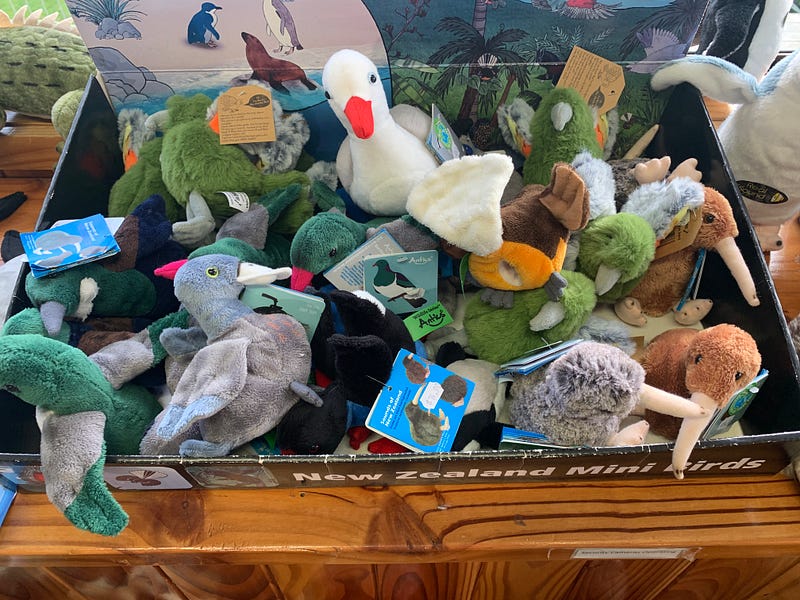
However, the next day, at a Department of Conservation gift shop we encountered a bin filled with all the stuffed wild birds of New Zealand, each with its own call when you squeezed it, including of course, a kea.
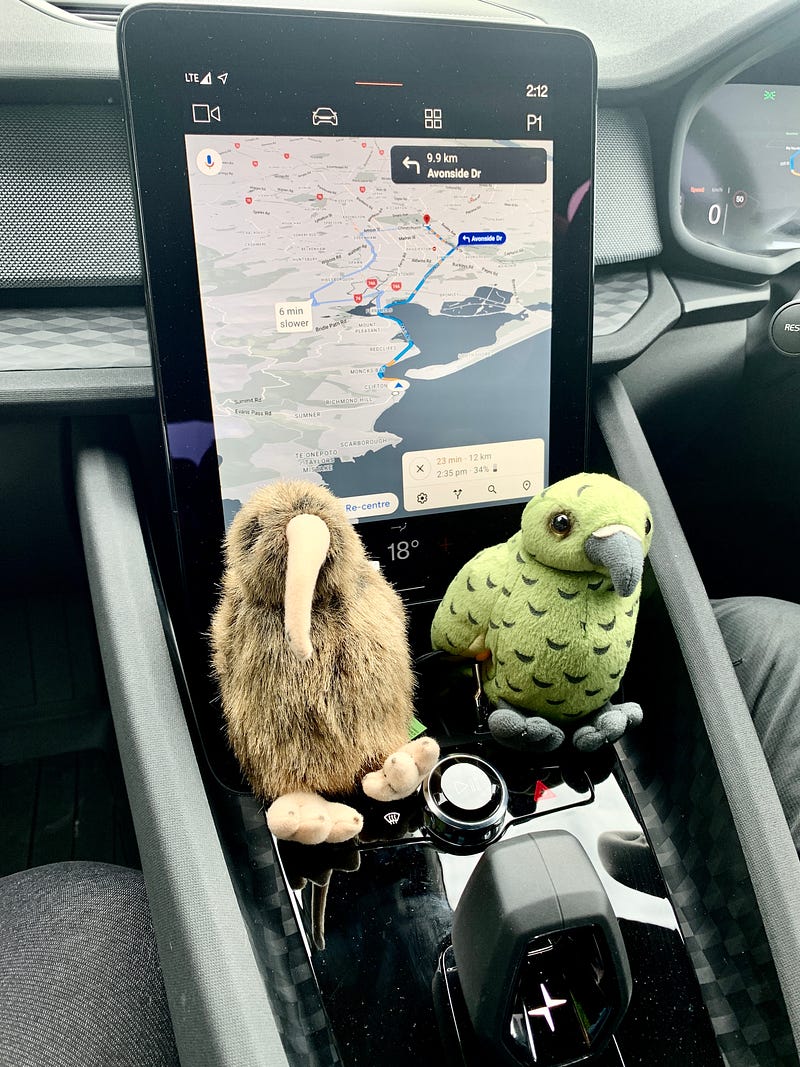
So now, our kiwi has a friend, and they travel together with us in the console of our spiffy Polestar 2, between the front seats. We squeeze them hello in the morning, and whenever something exciting happens — plus of course, the kiwi still shrieks to keep me alert when there’s danger on the road ahead.
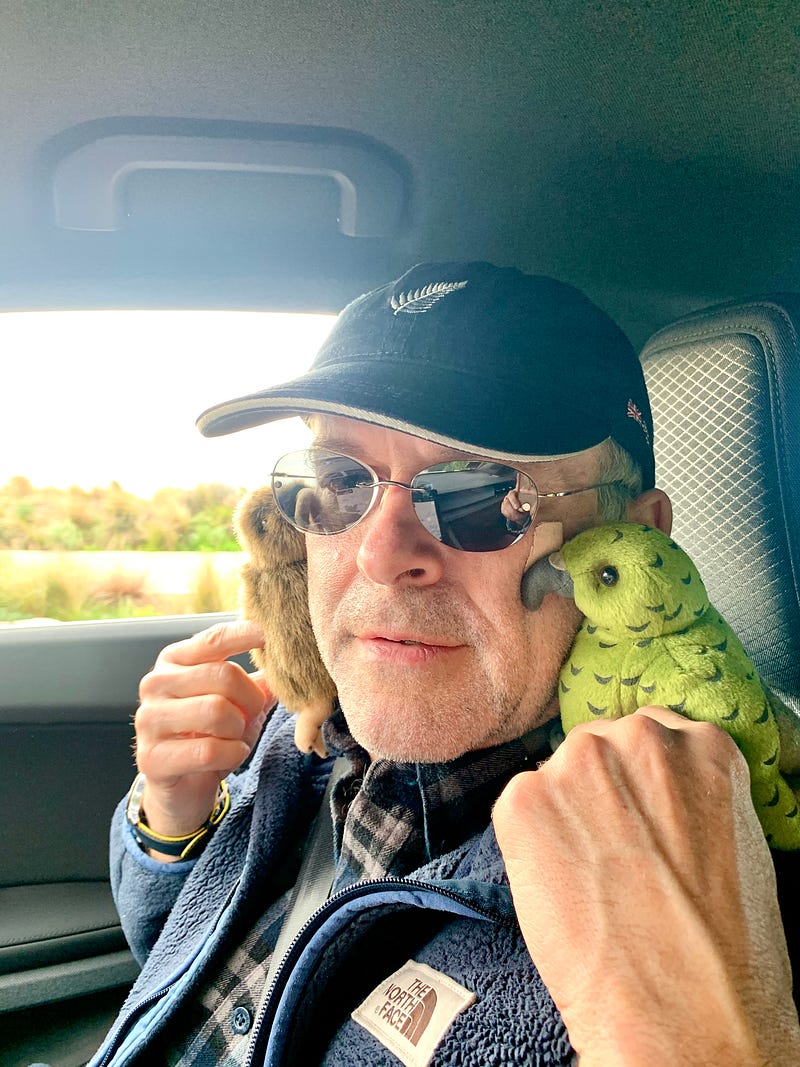
It is all we can do not to buy more of them…a little blue penguin? A tūi? A kakapo? But we know, that way madness lies. If we buy one more, we will have opened the floodgates to the whole menagerie. How would we explain at customs that we are traveling with a suitcase full of endangered New Zealand birds?
***
I’ve been inspired on wildlife encounters by Brad Yonaka and the tale of his up-close and personal encounter with Mountain Gorillas. Getting there was definitely not half the fun.
And, of course, by Kim Baker, and her story about what travellers can learn from the wisdom of birds.
Please remember to check out my new travel book: Mature Flâneur: Slow Travel Through Portugal, France, Italy and Norway:


