
Why We Need Parents to Stop Posting Their Children Online
The movement inspired by Wren Eleanor, the 3-year-old influencer, should be a wake-up call
A TikTok mom has stirred quite a controversy lately, with many calling her out for exploiting her 3-year-old daughter Wren Eleanor.
Wren has a huge following of 17.3 million people on TikTok. Her clips are adorable — she plays with dolls, snuggles with stuffed animals, poses in different outfits, and does girlie stuff with her mom.
But then a Tiktok mom noticed that some of Wren’s videos were being saved by other users in large numbers.
Video of her wearing a cropped shirt was saved more than 45,000 times. One of her eating a hotdog, 345,000 times. A video of her washing her hair in a tub, 60,000 times.
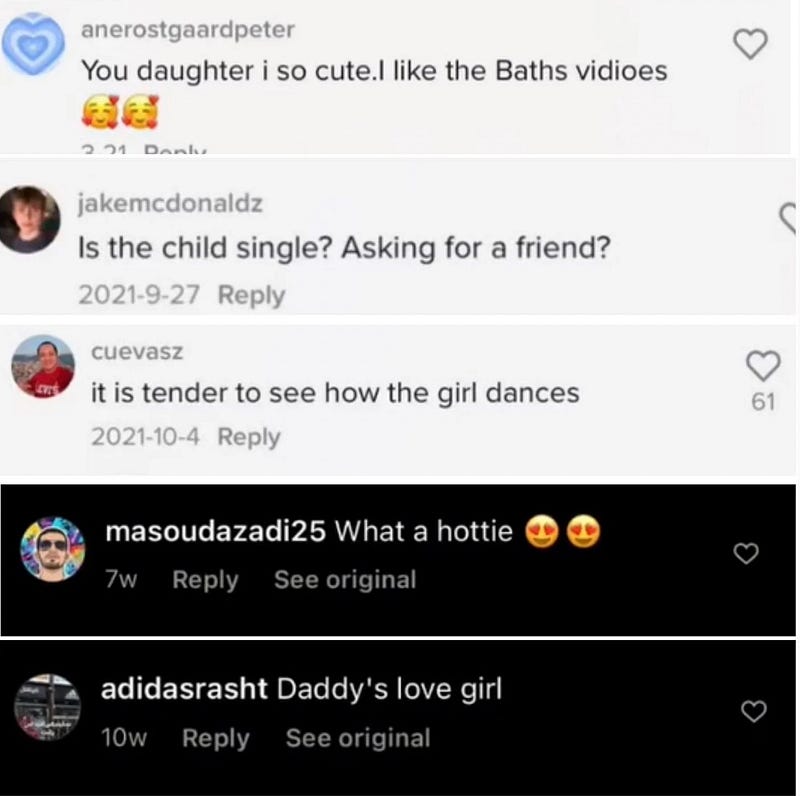
And there were disturbingly inappropriate comments like these:
It gets worse.
Grown men are creating duets (videos of themselves reacting to another post) with videos of Wren. I won’t post an example because it’s creepy.
This ignited an Internet storm with people, especially moms, advocating for Wren on Reddit and elsewhere.
It has also created a movement of moms vowing to keep their children’s photos and videos off social media.
But this situation is just part of a bigger problem that exists on the Internet — the exploitation of children and the invasion of their privacy by parents blinded by the lure of social media.
What kind of consequences does that have on a child? Why are parents still allowed to post content of their children who can’t consent?
The lure of social media blinds us
People are like zombies when it comes to social media, leaving a long digital trail of personal information of their whereabouts, what they did, where they went, and whom they met.
And they drag their children into the limelight. Children who are too little to consent, doing kid things, and trusting their parents to keep them safe.
I’m reminded of the teenage daughter of actress Gwyneth Paltrow. In 2019, she criticized her mom for sharing a picture of her on Instagram without her consent.
She commented: “Mom we have discussed this. You may not post anything without my consent.”
Paltrow replied: “You can’t even see your face!” Her daughter had ski goggles on.
Ski goggles or not, I’d say her daughter had the right to not have her image shared with her mom’s 5.3 million followers.
I used to post stuff online too until I moved to Europe. My husband rubbed off on me. He’s super cautious about his privacy — it’s a German thing.
When we had our son three years ago, it was a given that we wouldn’t post any of his pictures and videos online. Why would we when we can share him privately with our friends and family?
And they know that posting any pictures or videos of our family on social media is off-limits. We’ve made that very clear. If anyone does, they’ll be banned from seeing our son.
Today’s children grow up with their entire childhood — from the ultrasound photo to their graduation — documented on Facebook, Instagram, TikTok, Twitter, and YouTube by their parents.
It’s become normalized.
We’ll never allow an adult sitting on a park bench to film our child and showcase that to the whole world. But, that’s what’s happening; the only difference is it’s on a computer display.
It doesn’t help that it’s enabled by the public giving a standing ovation with likes, shares, and comments. Validation is an enticing drug. It gives a false sense of security and safety.
We serve our children on a platter for anyone to consume — that’s the kind of society we’ve created for our children.
Social media is a paradise for child predators
TikTok is supposedly restricted to those aged 13 and over, but the majority of US-based TikTok users are 10–19. That’s because to get into the app, all you have to do is lie about your age.
This makes it a sweet hunting spot for child predators.
And TikTok operates in over 150 countries. So, when parents post pictures and videos of their children online, it travels halfway around the world into the hands of strangers, including child predators.
All they have to do is wait for a parent to post a video of their little girl eating a pickle, washing her hair, splashing a water balloon, posing in adult’s clothing, showing off her big, blue eyes — types of videos Wren’s mom, Jacqueline, posted on her Instagram.
These seemingly innocent posts are not so innocent for pedophiles.
The Children’s Online Privacy Protection Rule (COPPA) enacted in 1998 protects children online. It forbids data collection from children under 13 unless the parents consent.
But that’s useless when it’s the parents putting their children at risk.
Recently, Jacqueline posted a statement saying she will disable the download and duet function on all her social media posts.
I’m glad she’s trying to keep her daughter safe, but she’s naive if she thinks that’s going to be enough.
It’s like putting a fence around a children’s park to ensure pedophiles can’t film your child. He can poke a hole, zoom in, or blend in.
Likewise, anyone can just record Wren’s videos with screen-grabbing software regardless of whether TikTok’s download features are active or not.
The bottom line is that by posting your child on social media for all the world to see, you’re providing endless sexual entertainment for child predators without meaning to.
Wren’s mother says that law enforcement officers and the FBI have confirmed there is no evidence of Wren surfacing on pornographic sites.
But she’s already been subjected to guys drooling over her and sharing her on who knows where. And there’s still plenty of time for her to surface on pornographic sites.
We won’t solve this issue by saying don’t interfere with another parent’s decision about their children
I understand why Jacqueline doesn’t want to give up TikTok.
She’s a single, stay-at-home mom trying to provide for her child. I don’t think she went in hoping to be a poster mom for what not to do on social media.
But are money and fame important enough to risk your child? Ten years from now when Wren is 13, how would she feel about her mom using her without her consent?
France has already started the ball rolling. Parents can be sued by their children for posting photos of them without consent with a penalty of one year in prison and a fine of $45,843.
But the laws elsewhere, including the US, haven’t caught up.
For every Jacquelines, there are thousands of wannabes hoping to make it big by shoving cameras on their children’s faces and using their play time for that viral shot.
Until we get to a place in our society where children’s privacy is valued and respected, child predators will continue to look for them on social media.
And when parents finally say enough is enough, our world will be a safer place for our children.
P.S. A new legislation has been proposed to protect child actors in social media. It’s not a law yet, but definitely a good start.


