
What You May Be Missing When You Go Outdoors
And how to get it — Part 1
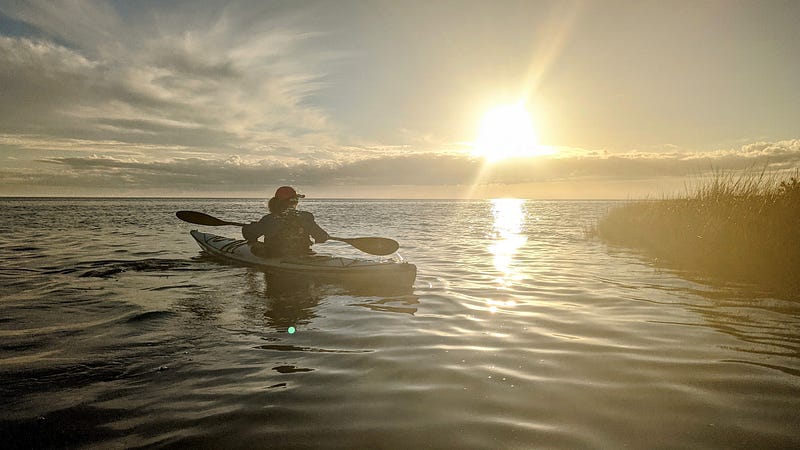
As an outdoor trip leader, I sometimes feel that something is missing. Not for myself but for my clients. We spend a day together, exploring gorgeous shorelines by kayak. They seem to enjoy the trip. They are all smiles as they depart. They thank me profusely and leave a generous tip. Yet the vague feeling remains: they didn’t get everything I wanted them to. They didn’t get the full experience.
What may be missing
What were they missing, and how could I help them get it? I thought more about these questions, as my partner and I returned from Penobscot River Trails, a network of world-class nordic ski trails in the wilds of northern Maine. The guestbook there indicates that many who visit, travel two-plus hours to do so, just as we did. Typically, on a winter weekend, the parking lot is full.
What compels people to spend 25 percent of their Saturday or Sunday in a vehicle? Couldn’t they have gotten an equivalent workout on a stationary bike at home? Wouldn’t it have been easier to get their outdoor time by walking around their neighborhood? Couldn’t they have satisfied their appetite for natural beauty by watching a nature show on a wide-screen tv? If so, what then, had they come for?
We’ve probably known the answer all along. But we don’t talk about it often because, well, it makes us feel a little hokey. Kind of like a group hug.
Ask a skier why they love to ski. Ask a fly fisherman why they love to fish. “Because it helps me access the spiritual part of my brain,” won’t likely be the first thing to trip off their tongues.
But, truly, even though they may never say it, most likely, that’s why they’re there.
If recent brain/nature research has it right, the highest value nature gives is to help us shift to a broader, deeper, more spiritual form of consciousness.
There, I said it. But before that, science said it. Before that, Emerson. And before that, all those cats through history who headed out into the wilderness for spiritual enlightenment.
Don’t run away. Lots of people are uncomfortable talking about spirituality. (I feel tempted to run also, just so you know.) But, we’re not talking religion here and we’re not talking hocus pocus. It’s simply about accessing a part of your brain that normally lies latent. It’s about a shift in perspective that helps you see the world closer to the way it really is.
Psychologist, educator, and author of The Awakened Brain, Lisa Miller has done extensive research on the neuroscience of spirituality. Miller found that experiences in nature engage the same region of the brain that is activated by more traditional–i.e. “religious” — spiritual experiences. Miller adds that we are all hard-wired for this type of experience. She also found that opening our senses when out in nature is key to accessing this otherwise little-used part of the brain.
In a different but somewhat parallel arena, the relatively new science of awe offers insight into how time in nature affects consciousness. A key tenet of awe science is that awe can produce a shift in consciousness. In the words of a Berkley study, “Awe experiences are self-transcendent. They shift our attention away from ourselves, make us feel like we are part of something greater than ourselves, and make us more generous toward others.”
If that’s not spiritual, then I don’t know what is.
The science of flow, the science of awe, the recent brain/nature research, and the work of Lisa Miller all offer insights into the consciousness shift that can occur when we spend time out in nature. These theories also overlap in important ways.
Based on my reading, my experience, and the question I started with, I have been thinking about how experiences variously described as absorption, connection, flow, and awe can each be pathways to deepened consciousness.
As I think about these experiences, it occurs to me that, by happy coincidence, Penobscot River Trails is the complete package in terms of promoting a shift to a broader, deeper, more spiritual form of consciousness.
“Awe experiences are self-transcendent. They shift our attention away from ourselves, make us feel like we are part of something greater than ourselves, and make us more generous toward others.”
Absorption, Connection, Flow, & Awe
With its undulating hills and flats, sun and shade, and vistas of woods and river, the visual variety of the main (“Riverside”) trail wakes up the senses. Enjoy that stream of visual beauty long enough and you no longer have to willfully pay attention to it. Instead, it draws you in and holds your attention. As you get farther out the trail, your inner monolog is hushed. You are hearing the chickadees, smelling the balsam, and seeing the interplay of sun and shadow on the snow. That’s your dose of absorption.
The trail system is linear. None of the trails are more than a half-mile from the river and they all connect back to it. The river is your companion, helping to unify the experience. The trail system is extensive enough to provide moments of solitude. In counterpoint to that are the smiling faces of other skiers — and the sense of camaraderie in the brief passings. You’ve all come to love this beautiful place. The warming “huts” you stop at are spacious, comfortable, and have stunning views. As the recipient of such hospitality, it’s easy to feel a generous spirit toward others. It’s all a happy feedback loop, as immersion in nature is shown to foster an increased closeness to nature and to people. Served up fresh, a big serving of connection.
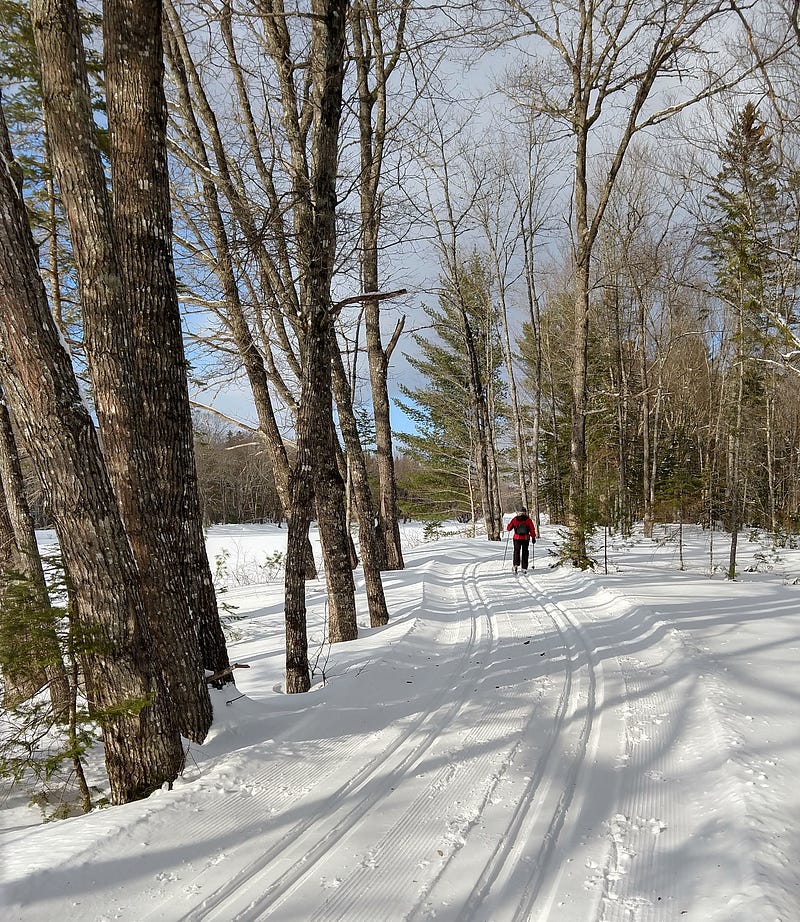
The groomed ski tracks and the scarcity of trail intersections minimize the need to stop and look at a map. The decision-making part of the brain doesn’t need to engage. You put your skis in the track and go, and keep going. The kinesthetic rhythm of skiing is a sensation you are paying attention to. You work to get maximum glide from each stride — and then, once you have found your groove, your body knows what to do, and your frontal lobe no longer needs to think about it. Kick and glide, pole and release. You feel like you could do this forever and would wish to be nowhere else. This is your ticket to flow.
If you ski far enough and if the weather is clear, you are treated to views of snow-capped Mount Katahdin. At Pines & Ridges Warming Hut, you get a magnificent but still partial view. Another five miles out the trail, near Trails End, at the Long Meadow Warming Hut, you get a breath-taking view of Maine’s highest mountain, a pinnacle of rock and snow reaching up to where nothing but clouds should be. Vast and beautiful, it commands your attention and helps you see the truth about your place in the big scheme of things. This is your invitation to awe.
Adding it up, this trail beside a river stimulates your senses, helps you feel connected, promotes a sense of flow, and provides an experience of awe. All the pathways to a consciousness shift are present. The trail system was not designed by brain scientists, but — it seems — brain scientists could not have designed it better.
What can prevent us from getting it
Back to my question at the top of this story. After spending a day paddling a gorgeous coastline, why do some of my tour guests not experience these beneficial consciousness shifts?
Why do I not always experience it myself?
Being out in nature, unfortunately, doesn’t automatically get us into the “awakened” brain state Miller talks about. Unfortunately, we don’t walk out the door and instantly experience feelings of absorption, connection, flow, and awe. Extending our stay to several hours doesn’t guarantee anything either.
Chances are that you remember very little from your last commute to work, to the store, or to wherever you go regularly. Our brains are good at functioning on autopilot, freeing up our conscious minds to think about other stuff. And think about other stuff we do. As humans, that is our superpower.
If asked what you remember from your last walk in the woods, you might give the same answer — very little. Again, this is not because there was nothing to see, but because inner monolog (what Miller calls the rumination box) sucks up all our bandwidth.
Our brains process a limited amount of information at a time. If we think about the past or the future, the features of the present go unnoticed. It’s as simple as that.
We open a physical door to go outdoors. But if we don’t actively give attention to our senses, the doorways of our minds remain closed. In particular, these are some of the culprits that get between us and the full experience of nature: –anxiety, worry, and stress –physical discomfort –distractions (yes, your phone is one of them) –multi-tasking –conversation other than about the present moment –the inner monolog
The downside of inner thinking is that we miss stuff out there in the world. Including the present. Including natural beauty.
We also miss out on more than that. When we’re reminded, “Stop and smell the roses,” it’s not just the smell of the roses that’s important. It’s the opening of our senses to trigger that shift in consciousness.
So, do stop, and do inhale the scents of the world. When we do this, we gain a chance to experience absorption, connection, flow, and awe. We gain the opportunity to be drawn into a broader, deeper, more spiritual way of being.
Click here or the link below to read Part 2:


