
Why We Can’t Jump from Sad To Happy
And a powerful tool we can use in the meantime

We live in a happiness culture. We strive to be happy every day.
If we’re not happy, we’ve failed. We’re meant to be happy all the time, right?
From a young age, we’re taught that certain emotions like sadness are bad. If it doesn’t feel good, it can’t be good. But these so-called “negative” emotions have benefits too. I’ve discussed the benefits of sadness in another article, How to be Sad. We need to feel emotions to process them.
When we try to push our “negative” emotions away, they stick with us longer. I spent years thinking that if I just had enough control over my mind, I could flip from being sad to happy.
That’s what all the happiness books say, common idioms like, “life is 10% of what happens and 90% of how you react to it”. But without context, it comes across as “think happy, be happy”. If we react by feeling sad, laying on the couch with blankets over our heads, we’ve messed up. If we could just change our mindset, everything would be good.
And while we can get back to the happy level, it’s not a leap, but more like micro-steps. How can we expect to get from sad to happy if we don’t know the emotions between them?
The Emotional Guidance Scale
In Ask and It is Given, Esther and Jeremy Hicks introduce the Abraham-Hicks Emotional Guidance Scale. It’s a gentler way to approach our emotions. It asks us to look at what emotion we’re currently at, and where we’d like to be. Seeing all the emotions in between gives us a clear idea of the amount of work there is. We can’t jump from sad to happy without processing the emotions in between. When we try, it makes things worse because we’re suppressing our emotions.
The idea is that we can move up along the scale to higher emotions in baby steps.
- Joy/Appreciation/Empowerment/Freedom/Love
- Passion
- Enthusiasm/Eagerness/Happiness
- Positive Expectation/Belief
- Optimism
- Hopefulness
- Contentment
- Boredom
- Pessimism
- Frustration/Irritation/Impatience
- Overwhelment (feeling overwhelmed)
- Disappointment
- Doubt
- Worry
- Blame
- Discouragement
- Anger
- Revenge
- Hatred/Rage
- Jealousy
- Insecurity/Guilt/Unworthiness
- Fear/Grief/Desperation/Despair/Powerlessness
The Emotional World Wheel
One of the flaws of the Abraham-Hicks Emotional Scale is that it doesn’t include sadness, one of our core emotions. For that, we can look at the Emotional Word Wheel by Geoffrey Roberts to see what emotions fall under sadness.
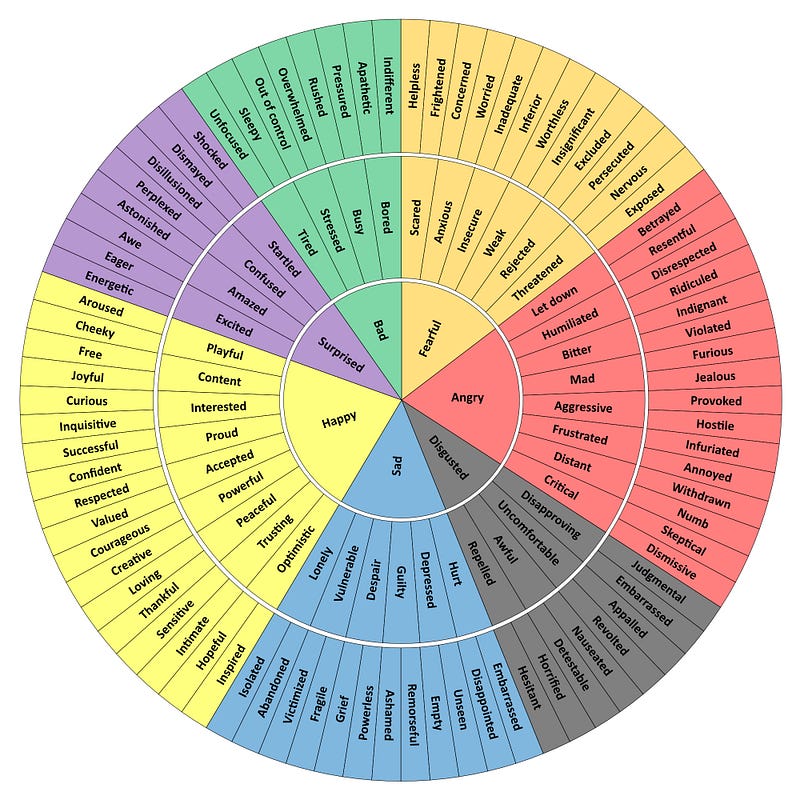
The numbers in parentheses indicate where the emotion lies on the Emotional Guidance Scale.
- Hurt — Disappointment falls under this /(#12)
- Depressed
- Guilty / (#21)
- Despair / (#22)
- Lonely
- Vulnerable
How to Use the Emotional Guidance Scale and Emotional Word Wheel
- Identify the emotion — if you don’t know, you can ask between a range, “Am I feeling blame or disappointment?” and see which emotion feels strongest. If none of the emotions on the scale resonate, look at the emotional wheel instead. Do what I did for sadness and find an emotion that you identify with and refer back to the emotional scale.
- Identify the emotion at the level above — if you feel sad, specifically disappointment (#12), you aren’t going to straight to happiness (#3). The next emotion would be overwhelmt (#11).
- Think of thoughts that give you relief — this might look like “I’m so disappointed that I didn’t get the job”, to “I’ve been so overwhelmed lately, I didn’t give my best interview.” Sometimes, this step is enough, if it isn’t proceed to steps 4 and 5.
- Ask yourself, “What can I do to get to the next level?” — If you’re going from disappointment (#12) to overhwhelmt (#11), look in your environment and see what’s affecting you. Is it financial stress, a messy home, or a busy schedule?
- Make a list and plot your steps in a calendar — Write down all the things that would make you feel less overwhelmed. Plot one thing to do per day on a calendar. Having one thing per day is more achievable and will help boost your confidence. You’ll feel less overwhelmed, making it easier to move up to the next level. I have a friend who puts easy things on her daily to-do list. Start easy and build up.
As you practice this, you will start to release resistance and move up the emotional scale. For small things, you might notice an improvement within minutes. It’s not always instant, depending on what’s happened, it could take longer.
Two Other Ways to Move up the Emotional Guidance Scale
In Ask and It is Given, Esther and Jeremy Hicks list 22 processes to move up the Emotional Guidance Scale. Each of their practices are designed for a specific range of emotions. I’ve included the number range in the practices below. While I personally wouldn’t do most of the processes they list, there are a couple that I find practical and have used before:
- (4–16) Ask yourself, “Wouldn’t it be nice if…?” — this changes our energy from negative to positive. It’s more light-hearted than, “I want/need this to happen,” which stems from a feeling of lack.
- (8–17) Identify what you want — When you’re in a negative place, you’re in a good position to figure out what you want because you’re experiencing what you don’t want. You could combine this with the process above, and ask yourself, “wouldn’t it be nice if…?”
What We Can Do in the Meantime
Deep-seat emotions are unlikely to release in a few hours. It may take weeks or months. Going from sad to happy can take a long time. So what can you do in the meantime?
I recently discovered an exercise called Release Writing. It’s a powerful tool that has helped me understand and process my emotions.
This is my version adapted from Expectation Hangover by Christine Hassler:
- Use pen and paper — this is important. The neural impulses from our fingers go to the brain. This is why writing can help to release emotions.
- Write down a list of things you want to release — some of mine are “forgiving certain family members”, “the need to feel successful”, and “emotions behind my temper.” If you don’t know what you want to release, skip this step and go to straight to step #4
- Pick one thing from your list that you want to release
- Write whatever comes to you — don’t stop to interpret it, just let it flow out. It doesn’t need to make sense. I naturally prompt myself to come up with solutions (e.g., to move on I need to…/my next step is…), this isn’t necessary to release the emotion, but I find it helpful
- Do it for 10 minutes every day — I’m not fussed if I miss a day, but regular practice makes it easier. Some emotions need to be “worked on” longer than others.
- When you’re finished, rip up the piece of paper and throw it away — Don’t re-read it either, otherwise, it will recycle the emotion rather than release it. If you hold onto the paper, the pattern will stay in your lower levels of consciousness.
At first, it was a little bit difficult. Sometimes it feels stupid and you don’t know what to say. But it’s one of those things that gets easier every time.
The Emotional Guidance Scale showed me that there are so many emotions between sadness and happiness. How can we expect to jump from one to the other? It gave me permission to take my time with my emotions and not feel guilty for not being able to flip the switch. Like most things in life, it’s a process.
With some time and patience, we have the ability to move up the emotional scale by releasing our emotions. We can go from sad to happy.