
Why We Call Him St. John Paul the Great
His successors describe the greatness we sensed 50 years earlier: “In the struggle between the spirit and power, the spirit proved stronger’’
The difference between a saint and a saint called “the Great?”
Pope Francis and Pope Emeritus Benedict both endorse something my little town sensed a half-century ago: history’s best-recognized saint should forever be called St. John Paul the Great.
To honor the May 18 centennial of John Paul’s birth, Pope Francis agreed to co-author a book called “John Paul the Great.’’ Benedict, a brilliant theologian, just mapped out why his predecessor should be called John Paul the Great.
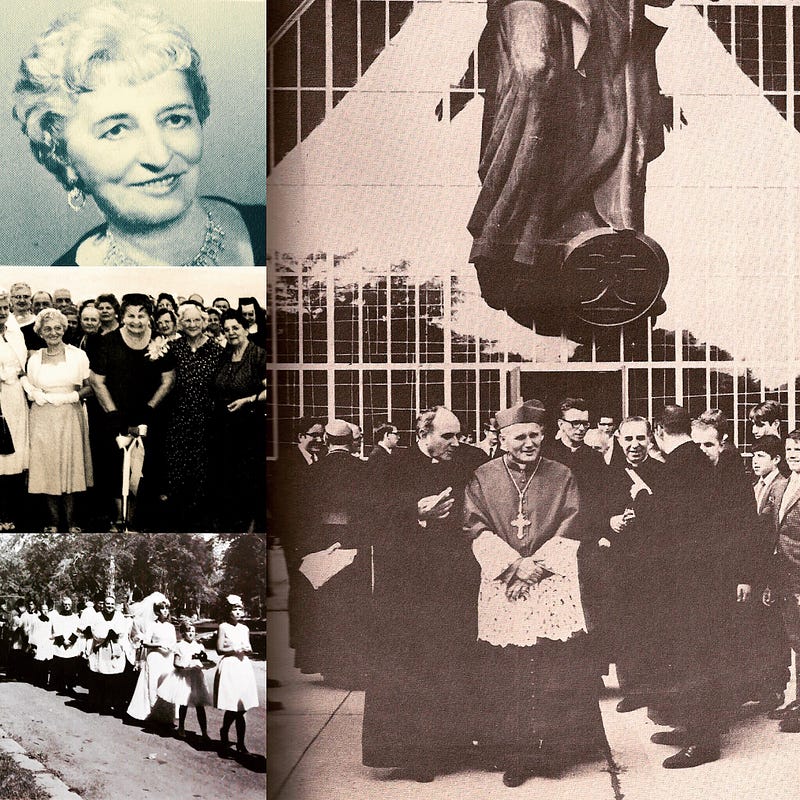
But the first Americans to host him during his inaugural visits to North America recognized John Paul’s greatness even in 1969 when he was a 49-year-old cardinal. My great-grandmother was part of those efforts. My father recalls taking this saint for a bite to eat.
They saw things. Many others did too. At age 22, my first “really big’’ story for the Chicago Tribune was writing about John Paul and his impact on our little Hamtramck, Michigan.
But Pope Benedict, who John Paul commissioned to write much of the Catechism of the Catholic Church, explains the distinctions with authority:
Definition of a saint and a saint called “the Great”
“A saint is the man who is open to God and permeated by God,” Benedict writes. A holy man is the one who leads away from himself and lets us see and recognize God.”
Defining the term “great,” is more challenging, Benedict adds, noting only two other popes have been called “the Great” in the past 2,000 years:
- Leo I (440–461) and Gregory I (590–604): “In the case of both, the word ‘great’ has a political connotation, but precisely because something of the mystery of God himself becomes visible through their political success.”
- “Through dialog, Leo the Great was able to convince Attila, the Prince of Huns, to spare Rome — the city of the Apostolic Princes Peter and Paul. Without weapons, without military or political power, through the power of his conviction for his faith, he was able to convince the feared tyrant to spare Rome. In the struggle between the Spirit and power, the Spirit proved stronger.”
- “Gregory I’s success was not as spectacular, but he was repeatedly able to protect Rome against the Lombard — here too, by opposing the spirit against power and winning the victory of the spirit.”
Benedict: The similarity between the greats is “unmistakable”
Leo the Great and Gregory the Great confronted the greatest dangers of their time while John Paul came of age at the epicenter of World War II and won the Cold War without firing a shot.
“If we compare both stories with that of John Paul II, the similarity is unmistakable,” Benedict explains. “John Paul II also had no military or political power. During the discussion about the future shape of Europe and Germany in February 1945, it was said that the pope’s reaction should also be taken into account.”
Soviet ruler Joseph Stalin then asked: “How many divisions does the Pope have?”
“Well, he had no available division,’’ Benedict continued. “However, the power of faith turned out to be a force that finally unhinged the Soviet power system in 1989 and made a new beginning possible. Undisputedly, the pope’s faith was an essential element in the collapse of the powers. And so, the greatness that appeared in Leo I and Gregory I is certainly also visible here.’’
Leaving “open the question of whether the epithet “the great” will prevail or not,’’ Benedict concluded, “It is true that God’s power and goodness have become visible to all of us in John Paul II. In a time when the Church is again suffering from the oppression of evil, he is for us a sign of hope and confidence.”
Pope Francis says of John Paul: “From Heaven, he continues to intercede for the People of God and peace in the world.”
“Today we can say that we live in a society where the Father is missing, a sense of being orphans that affects one’s belonging and fraternity,” Pope Francis said, adding the Holy Spirit connects us to the Father. “We ask the Holy Spirit to remind us always, always, of this access to the Father.”
During the early 1960s, John Paul and Benedict were young men deliberating over Vatican II. Benedict recalls: “The deliberations of the Council had been presented to the public as a dispute over the Faith itself, which seemed to deprive the Council of its infallible and unwavering sureness.’’
Those turning point years brought about the turbulent 1960s and uncertain 1970s where Benedict recalls, “This feeling that nothing was no longer certain, that everything was questioned.’’ St. Paul VI, John Paul’s predecessor, “faced ever more pressing problems that ultimately questioned the existence of the Church Herself.’’
When he became pope in 1978, John Paul faced “an impossible task,’’ Benedict said, “Yet, from the first moment on, John Paul II aroused new enthusiasm for Christ and his Church.’’
Pope Francis writes in the new book that John Paul always revealed his humanity and vulnerability, showing “every gesture of his, every word, every choice he made always had a much deeper value and left a mark.’’
The May 17, 2020, Sunday Gospel message on the eve of John Paul’s 100th birthday is Jesus telling His disciples:
“If you love me, you will keep my commandments. And I will ask the Father, and he will give you another Advocate to be with you always, the Spirit of truth, whom the world cannot accept, because it neither sees nor knows him. But you know him, because he remains with you, and will be in you. I will not leave you orphans; I will come to you. In a little while, the world will no longer see me, but you will see me because I live and you will live. On that day you will realize that I am in my Father and you are in me and I in you. Whoever has my commandments and observes them is the one who loves me. And whoever loves me will be loved by my Father, and I will love him and reveal myself to him.” (John, 14:15–21, NABRE)
The Holy Spirit reveals Jesus within you and Jesus within others
A newcomer immediately considered father? Soon after he arrived at Orchard Lake, he was declared “the Father of Orchard Lake.’’
Read the original words of the people who met John Paul at Orchard Lake at the time they met him in 1969, and they already saw this 49-year-old cardinal from Poland becoming How did they know? How could they even imagine?
Perhaps because, as Jesus told His disciples, John Paul allowed himself to be filled with the Holy Spirit, knowing, “In a little while, the world will no longer see me, but you will see me because I live and you will live… I am in my Father, and you are in me and I in you… whoever loves me will be loved by my Father, and I will love him and reveal myself to him.’’
Look at the photo above of John Paul in 1969 and note he appears to “pop-out.’’ People were always drawn to him because they sensed Jesus and the Holy Spirit within John Paul.
His joy, the Spirit, the intellect of a well-educated mystic, and the purity of a child. Together, all these features made him “Christ-like.’’ Watch the video below, and it’s clear that even small children sensed John Paul’s Christ-like’’ qualities drew people toward him.
By sensing his beautiful heart, we also sensed his truth and greatness.


