
He Always Drew Them Near: John Paul Bringing Crowds Back to the Revived Catholic Mass
“It was like seeing the face of Jesus Christ for the first time”
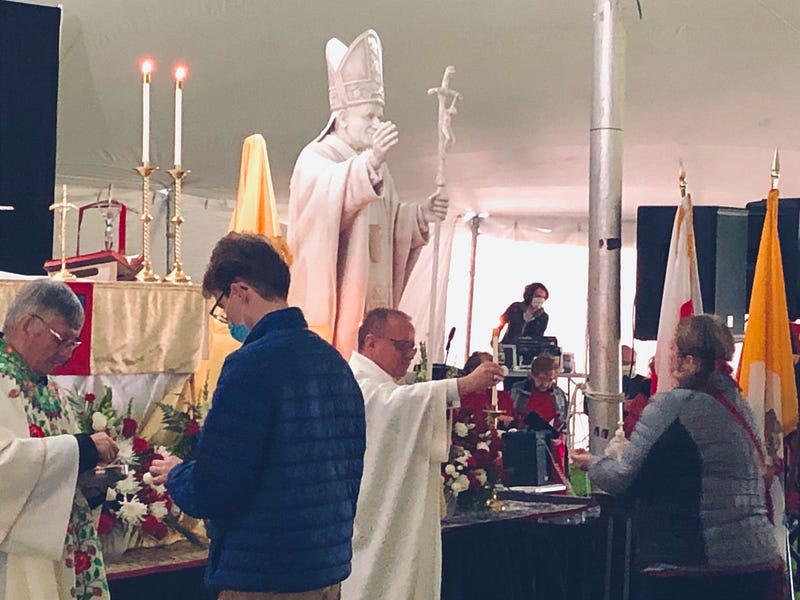
The Catholic Church, the largest family, reunited for the 100th anniversary of the birth of the father figure they knew best: St. John Paul the Great.
For two months, Catholics were isolated from the Eucharist, their churches, priests, and from each other. John Paul’s day ended the isolation.
“In the designs of Providence, there are no coincidences,’’ he taught us.
John Paul’s 100th birthday saw the return of a revived and social distant Mass with re-openings from Rome to tiny Orchard Lake, Michigan, both global hotbeds of coronavirus. Both spots were “homes’’ to John Paul. Both filled with hopeful news on his birthday:
- As Pope Francis celebrated a public Mass at John Paul’s tomb, Orchard Lake Chancellor Mirosław Król, himself a recovered coronavirus patient, celebrated a return of public Mass in a massive (yet socially distanced) tent of more than 500 faithful. Orchard Lake, which hosted John Paul during his first two North American visits, was his unofficial “home base’’ in America.
- Coronavirus cases in both Michigan and Rome continued to plunge with the Michigan governor announcing the reopening of parts of the state.
- Global markets soared for their best day in more than a month on news of promising vaccines and treatments.
- Pope Francis announced that the October Feast Day of St. Maria Faustina Kowalska was being added to the Church calendar. John Paul called the day he made Faustina a saint “the happiest day of my life.’’
- #ThankYouJohnPaul2 began trending on Twitter as people around the world celebrated the saint who led the Church from 1978–2005.
- John Paul’s biographer, George Weigel, said many of today’s bishops and priests continue to follow the first Polish pope’s example. “I am very impressed to the degree to which John Paul remains the model for bishops today.”
“I think it’s important now on this centenary not to look back on John Paul but to look forward through his eyes. For Catholics, in particular, to learn what he had to teach us and then to look forward through his eyes.’’
The first post-pandemic public Mass at the St. John Paul Shrine
Krol recalls celebrating his first Mass in John Paul’s private chapel read the Gospel as a young priest while “he looked at me intently.’’
“I will never forget his eyes looking at me,’’ Krol said. “That was the most powerful moment in my life. And I asked him after that Mass ‘Bless me Holy Father so that I will be a good priest.’’
More than 500 came out on a windy, rainy early evening as the Gospel described the unleashing of the Holy Spirit upon the world.
“Do you have the courage to reject other gods of our time?’’ Krol asked. “Evil is actively working, but we are filled with the truth of Jesus Christ. We have to say ‘no’ even to the kings of our times when they come and try to convince us that there is something more powerful, something more important than God. I hear the words of John Paul, ‘Be not afraid.’ Preach in good times but also in bad times.’’
He explained how John Paul’s parents are now themselves beginning the canonization process, noting his mother bravely chose to have him when doctors recommended an abortion to protect her own health. She decided to have him at age 36 and died when he was a boy.
This saint understood pandemics as well. His much older brother Edmund, a doctor born in 1906, died ministering to the sick in another epidemic, treating a scarlet fever patient when John Paul was 12. His father, Karol Senior, raised him, teaching him the faith until he too died, leaving the future pope orphaned at age 20.
“Read more and learn about this great man,’’ Krol said. “Pray to God to be more like John Paul the Great. All of us are sinners but we can work with the grace of God to become Holy. We are all called to be Holy.’’
On birthdays, Poles sing “Sto lat,’’ may you live 100 years. But Catholics know St. John Paul’s lessons are timeless.
Typically, bishops rise to the papacy at an advanced age. John Paul’s successor, Pope Benedict, became pope in 2005 at age 78 while Pope Francis, now 76, became pope at age 69.
But John Paul’s life is unique, becoming the world’s youngest cardinal at age 47 and rising to the papacy at 58. Over the next 27 years, he encountered more people through live audiences than anyone in history.
We saw him in his prime and also watched him age and suffer greatly, teaching us how to live, how to love, and how to die.
Mother Maria Tekla Famiglietti, who met John Paul in 1979 and died March 3, often recalled her first meeting with the Holy Father: “It was like seeing the face of Jesus for the first time.’’
Pope Francis added: “In the life of Pope John Paul II, we can see a man sent by God, prepared by Him, and made Bishop and Pope to guide God’s Church. “Today, we can say that the Lord visited His people.”
“Saint John Paul II gave us an example of this closeness, to the great and the small, to the close and the far away,” Pope Francis said, stressing: “He always drew them near.” #ThankYouJohnPaul2


