
This Man Hung Himself Several Times (Despite Being a Famous Criminologist)
Nicolae Minovici’s strange experiment will shock you.
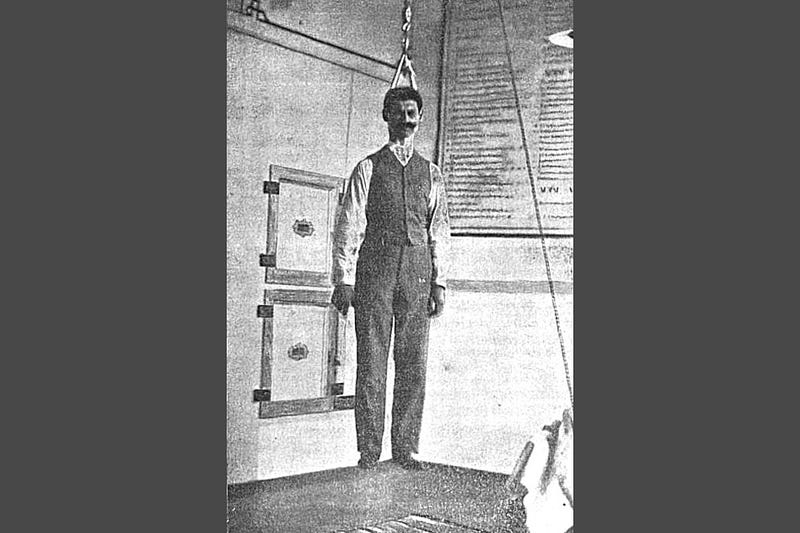
“I let myself hang six to seven times for four to five seconds to get used to it.”
No — Nicolae Minovici wasn’t insane. But I must admit what he did to himself was bizarre and shocking. Before exploring those details, let’s get to know him a little bit.
Born in Romania in 1868, Nicolae completed his secondary education at Saint Sava High School in Bucharest. Then in 1891, he enrolled at the School of Fine Arts as he was passionate about it.
But one of his older brothers, Mina Minovici (who was a forensic scientist and criminologist himself), didn’t like this idea. So he started persuading Nicolae to quit studying arts and enroll in the Faculty of Medicine.
Influenced by his older brother, Nicolae quit his Arts study after just one year and got himself admitted to the Faculty of Medicine.
Fast forward, in 1898, he got his Ph.D. in forensic science with a thesis on “Les tatouages en Roumanie” (Tattoos in Romania).
In the next year, he published his paper on the alleged relationship between tattoos and criminal personality. Contrary to popular opinion, he concluded that there is no relation between tattoos and criminal activities.
Nicolae started his career as a forensic scientist and criminologist.
At the beginning of the first decade of the twentieth century, he worked as a forensic professor at the State School of Science in Bucharest. It was the time when Nicolae decided to conduct a comprehensive study of death by hanging.
Why this topic?
Well, he wanted to know what happens when someone hangs himself and dies. Interestingly enough, this research project led him to hang himself several times through a series of experiments. And, of course, the experiments were extremely risky.
But he did it anyway as he realized it could be impossible for him to understand what happens when someone commits suicide by hanging — without hanging himself in the first place.
Thus he became both the subject and the scientist.
The first type of experiment was quite simple. He used a pully attached to the ceiling and a non-constricting noose with a dynamometer. Then, as you see in the below image, he lied down on the bed, slipped the noose through his head, and pulled the end of the rope as hard as he could.
He would lose the rope’s tension only when he was about to faint.
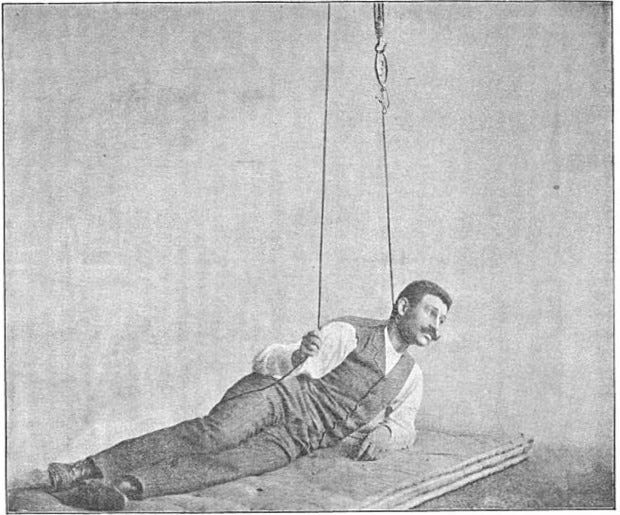
The result? His face turned purple red almost immediately and his visual got blurred. Due to the extreme pain, he lost consciousness in seconds.
In his own words —
“After five seconds I felt that a sort of purple veil was falling over me. And then the veil became black. At an incredible speed, I saw all kinds of images pass before my eyes and I felt a kind of electric discharge. I lost my sense of reason and everything became black.”
The second type of experiment was extreme. This time Nicolae decided to be lifted from his neck using the non-constricting noose.
For this dangerous experiment, he gathered a couple of assistants. His assistants pulled the other end of the rope with all their might to disconnect him from the ground while counting the seconds loudly.
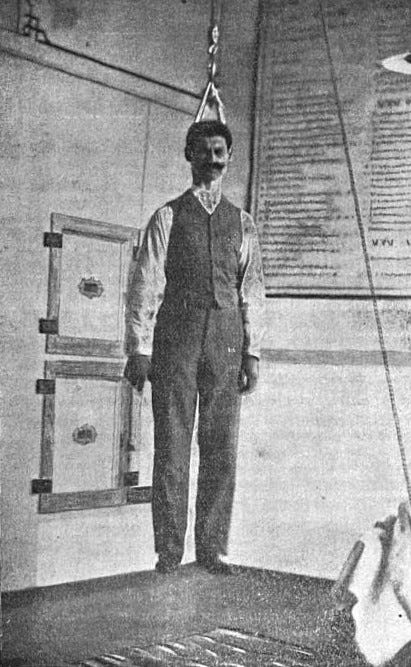
This way, Nicolae only managed to hang himself for five seconds for the first few times. The pain was unlike anything he had ever experienced. He said that after practicing a few times, he managed to endure up to twenty-five seconds of hanging by his neck.
“My eyelids closed tightly, as if with unseen strength. Then I felt my airways close, followed by a sinister roar in my ears. And I heard the voice of the servant pulling the rope no more,” He explains.
“I let myself hang six to seven times for four to five seconds to get used to it.”
After each of these experiments, he would experience extreme pain in his neck and difficulty eating food for weeks.
For the last type of experiment, Nicolae used a constricting hangman’s knot instead of the non-constricting one. This experiment was the most dangerous one that could cost his life if anything went slightly wrong.
He gave his assistants proper instructions. Then he tied the knot and placed his head through the noose. His assistants pulled the rope using their strength when he gave the signal.
As soon as they did it, the hangman’s knot would start its job, and an excruciating pain ripped through Nicolae’s neck. It was so painful that Nicolae signaled his assistants to let him down after only three seconds.
Nicolae then took notes of his near-death experience hanging by the neck. As you can imagine, he endured out-of-the-world pain and difficulty swallowing anything for the following month.
In 1904, Nicolae published his research titled “Study of Hanging” in Romania and one year later, in France. It’s considered one of the finest and most detailed studies on hanging.
The 200-page study included different hanging experiments, various clinical records, statistics, anatomy notes, and even the knots information used by suicide victims. The study was quoted in successive studies on the topic.
Nicolae writes, “In our table on professions, we noticed that the highest number of hanged people is represented by individuals in the lower class, the poor population and especially those without education. (…) The causes of hanging, the study shows, sometimes come from a mental imbalance, the origin of which can be found in the study of the social classes, in the multiplication of desires and diminishing of the duties to be fulfilled, upset, imitation and especially alcoholism; it is clear that social therapy is required.”
Apart from this research on hanging, Nicolae did a lot of great work. The documentary titled “The Minovici Brothers” by N. Ioanid and B. Angelescu portrays Nicolae as a stubborn, bold, but voluntary character.
Here are a few things that can help you understand how Nicolae Minovici was as a person:
- Nicolae founded the Legal Medicine Association of Romania and was the publisher of the Romanian Journal of Legal Medicine.
- He initiated one of Romania’s first ambulance and emergency services.
- At one point in his life, he became mayor of Băneasa of Bucharest.
- He also established shelters to help single mothers during childbirth.
- He was a folk art objects collector throughout his life.
- And he always helped families in need.
This incredible man who went too far for the sake of science died in 1941 from an illness related to vocal cords.
He died as a bachelor and donated all his wealth and art collection to his country. His villa in Bucharest is now an ethnological museum open to tourists around the world.
When I think about this man, I wonder how crazy things people in history have done to find truths and, therefore, make our life easy.
Sources: Neatorama, Steemit, Wikipedia, Bizzarrobazar, Stiridiaspora, Bucharest 101.
New to Medium?? Unlock thousands of AWESOME stories only for $5/mo. and OUTSHINE others — Click Me.
If you want to read more of my writings, do check out the following articles.


