
Why There Is No Conflict Between an Urgent Deadline and Taking Small Steps

I love talking in depth about the brilliance of small steps (and kaizen) or even taking just one tiny step in a project a day.
But we often have deadlines for specific assignments (which could also be self-imposed if we wish to learn more or become more prolific in a particular area by a certain date), and small, effortless steps might seem unreasonable. Especially if they are done only once a day.
However, you don’t have to do just one of those simple steps a day. You can take several of the small, effortless steps in any one day, doing something else between them.
I do this, for example, with many of my large projects and those that have deadlines. I start with committing to the smallest step for the project and then give myself permission to do something else between the single steps. I often find myself getting more and more into the flow after one or two initial steps, and then not wanting to leave the project for a while.
For this see the Booster Games in this article:
Sometimes increasing the duration of a step might help too. In September 2018, I realized that I was resisting doing some of my projects for both short and more extended periods. I couldn’t record points per completed bit of a project. Like, for example, preparing slides for a presentation: one slide might have taken one minute, another twenty. Giving myself points for the time spent on the project seemed like a good solution.
The first idea I had was to record my points for each minute. No, I thought, that many points would be too tedious to record. Five minutes required conversion of the minutes into points and the uneven number bothered me. Then I had it — ten minutes per point sounded neither too short nor too long. Just right. So I would earn six points per hour, one hundred and forty-four for the whole day (twenty-four hours).
A small side-note: Enough sleep as well as taking care of my health earned me not only the points but a star too. This was one of the reasons I called this design the “Balance Game.”
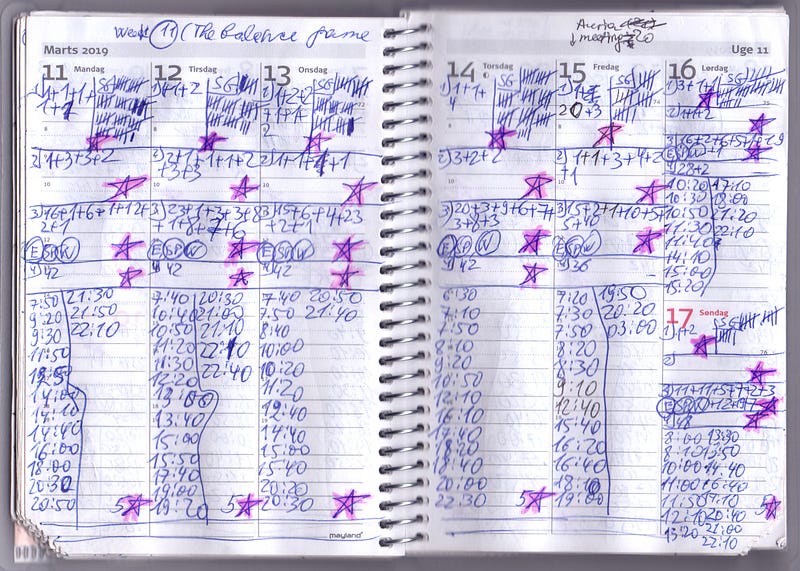
By recording a point for a specific period of time, I could see how I used my time. I tried it for a week and loved the approach. So I continued by setting the timer for ten minutes, concentrating on a task the best I could, and when the alarm went off, I recorded a point for that project. Then I either continued with the same job or did something else for ten (or another number) minutes and then came back to the project at hand.
You might point out that this little break when the alarm went off could have disturbed the process of performing a task. But actually, it didn’t. I realized that sometimes, when the signal of my timer went off, I was lost in thoughts instead of attending to my project, and it brought me back into the moment. So I recorded a point and concentrated again on the project.
A note to this article: It is a modified excerpt from Self-Gamification Happiness Formula: How to Turn Your Life into Fun Games.
Thank you for reading this article! I hope you enjoyed it. If you did, then you might also like this one too:
P.S. To stay in touch, join my e-mail list, Optimist Writer.
About the author:
Victoria is a writer, instructor, and consultant with a background in semiconductor physics, electronic engineering (with a Ph.D.), information technology, and business development. While being a non-gamer, Victoria came up with the term Self-Gamification, a gameful and playful self-help approach bringing anthropology, kaizen, and gamification-based methods together to increase the quality of life. She approaches all areas of her life this way. Due to the fun she has, while turning everything in her life into games, she intends never to stop designing and playing them.