
Why the Over-Sexualization of Breasts Is a Genuine Danger to Women
And why it’s so important that we take urgent action to change this
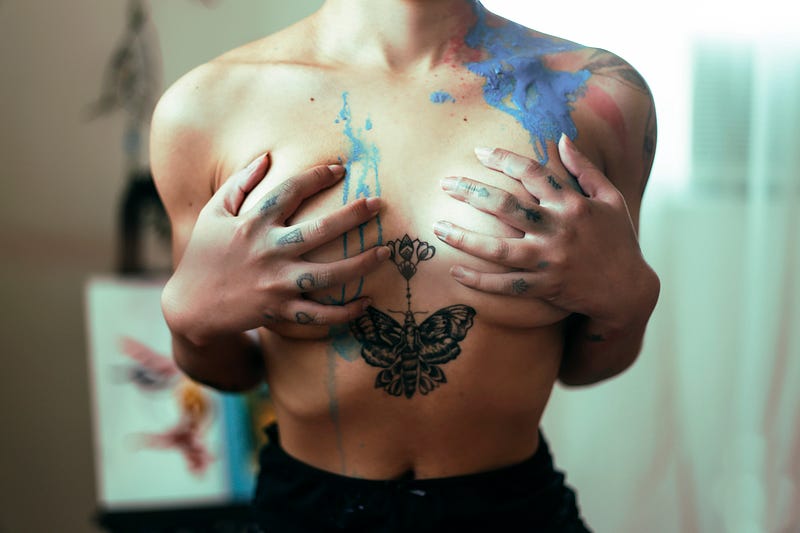
I’m afraid to go out in public without wearing a bra. I’ve been exploring this for a while now — allowing my body to exist exactly as it is without feeling like I have to “tuck and lift” in order to conform to social standards.
This isn’t an easy exploration. I have DD breasts, which means when I don’t wear a bra, everyone in the vicinity notices.
And that’s why I’m scared. My experience has been that many men associate any breast “exposure” with sexual invitation. Any.
There’s the traditional exposure — a flattering bra that pushes the girls up and creates a lovely swell of cleavage at the plunging neckline of a feminine blouse.
Then there are other kinds of exposure. For instance, a woman with large breasts who chooses not to wear a bra. It doesn’t matter if she’s wearing a turtleneck — somehow, the sight of swinging, pendulous breasts implies a woman’s desire be propositioned by a stranger.
And that’s not all. You can have adorable A-cup bitty titties that don’t even need a bra, but if your nipples happen to be blazing, there it is again: those hard bumps of flesh become beacons for unwanted sexual attention.
Or how about a woman breastfeeding in public? Think this isn’t an issue? If so, you’d be seriously mistaken. I know many women who have been propositioned by strangers in a park or at restaurants while they are feeding their infants. And in her recent Telegraph article on breasts and bras, editor Claire Cohen writes that she has interviewed dozens of women who were in tears over this issue.
You might not think much of this is problematic. Maybe the breastfeeding thing. But the rest of it… What’s the big deal? Put on a bra, right? Get some band-aids on those nipples. Cover it up and it won’t be a problem.
But it is a problem.
In fact, I’d go so far as to say that the way we have been taught to over-sexualize breasts has put women in serious danger.
And no amount of covering up is going to change that.
Our Complicated Relationship with Our Breasts
Like all women, I’ve always had a complicated relationship with my breasts. They were C-cups by the age of 12, DDs by 16.
I learned to hate them because they invited unwanted attention.
I felt they were the reason why I was repeatedly sexually assaulted in middle school. They made me feel dirty every time I went to the grocery store down the street from our house to pick up something my mom needed for dinner and men in their 30s and 40s looked me up and down like starving wolves about to pounce.
I wanted mine to be smaller. If they were smaller, I thought, I wouldn’t constantly be receiving this unwanted sexual attention, these uninvited sexual advances.
But I noticed my friends with small breasts had no fewer issues with that. And on top of that, they felt like they weren’t feminine or attractive enough.
The mixed message in all this became impossible to navigate. How were we supposed to want to be beautiful and desirable when being beautiful and desirable cost us our sovereignty? How could we achieve both objectives, when they were mutually exclusive?
Ultimately, I think many women come to the unsettling resolve that our breasts don’t really belong to us. How can they? We are taught to look at them and judge them through men’s eyes. They are monitored and censored by men. And their presence — in almost any context — is perceived by men as a sexual signal, something we’re supposed to resignedly accept because it’s a “biological response.” (This “biological response” argument is propaganda, by the way, but that’s another story for another time.)
What I have come to realize in recent years is that the way our culture has taught us to perceive female breasts is just as dangerous and insidious as the attempt to control a woman’s reproductive choices.
We, the humans behind the breasts, have been removed from this equation.
Over-Sexualization Erases a Woman’s Humanity
I recently received the following comment from a man on one of my articles explaining why it’s overwhelmingly inappropriate for men to sexually proposition women they don’t know online:
Do you think men see your writings and pictures as an exercise in expressing your inner Feminine? When men see you share your naked body it means that you are making yourself available. How you “feel” is not going to change how men react.
Do you see the issue?
Every single thing he said reduced me to an object.
There is absolutely no recognition of my humanity as you can clearly see by the way he puts the word “feel” in quotation marks — as if I do not have feelings or if I do, they do not and should not matter. He further objectifies me by invalidating my creative expression (only subjects have something to express — objects are passive and empty) and then normalizes the idea that men should equate any naked female body with a signal for “availability” — and that, my friends, is the rationalization of rape.
I want to drive this point home. When men see a naked woman, a woman who isn’t wearing a bra, or a woman whose breast is somewhat visible because she is breastfeeding, and they equate that to “availability,” we are rationalizing rape.
A woman existing in her own body, even nude, is not an invitation for sex. Unless she specifically asks for it, unless there is clear, conscious, and enthusiastic consent for sexual engagement, there is no invitation. There is no “availability.”
Until we come to a clear understanding of this as a culture, women’s bodies will always be in danger.
How Biology Proves Sexism
There is very little biological difference between the male and female chest. Men have nipples because we all begin as gender neutral.
Female breasts are simply deposits of fat that exist to protect the mammary glands.
Guess what? Men have mammary glands, too. To paraphrase Charles Darwin, all male mammals have “rudimentary” breasts. They simply weren’t “activated” during puberty, as they are for women.
To further my point, men can develop breast-like tissue in the form of fat deposits. Men can also develop breast cancer — one out of every 100 cases of breast cancer is found in men.
So what’s the problem here? Why are my breasts censored by social media? Why can’t I go topless at a beach or swimming pool? Why did it take until 2018 for all 50 states to legalize breastfeeding in public? And why are women’s breasts seen as an invitation for sexual engagement or a signal of sexual availability?
The reason is simple — and sinister. The over-sexualization of the female breasts accomplishes the ultimate goal of the patriarchy:
It keeps men in control of women’s bodies.
Why We Must Free the Nipple
I feel very strongly about continuing my work to normalize the sight of the female breast. To “de-sexualize” it. And to refuse to take on any shame around those efforts.
So long as we continue down this road in which the breast is censored, shaped, controlled, and coveted by outside forces, women will always be at the mercy of rape culture. Our bodies will never truly belong to us.
I shouldn’t have to worry about being propositioned when I run into Walmart to pick up some lettuce with my breasts swinging freely underneath my flannel shirt. A woman should be able to breastfeed her baby anywhere she wants without worrying about being hit on or asked to move into a more discreet place. And yes, if male nipples are allowed on Instagram, then female nipples should be allowed, too — because as I’ve established, the medical community is beginning to define nipples as “gender neutral.” Which is yet more evidence of the sexism of all the platforms that ban “female” nipples.
Yes, this is important. Even sexist nipple bans on Instagram.
The over-sexualization of the female breast is a danger to us. The censorship of the “female” nipple is a danger to us. Every instance of this normalizes rape rationalization, the objectification of women, and male ownership of the female body.
I’ve had enough. I want my body back.
© Yael Wolfe 2022
More on the sexual objectification of women: