
Why Everyone Should Be Worried About Social Media’s Censorship of Sexuality
How Facebook and Instagram are becoming weapons of the patriarchy
Let me tell you something about me that is, perhaps, more important than anything else as I charge into my 40s: I want to do whatever I want with my own body. I insist on presenting it, offering it, and guarding it in any way I please. I want to own my sexuality and be the only person who gets to decide how I use it, define it, enjoy it, and share it.
I haven’t had this luxury in my life. In fact, it shouldn’t even be considered a luxury — it should have always been my right. And yet, I find I have to fight for this right every day.
Just like most women.
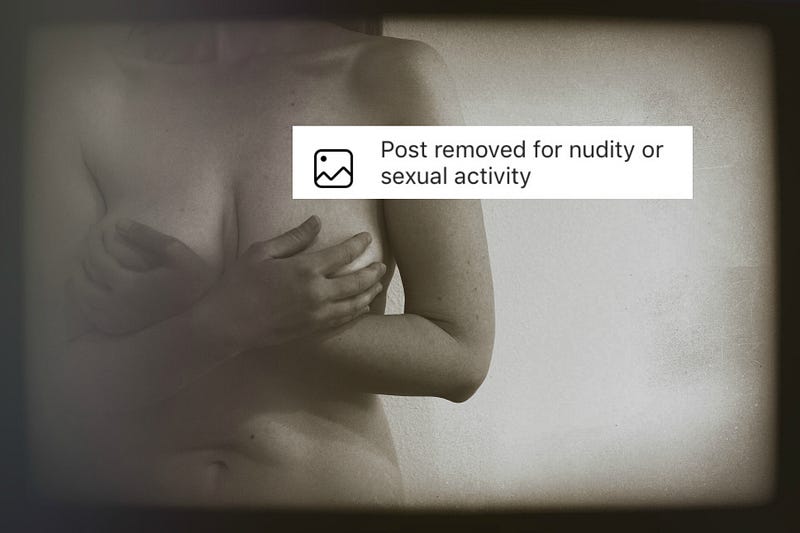
One of the greatest leaps I took in this journey was to start writing about my body and my sexuality on Medium. And as random as this might sound to some of you, that very quickly evolved into posting nude and semi-nude photographs of myself on Instagram. I was determined to rewrite my story and take back my power.
As I posted more photos, I began to notice that other women I followed who posted nude photos on Instagram were either having photos removed by the system or were losing their entire accounts.
This is against our community guidelines became a phrase I lived in fear of. I thought I was safe, though, so long as I never showed my nipples. (Heaven forbid.)
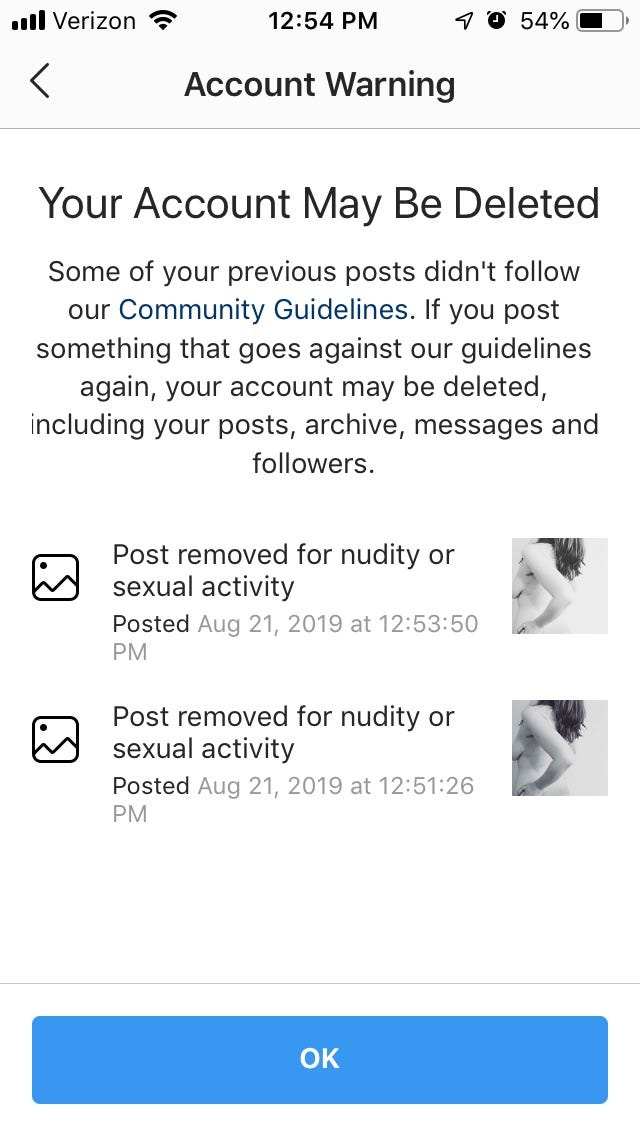
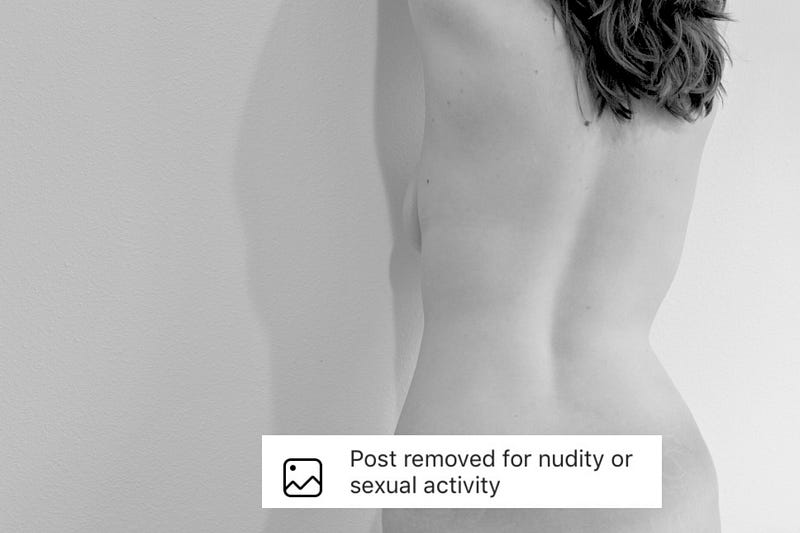
Needless to say, I was stunned one day when a photo I tried to post was immediately removed. In the photo, I’m naked, yes, but you can only see my back, arm, and side boob. I took the photo in order to show off my underarm hair, which was a huge stretch out of my comfort zone. But it felt like an empowering way to help me celebrate my body and the efforts I was making to accept it in its natural state.
I thought the removal was a mistake, at first. It happened so fast, literally a second after I hit the Post button. Surely, it was a fluke. So I tried again, and again, it was immediately (within a second or two) removed. This time, I read the warning more carefully: Post removed for nudity or sexual activity.
Again, I was stunned. First of all, what could possibly be objectionable in my photograph? My back? My arm? My body hair? No, it had to be the side boob, right? But really — side boob? How many actresses have appeared on major television networks during award shows in dresses that show off top, side, or bottom boob? I had fully cropped out my nipple — what was the problem?
Secondly, the timing of it made me suspect that my photo was “caught” by the body equivalent of facial recognition software. Maybe my pose had set it off? The curve of side boob? The point is, there was no way someone reported that post and that it was deleted within a second of me posting it. And being as it happened twice in a row, I’m convinced it was A.I. that flagged my photo — not a puritanical Instagram user.
Somehow, that made it all the worse.
The next morning, when I logged in to my account, I found my feed was blank. I clicked on my profile page and my heart sank. My posts were gone. My followers, gone. The accounts I followed, gone. Everything was gone.
This account has been deleted for violating our community guidelines, it stated.
I almost cried. I had spent so much time writing and curating content for that platform and in less than 6 weeks, I’d managed to get myself in the crosshairs of the Morality Police. All that work for nothing.
But more importantly, I was livid. At first, I felt almost ashamed, like I’d done something wrong. Like I’d been inappropriate, behaved badly. Was it dirty and shameful that I wanted to explore my body and sexuality in this way?
Fuck no, I quickly decided. This is just another example of the bullshit rules of the patriarchy and how they try to control women’s bodies. If a man wants to post a photograph of himself without a shirt on, he is welcome to do so on Instagram. If a woman does, it is considered sexual content.
This is what the patriarchy has decided: a woman’s body is inherently and solely sexual and therefore must be regulated when it comes to public consumption.
A few hours later, my account was restored for reasons that were never explained to me. And over the course of the next month, it was shut down two more times, even though I hadn’t tried again to post a nude photograph and I had removed the others.
It became clear to me that Instagram’s sexist policies were going to drag me down as long as I dared to write about sex and present my body in the way I want to present it.
This was war.
I’ll be the first to admit that I’m not a very good revolutionary. I get really fired up about the idea of taking on the oppressor, but in actuality, I’m clumsy and ineffective.
How the hell does one fight the arm of the patriarchy in the form of a massive corporation like Instagram? I posted a photo of myself wearing a thin, white shirt one day, without a bra on, nipples blazing. Suck on that, Instagram! Pun intended.
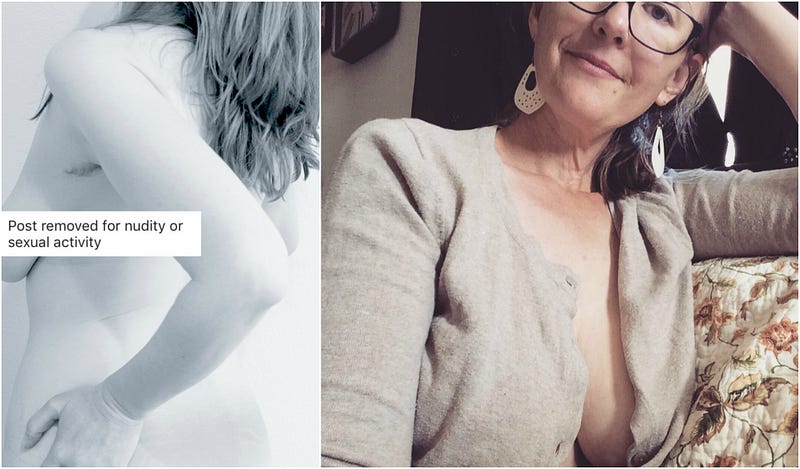
Another day, I wore a tight cardigan, unbuttoned, again with no bra underneath, and let my side boob show. Interestingly, they never flagged that one. Hmmm…because I’m wearing a cardigan? Am I the only one who sees the absurdity in that? Side boob is side boob. Not to mention the fact that the underarm hair photo is totally nonsexual (in my opinion) whereas the cardigan photo is sexy. Wouldn’t it make more sense that the sexy photo was considered a violation of their community guidelines?
Anyways, shocking as this will be to hear, neither one of these photos brought down this Goliath. No, my blazing nipples and audacious side boob did not topple Instagram’s sexist institution.
Sorry, sisters. I tried.
By that time, I already knew Facebook’s sexist policies were just as bad — not surprising, since Facebook is the parent company of Instagram. Earlier in the summer, my sister had tried to sell her breast pump on Facebook Marketplace and her post was instantly deleted for violating the community guidelines around sexual content.
If you didn’t catch that, she was being prohibited from using the word “breast” because it was flagged as sexual content. And this was in reference to a breast pump. This did not violate Facebook’s community guidelines, which explicitly state that breastfeeding and references to breastfeeding are allowable — yet still, she was prohibited from using the word breast and had to bypass the Marketplace and message her mom-friends with the news that she had a “b***st pump” for sale.
Recently, I’ve watched many of my fellow writers get shadowbanned on Facebook, because they are supposedly in violation of the platform’s community standards. Facebook lists the following as items that are prohibited (emphasis mine):
An offer or ask for pornographic material (including, but not limited to, sharing of links to external pornographic websites)
Sexually explicit language that goes into graphic detail beyond mere reference to:
-A state of sexual arousal (wetness or erection) or
- An act of sexual intercourse (sexual penetration, self-pleasuring or exercising fetish scenarios)
With the slippery definition of the term pornography (“Photographs, films, books, or other material depicting erotic or sexual acts designed to cause sexual arousal,” according to Nolo’s Plain English Law Dictionary), Facebook could easily argue that our articles about sex — even if they aren’t graphic — might cause someone to feel aroused and by that definition…well, it’s pornography. Same goes for my side boob, I suppose.
I haven’t had any of my own work banned on Facebook at this point, though that’s because I am not very active there. I’ve been disillusioned with Facebook for far longer than I’ve been disillusioned with Instagram and as such, I spend very little time there and rarely use that platform to share my work.
However, I’m extremely sympathetic to those who are struggling with this. The general consensus has been that fellow Medium writers are reporting links shared by writers who are talking about LGBTQ issues, sexuality, and feminism (among other things). If that’s so, it’s a frustrating and painful betrayal, to be sure.
But we all know what it’s like to be involved in online communities. It can be very empowering and motivating…and also as dysfunctional and incestuous as a soap opera. This happens in my brother’s gaming community and my sister’s online knitting group. We’re never going to escape petty jealousies, vindictive behavior, and backstabbing aggression.
My point here is that I hope, as the dust settles, we keep our focus on what matters. The real problem is that Instagram and Facebook have bullshit, sexist policies. No one would be able to do any damage to us by reporting our posts if the platforms didn’t already support this unfair censorship.
I realize that there’s a difference between getting banned from posting side boob photos and being banned for posting links to articles about sex — you could argue that side boob photos are more “aggressive” than links to articles about sex. However, both prohibitions stem from the same dysfunctional and damaging beliefs our culture has around sex and both seek to control and repress sexuality — particularly female sexuality.
Sex educator Ev’Yan Whitney says:
Oppression is in the algorithm. It creates rules that say my body cannot be celebrated outside of the male gaze… It teaches me that my body is inherently pornographic and automatically sexualized — even when it’s just being a body. It teaches me that my body and my work are only allowed to exist if it’s to be consumed for and by the pleasures of men. It communicates that male sexuality, their bodies, and the way they celebrate them are the default and priority. It’s racist, sexist, transphobic, whorephobic, fatphobic, and white supremacist. It puts us — SWers, sexuality educators, fat, trans, black, brown, femme, non-binary people — at risk. It silences our voices, censors our art, invalidates our cashflow, and shadowbans our wisdom. It polices our existence and the space we take up. It tells us we are dangerous.
The issue is not those who are reporting sex bloggers. The issue is that we are trying to free ourselves using the tools of the oppressor.
That’s what we have to fight.
While I don’t want to disregard the pain and frustration this has caused many writers, I also want to encourage all of us to remember who we really are. We’re brave enough to share our deepest shames, our most embarrassing stories, our gentlest vulnerabilities, our forbidden desires, our greatest moments of pleasure. We are warriors and nothing is going to stop us from continuing to tell our stories — not oppressive social media, and certainly not angry fellow writers.
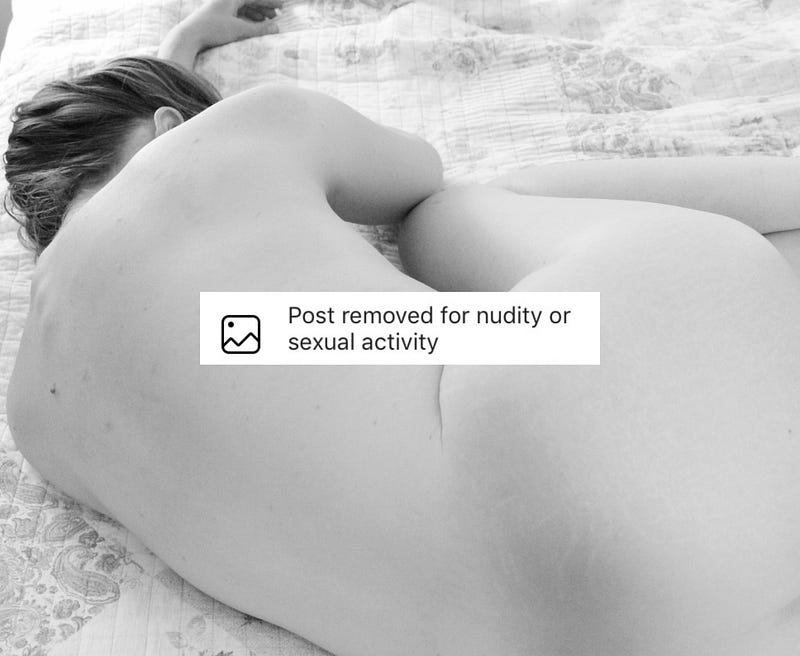
This is our moment at the crossroads. This is our call to fight harder against these goliaths. Don’t stop once the dust settles. Keep talking about this. Fight to free the nipple. Post rebellious photos, even if they’re as ineffective as mine are. Or leave the platforms, entirely.
And let’s get strategic, while we’re at it. So long as these bullshit community guidelines exist, we are always going to be at risk talking about what we talk about and posting supposedly scandalous photos. We can’t afford to rely on Facebook and Instagram to share our work. We are not going to be empowered there.
Let’s get on Twitter, a much more accepting platform. Let’s share ideas for other platforms that aren’t playing Morality Police. And let’s put our efforts into our email lists so the people who are interested can hear from us directly without the interference of social media.
We’re better than this. We’re smarter. And we’re definitely more woke. So we will win. Eventually.
Facebook and Instagram…we’re coming for you.
© Yael Wolfe 2019
My story on the Instagram side boob debacle:
If you like my work and want to stay updated, click here to subscribe to my newsletter.


