avatarShin Jie Yong, MSc (Res)

Free AI web copilot to create summaries, insights and extended knowledge, download it at here

3258

Abstract

s://cdn-images-1.readmedium.com/v2/resize:fit:800/1*pAnjzJmlCqFu0k6gLZhrOQ.png"><figcaption><a href="https://www.nature.com/articles/s41594-020-0479-4">Source</a>: Henderson et al. (2020). Representations of the down (top left) and up (top right) state SARS-2 structures (PDB 6VXX and 6VYB, respectively), colored according to the specified domains (bottom). The receptor-binding domain of the S1 subunit is colored dark blue. In the ‘up’ state, the RBD is open.</figcaption></figure><figure id="1cd2"><img src="https://cdn-images-1.readmedium.com/v2/resize:fit:800/1*y7vZgWEOpaE3fWVsPMUkZw.png"><figcaption></figcaption></figure><h1 id="3f70">The ‘open’ state is more vulnerable</h1><h2 id="eb52">1. D614G mutation</h2><p id="e142">Around February of 2020, a SARS-CoV-2 strain with the <a href="https://readmedium.com/what-the-d614g-mutation-means-for-covid-19-spread-fatality-treatment-and-vaccine-7dda1c066f0d">D614G mutation</a> appeared in Europe, where the 614th amino acid mutated from aspartic acid (D) to glycine (G). This strain soon became dominant worldwide, where the majority of circulating SARS-CoV-2 have this mutation.</p><p id="34b5">Indeed, <a href="https://science.sciencemag.org/content/370/6523/1464">animal</a> <a href="https://www.nature.com/articles/s41586-020-2895-3">experiments</a> have confirmed that the D614G mutation increased the virus’s transmissibility and infectivity by promoting the ‘open’ state of the spike protein’s RBD. This provides SARS-CoV-2 more opportunity to bind to the human cell receptor.</p><p id="9b63" type="7">In the ‘up’ state, the RBD is open and can bind to the cell receptor. In the ‘down’ state, the RBD is close and cannot bind to any receptor.</p><p id="9fb1">But the ‘open’ state exposes SARS-CoV-2 to circulating antibodies. Antibodies are Y-shaped proteins made by B-cells (a type of white blood cell) that binds and neutralizes viruses and other microbes. Therefore, being more infectious comes at a cost as the coronavirus would expose itself to antibody neutralization.</p><p id="f1c7">This is confirmed in a study published last month in <i>Cell Host and Microbe</i>, titled “<a href="https://www.sciencedirect.com/science/article/pii/S193131282030634X">D614G Spike Mutation Increases SARS CoV-2 Susceptibility to Neutralization</a>.” As the title speaks for itself, SARS-CoV-2 with the D614G is more infectious but also more vulnerable to antibody neutralization than the original SARS-CoV-2 strain. The antibodies this study used were derived from the blood sera of mice, non-human primates, and humans exposed to SARS-CoV-2 spike proteins.</p><p id="6795">“The D614G mutation causes the virus to infect cells more efficiently but also creating a pathway to the virus’ vulnerable core. With one flap open, it is easier for antibodies to infiltrate and disable the virus,” Erol wrote.</p><p id="60b8">Moreover, SARS-CoV-2 with the D614G mutation would increase viral replication and shedding since it's more infective, after all. Indeed, <a href="https://www.ncbi.nlm.nih.gov/pmc/articles/PMC7332445/">clinical samples</a> from Covid-19 patients infected with this SARS-CoV-2 strain were richer in viral RNA. But the Covid-19 disease severity or mortality remains the same. This paradox c

Options

an be explained by the fact that mutations increasing SARS-CoV-2 infectivity also exposes the coronavirus to antibody neutralization, as Erol proposed.</p><p id="fe45" type="7">But the ‘open’ state exposes SARS-CoV-2 to circulating antibodies…Therefore, being more infectious comes at a cost as the coronavirus would expose itself to antibody neutralization.</p><h2 id="33ef">2. N501Y mutation</h2><p id="1b36">The same applies to the more recent N501Y coronavirus strain that is rapidly spreading now. Bioinformatics <a href="https://science.sciencemag.org/content/369/6511/1603">modeling</a> <a href="https://www.biorxiv.org/content/10.1101/2020.12.16.423118v2">studies</a> have found that the N501Y mutation — change of amino acid at position 501 from asparagine (N) to tyrosine (Y) — promotes the ‘open’ state of the coronavirus's RBD.</p><p id="9fea">Thus, although the N501Y strain is more efficient at infecting cells, it might also be more prone to antibody neutralization, Erol suggested. However, this theory has only been supported by computational data, so further cell culture or animal studies are warranted.</p><p id="ab71">Nevertheless, Erol’s theory helps explain why the N501Y strain is not any more deadly despite being more efficient at infecting cells. Indeed, a preprint study has found that clinical samples from patients infected with the N501Y strain had <a href="https://www.nature.com/articles/d41586-021-00031-0">3-times higher</a> viral loads than patients infected with SARS-CoV-2 without N501Y mutation. However, an <a href="https://www.biorxiv.org/content/10.1101/2021.01.07.425740v1">early preprint</a> has found that the Pfizer mRNA vaccine works against the N501Y strain. Antibodies isolated from the blood of vaccinated persons effectively <a href="https://medicalxpress.com/news/2021-01-pfizer-vaccine-virus-variant.html?utm_source=nwletter&amp;utm_medium=email&amp;utm_campaign=daily-nwletter">neutralized</a> both SARS-CoV-2 with or without the N501Y mutation.</p><figure id="048f"><img src="https://cdn-images-1.readmedium.com/v2/resize:fit:800/1*y7vZgWEOpaE3fWVsPMUkZw.png"><figcaption></figcaption></figure><h1 id="705b">Short abstract</h1><p id="ec64">We have heard all the negative things from SARS-CoV-2 strains or variants, such as the D614G and N501Y mutations. The increased infectivity and transmissibility these mutations bring is indeed a cause for alarm, since more cases equal to higher death counts. However, it’s also fortunate that these mutations render SARS-CoV-2 weaker against the immune system, where it’s more susceptible to antibody neutralization. Otherwise, the increased viral replication and shedding would lead to more lethal Covid-19. Overall, although the increased transmission from D614G and N501Y mutations is unfortunate, we can be glad that the disease severity and death rate are not any worse.</p><p id="edd4">22 March 2021 update: Things are different now. With the emerging E484K mutation that helps SARS-CoV-2 to evade antibodies, the weakness of D614G and N501Y mutations are covered, and Covid-19 has <a href="https://shinjieyong.medium.com/why-the-u-k-coronavirus-strain-just-got-slightly-deadlier-to-our-surprise-cf42b25cb699">become a bit deadlier.</a></p></article></body>

Why the Coronavirus D614G and N501Y Mutations Are Not Entirely Disastrous

While the mutations increase SARS-CoV-2 infectivity, it also exposes the coronavirus to antibody binding and neutralization.
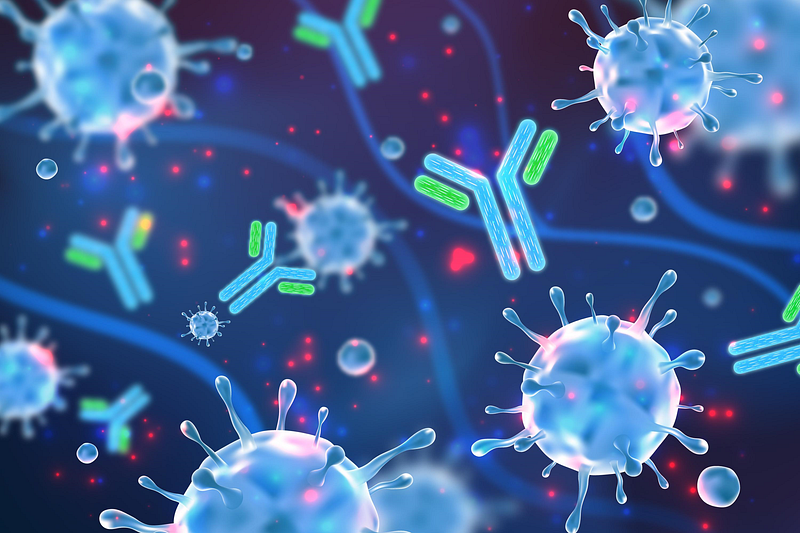
Background vector created by pikisuperstar — www.freepik.com. The Y-shaped protein is an antibody that binds and neutralizes viruses.

The recent advent of a new coronavirus strain or variant in the U.K. and other countries — called N501Y (or VUI-2020/01 or lineage B.1.1.7) — have raised only concerns. The vaccine efficacy is questioned. The increased transmissibility would mean higher death counts, even though the virus’s lethality remains the same.

“With increased transmissibility and similar disease severity, the variant does, however, raise alarm: without increased control to slow its spread, there will be an increased impact on already stressed and pressurized health facilities,” Hans Henri P. Kluge, MD, Regional Director for Europe at the WHO, said in a statement yesterday.

However, a paper published in the journal Immunological Letters this month, titled “Are the emerging SARS-COV-2 mutations friend or foe?” offers interesting insights into the coronavirus mutations, arguing why such mutations may not be entirely unfavorable for humans. Adnan Erol, a retired professor and independent researcher, is the sole author.

The ‘up’ and ‘down’ states

The novel coronavirus, SARS-CoV-2, uses its spike protein to bind and infect human cells. The SARS-CoV-2 spike protein is composed of two subunits — S1 and S2.

The S1 subunit contains the receptor-binding domain (RBD) that binds to the receptor on the human cell surface. The receptor can be ACE2, neuropilin-1, or CD147/basigin. After S1-receptor binding, the S2 subunit then catalyzes the coronavirus’s fusion with the human cell membrane — completing cell infection.

More on the specifics: The RBD of the S1 subunit can exist in two states, which are the ‘up’ and ‘down’ states. In the ‘up’ state, the RBD is open and can bind to the cell receptor. In the ‘down’ state, the RBD is close and cannot bind to any receptor.
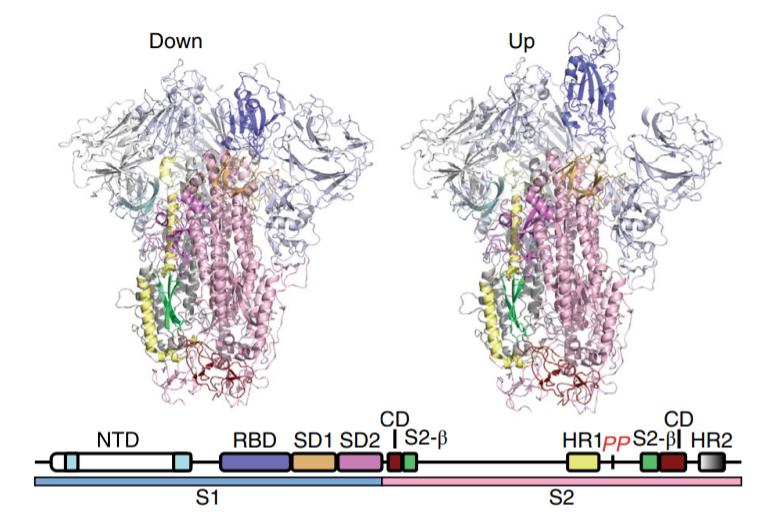
Source: Henderson et al. (2020). Representations of the down (top left) and up (top right) state SARS-2 structures (PDB 6VXX and 6VYB, respectively), colored according to the specified domains (bottom). The receptor-binding domain of the S1 subunit is colored dark blue. In the ‘up’ state, the RBD is open.

The ‘open’ state is more vulnerable

1. D614G mutation

Around February of 2020, a SARS-CoV-2 strain with the D614G mutation appeared in Europe, where the 614th amino acid mutated from aspartic acid (D) to glycine (G). This strain soon became dominant worldwide, where the majority of circulating SARS-CoV-2 have this mutation.

Indeed, animal experiments have confirmed that the D614G mutation increased the virus’s transmissibility and infectivity by promoting the ‘open’ state of the spike protein’s RBD. This provides SARS-CoV-2 more opportunity to bind to the human cell receptor.

In the ‘up’ state, the RBD is open and can bind to the cell receptor. In the ‘down’ state, the RBD is close and cannot bind to any receptor.

But the ‘open’ state exposes SARS-CoV-2 to circulating antibodies. Antibodies are Y-shaped proteins made by B-cells (a type of white blood cell) that binds and neutralizes viruses and other microbes. Therefore, being more infectious comes at a cost as the coronavirus would expose itself to antibody neutralization.

This is confirmed in a study published last month in Cell Host and Microbe, titled “D614G Spike Mutation Increases SARS CoV-2 Susceptibility to Neutralization.” As the title speaks for itself, SARS-CoV-2 with the D614G is more infectious but also more vulnerable to antibody neutralization than the original SARS-CoV-2 strain. The antibodies this study used were derived from the blood sera of mice, non-human primates, and humans exposed to SARS-CoV-2 spike proteins.

“The D614G mutation causes the virus to infect cells more efficiently but also creating a pathway to the virus’ vulnerable core. With one flap open, it is easier for antibodies to infiltrate and disable the virus,” Erol wrote.

Moreover, SARS-CoV-2 with the D614G mutation would increase viral replication and shedding since it's more infective, after all. Indeed, clinical samples from Covid-19 patients infected with this SARS-CoV-2 strain were richer in viral RNA. But the Covid-19 disease severity or mortality remains the same. This paradox can be explained by the fact that mutations increasing SARS-CoV-2 infectivity also exposes the coronavirus to antibody neutralization, as Erol proposed.

But the ‘open’ state exposes SARS-CoV-2 to circulating antibodies…Therefore, being more infectious comes at a cost as the coronavirus would expose itself to antibody neutralization.

2. N501Y mutation

The same applies to the more recent N501Y coronavirus strain that is rapidly spreading now. Bioinformatics modeling studies have found that the N501Y mutation — change of amino acid at position 501 from asparagine (N) to tyrosine (Y) — promotes the ‘open’ state of the coronavirus's RBD.

Thus, although the N501Y strain is more efficient at infecting cells, it might also be more prone to antibody neutralization, Erol suggested. However, this theory has only been supported by computational data, so further cell culture or animal studies are warranted.

Nevertheless, Erol’s theory helps explain why the N501Y strain is not any more deadly despite being more efficient at infecting cells. Indeed, a preprint study has found that clinical samples from patients infected with the N501Y strain had 3-times higher viral loads than patients infected with SARS-CoV-2 without N501Y mutation. However, an early preprint has found that the Pfizer mRNA vaccine works against the N501Y strain. Antibodies isolated from the blood of vaccinated persons effectively neutralized both SARS-CoV-2 with or without the N501Y mutation.

Short abstract

We have heard all the negative things from SARS-CoV-2 strains or variants, such as the D614G and N501Y mutations. The increased infectivity and transmissibility these mutations bring is indeed a cause for alarm, since more cases equal to higher death counts. However, it’s also fortunate that these mutations render SARS-CoV-2 weaker against the immune system, where it’s more susceptible to antibody neutralization. Otherwise, the increased viral replication and shedding would lead to more lethal Covid-19. Overall, although the increased transmission from D614G and N501Y mutations is unfortunate, we can be glad that the disease severity and death rate are not any worse.

22 March 2021 update: Things are different now. With the emerging E484K mutation that helps SARS-CoV-2 to evade antibodies, the weakness of D614G and N501Y mutations are covered, and Covid-19 has become a bit deadlier.

Covid-19
Pineapple2021
Science
Life
Health
Recommended from ReadMedium