avatarShin Jie Yong, MSc (Res)

Free AI web copilot to create summaries, insights and extended knowledge, download it at here

3601

Abstract

encemag.org/content/370/6518/861">Neuropilin-1 is a host factor for SARS-CoV-2 infection.</a>” Judging from the titles alone, we know the hypothesis is confirmed to be true.</p><p id="a07a">In short, they showed that SARS-CoV-2 can still infect cells deficient in ACE2, as long as they express neuropilin-1. If both ACE2 and neuropilin-1 receptors are present, the infection became more infectious. Using genetic editing to cut or antibodies to block neuropilin-1, in turn, prevent SARS-CoV-2 infection.</p><p id="cef5" type="7">“Whereas ACE2 was detected at very low levels, [neuropilin-1] were abundantly expressed in almost all pulmonary and olfactory cells, with the highest levels of expression in endothelial cells.”</p><p id="2c3d">Binding to neuropilin-1 would hinder its <a href="https://theconversation.com/a-second-pathway-into-cells-for-sars-cov-2-new-understanding-of-the-neuropilin-1-protein-could-speed-vaccine-research-148497">normal function</a>, which is to aid neurons to make connections and blood vessels to grow. This explains why SARS-CoV-2 can attack the nervous and vascular systems. This explains why Covid-19 is also a <a href="https://readmedium.com/neuro-covid-gaining-recognition-as-new-disease-terminology-3b0c450fd868">neurological </a>and <a href="https://readmedium.com/simplifying-covid-19-into-one-mechanism-the-epithelial-endothelial-crosstalk-1d250dbd3083">vascular</a> disease. And why SARS-CoV-2/Covid-19 attacks the lungs and sense of smell since neuropilin-1 <a href="https://science.sciencemag.org/content/370/6518/856">is highly expressed</a> in the respiratory and olfactory tracks.</p><p id="94e8">As one of the studies in <i>Science <a href="https://science.sciencemag.org/content/370/6518/856"></a></i><a href="https://science.sciencemag.org/content/370/6518/856">stated</a>: “Whereas ACE2 was detected at very low levels, [neuropilin-1] were abundantly expressed in almost all pulmonary and olfactory cells, with the highest levels of expression in endothelial cells.” Endothelial means blood vessels; thus, neuropilin-1 concentrates in blood vessels and cells of the lungs and nose. This study also did an autopsy of olfactory cells isolated from the nose of deceased Covid-19 victims, showing that cells positive for neuropilin-1 — but lacking ACE2 — were still infested with SARS-CoV-2 particles.</p><p id="517a">Interestingly, <a href="https://journals.lww.com/pain/Abstract/9000/SARS_CoV_2_Spike_protein_co_opts.98244.aspx">another research group</a> had found that rats with chronic neuropathic pain no longer feel pain when the spike protein of SARS-CoV-2 blocked neuropilin-1. This is because neuropilin-1 participates in pain excitation in neurons. <a href="https://www.scientificamerican.com/article/what-we-know-so-far-about-how-covid-affects-the-nervous-system/">In an anecdote</a>, a 49-year-old South African male suffered a nerve injury in a motor accident in 2011. As a result, he lived with chronic pain — so unbearable that it disrupts his sleep every night — until he got Covid-19. “I found it very strange: When I was sick with Covid, the pain was bearable. At some points, it felt like the pain was gone. I just couldn’t believe it,” he said. “I lived a better life when I was sick because the pain was gone.” But the man recovered from Covid-19, and his pain resurfaced.</p><figure id="731b"><img src="https://cdn-images-1.readmedium.com/v2/resize:fit:800/1*y7vZgWEOpaE3fWVsPMUkZw.png"><figcaption></figcaption></figure><h1 id="04af">CD147 (Basigin)</h1><p id="aac6">This month, a new study was published in the <i>Nature</i>-part

Options

nered journal, <i>Signal Transduction and Targeted Therapy</i>, titled “<a href="https://www.nature.com/articles/s41392-020-00426-x">CD147-spike protein is a novel route for SARS-CoV-2 infection to host cells</a>.” Again, the title has said it all. Researchers in China discovered that SARS-CoV-2 could infect human cells and mice expressing CD147 (also called basigin). SARS-CoV-2 infection can be further blocked with Meplazumab (an anti-CD147 antibody) or boosted with increasing CD147 expression.</p><p id="cd88" type="7">“These findings demonstrate that CD147 provides more entries for SARS-CoV-2 infection and plays a potential role in mediating virus infection, especially in ACE2-deficient cell types.”</p><p id="bf29">More importantly, this study showed that T-cells (both CD4+ and CD8+) collected from human blood were susceptible to SARS-CoV-2 infection via CD147. Notably, the study also confirmed that these T-cells do not express the ACE2 receptor, which is expected as T-cells are inherently ACE2 deficient.</p><p id="8668">The T-cell’s CD147 functions as a receptor to receive <a href="https://www.sciencedirect.com/science/article/pii/S0008874913000592">chemotaxis signals</a>. Chemotaxis is the attraction or recruitment of immune cells to the area where foreign invaders are located. Thusly, CD147 expression heightens when T-cells are activated. As follows, in the above study, activated T-cells were also shown to be more susceptible to SARS-CoV-2 infection than inactive T-cells. This also explains why Covid-19 tends to <a href="https://journals.lww.com/bls/Fulltext/2020/07000/T_cell_response_in_patients_with_COVID_19.2.aspx">reduce T-cell count</a> in severe cases.</p><p id="1db1">In addition, the study determines the levels of ACE2 and CD147 expressions in human lung cells — BEAS-2B, and Vero E6 bronchial cells. Apparently, CD147 expression was 2.3-fold higher than ACE2 in Vero E6 cells, and ACE2 wasn’t even expressed in BEAS-2B cells. “These findings demonstrate that CD147 provides more entries for SARS-CoV-2 infection and plays a potential role in mediating virus infection, especially in ACE2-deficient cell types,” the study authors wrote.</p><p id="78d5">Exploiting the CD147 receptor is not unique to SARS-CoV-2. It’s also a receptor that the human immunodeficient virus type 1 (HIV-1) — that causes AIDS — <a href="https://www.ncbi.nlm.nih.gov/pmc/articles/PMC33473/">uses</a>. As T-cells are important for the specialized killing of infection, it’s not unexpected that viruses evolve ways to counter T-cells.</p><figure id="f347"><img src="https://cdn-images-1.readmedium.com/v2/resize:fit:800/1*y7vZgWEOpaE3fWVsPMUkZw.png"><figcaption></figcaption></figure><h1 id="f53d">Short abstract</h1><p id="d579">We thought ACE2 is the only receptor SARS-CoV-2 can use for almost a year, which is odd given that the lungs don’t even have a high ACE2 expression. But in the past month, two additional receptors of SARS-CoV-2 were discovered. One is neuropilin-1, which is highly expressed in the respiratory and olfactory tracts, specifically in cell types that SARS-CoV-2 preferentially infects. The second is CD147 (also called basigin), which is highly expressed in T-cells and bronchial cells in the lungs. This clarifies why Covid-19 tends to kill certain lung cells and T-cells that don’t have ACE2.</p><p id="7ea1">Overall, these two newly identified receptors of SARS-CoV-2 explain many facets of Covid-19 that ACE2 alone cannot. We now know why Covid-19 is a mix of pulmonary, vascular, neurological, immunological, and olfactory diseases.</p></article></body>

ACE2 Isn’t Solely Responsible for Covid-19, Which Explains A Lot

The discovery of two new receptors — neuropilin-1 and CD147 — explains why Covid-19 is a mix of respiratory, vascular, nervous, olfactory, and immunological diseases.
Abstract vector created by macrovector — www.freepik.com

It has been odd right from the start. If SARS-CoV-2 (the novel coronavirus that causes Covid-19) uses the angiotensin-converting enzyme 2 (ACE2) as a receptor to infect cells, then why is it a lung disease when the lungs have low levels of ACE2?

This was determined back in May 2020 in a study finding that alveolar cell type 2 (the primary target of SARS-CoV-2) in the lungs has ACE2 expression that is “4.7-fold lower than the average expression level of all ACE2 expressing cell types,” such as the liver, stomach, ileum, kidney, and colon.

Later, a systematic review published over a month ago further points out that SARS-CoV-2 tend to end up in places not consistent with ACE2 expression levels. Looking at the figure below, organs SARS-CoV-2 tend to localize (e.g., lungs and brain) do not always have high expression of ACE2, and vice-versa.
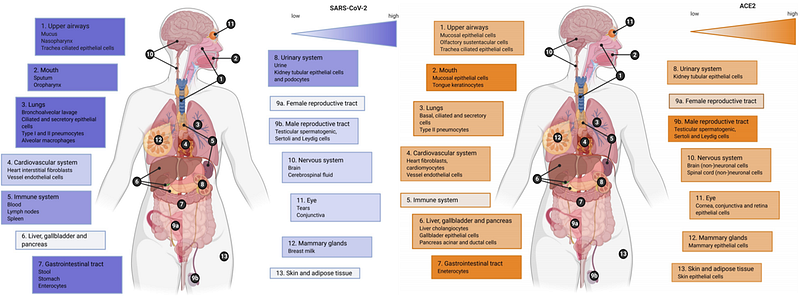
Trypsteen et al. (2020). Left: Gradient color (purple) indicates low to high evidence for SARS-CoV-2 detection; the highest expression was found in the upper airways, lungs, oral cavity, gastrointestinal tract, and urinary system. Right: Gradient color (orange) indicates low to high evidence for ACE2 expression; the highest expression was detected in the oral cavity, gastrointestinal tract, and the male reproductive system.

“Hence, the SARS-CoV-2 may depend on co-receptor or other auxiliary membrane proteins to facilitate its infection,” authors of the May study hypothesized. Indeed, in the past month, published studies have confirmed additional receptors that SARS-CoV-2 uses to sneak into cells, which are neuropilin-1 and CD147 (or basigin). These two new receptors also tell us why Covid-19 tends to cause problems in the pulmonary, vascular, nervous, olfactory, and immune systems with little or no ACE2 expression.

Neuropilin-1

In 2009, a study discovered that neuropilin-1 could bind to genes with patterns conforming to the C-end rule. Apparently, the genetic sequence of SARS-CoV-2 spike protein also has this C-end rule.

So, two independent groups of international researchers sought to test if SARS-CoV-2 could use neuropilin-1 as a receptor. The resulting two papers were published last month in Science with the titles, “Neuropilin-1 facilitates SARS-CoV-2 cell entry and infectivity,” and “Neuropilin-1 is a host factor for SARS-CoV-2 infection.” Judging from the titles alone, we know the hypothesis is confirmed to be true.

In short, they showed that SARS-CoV-2 can still infect cells deficient in ACE2, as long as they express neuropilin-1. If both ACE2 and neuropilin-1 receptors are present, the infection became more infectious. Using genetic editing to cut or antibodies to block neuropilin-1, in turn, prevent SARS-CoV-2 infection.

“Whereas ACE2 was detected at very low levels, [neuropilin-1] were abundantly expressed in almost all pulmonary and olfactory cells, with the highest levels of expression in endothelial cells.”

Binding to neuropilin-1 would hinder its normal function, which is to aid neurons to make connections and blood vessels to grow. This explains why SARS-CoV-2 can attack the nervous and vascular systems. This explains why Covid-19 is also a neurological and vascular disease. And why SARS-CoV-2/Covid-19 attacks the lungs and sense of smell since neuropilin-1 is highly expressed in the respiratory and olfactory tracks.

As one of the studies in Science stated: “Whereas ACE2 was detected at very low levels, [neuropilin-1] were abundantly expressed in almost all pulmonary and olfactory cells, with the highest levels of expression in endothelial cells.” Endothelial means blood vessels; thus, neuropilin-1 concentrates in blood vessels and cells of the lungs and nose. This study also did an autopsy of olfactory cells isolated from the nose of deceased Covid-19 victims, showing that cells positive for neuropilin-1 — but lacking ACE2 — were still infested with SARS-CoV-2 particles.

Interestingly, another research group had found that rats with chronic neuropathic pain no longer feel pain when the spike protein of SARS-CoV-2 blocked neuropilin-1. This is because neuropilin-1 participates in pain excitation in neurons. In an anecdote, a 49-year-old South African male suffered a nerve injury in a motor accident in 2011. As a result, he lived with chronic pain — so unbearable that it disrupts his sleep every night — until he got Covid-19. “I found it very strange: When I was sick with Covid, the pain was bearable. At some points, it felt like the pain was gone. I just couldn’t believe it,” he said. “I lived a better life when I was sick because the pain was gone.” But the man recovered from Covid-19, and his pain resurfaced.

CD147 (Basigin)

This month, a new study was published in the Nature-partnered journal, Signal Transduction and Targeted Therapy, titled “CD147-spike protein is a novel route for SARS-CoV-2 infection to host cells.” Again, the title has said it all. Researchers in China discovered that SARS-CoV-2 could infect human cells and mice expressing CD147 (also called basigin). SARS-CoV-2 infection can be further blocked with Meplazumab (an anti-CD147 antibody) or boosted with increasing CD147 expression.

“These findings demonstrate that CD147 provides more entries for SARS-CoV-2 infection and plays a potential role in mediating virus infection, especially in ACE2-deficient cell types.”

More importantly, this study showed that T-cells (both CD4+ and CD8+) collected from human blood were susceptible to SARS-CoV-2 infection via CD147. Notably, the study also confirmed that these T-cells do not express the ACE2 receptor, which is expected as T-cells are inherently ACE2 deficient.

The T-cell’s CD147 functions as a receptor to receive chemotaxis signals. Chemotaxis is the attraction or recruitment of immune cells to the area where foreign invaders are located. Thusly, CD147 expression heightens when T-cells are activated. As follows, in the above study, activated T-cells were also shown to be more susceptible to SARS-CoV-2 infection than inactive T-cells. This also explains why Covid-19 tends to reduce T-cell count in severe cases.

In addition, the study determines the levels of ACE2 and CD147 expressions in human lung cells — BEAS-2B, and Vero E6 bronchial cells. Apparently, CD147 expression was 2.3-fold higher than ACE2 in Vero E6 cells, and ACE2 wasn’t even expressed in BEAS-2B cells. “These findings demonstrate that CD147 provides more entries for SARS-CoV-2 infection and plays a potential role in mediating virus infection, especially in ACE2-deficient cell types,” the study authors wrote.

Exploiting the CD147 receptor is not unique to SARS-CoV-2. It’s also a receptor that the human immunodeficient virus type 1 (HIV-1) — that causes AIDS — uses. As T-cells are important for the specialized killing of infection, it’s not unexpected that viruses evolve ways to counter T-cells.

Short abstract

We thought ACE2 is the only receptor SARS-CoV-2 can use for almost a year, which is odd given that the lungs don’t even have a high ACE2 expression. But in the past month, two additional receptors of SARS-CoV-2 were discovered. One is neuropilin-1, which is highly expressed in the respiratory and olfactory tracts, specifically in cell types that SARS-CoV-2 preferentially infects. The second is CD147 (also called basigin), which is highly expressed in T-cells and bronchial cells in the lungs. This clarifies why Covid-19 tends to kill certain lung cells and T-cells that don’t have ACE2.

Overall, these two newly identified receptors of SARS-CoV-2 explain many facets of Covid-19 that ACE2 alone cannot. We now know why Covid-19 is a mix of pulmonary, vascular, neurological, immunological, and olfactory diseases.

Coronavirus
Science
Health
Innovation
Technology
Recommended from ReadMedium