
Simplifying Covid-19 Into One Mechanism: The Epithelial-endothelial Crosstalk
It could explain it all — from lungs to vessels to multiorgan.
The Multifaceted Covid-19
We see all imaginable symptoms with Covid-19, which is supposed to be a pneumonia disease. Yet Covid-19 can affect the brain, peripheral nerves, olfaction, taste, throat, thyroid, liver, gastrointestinal tract, kidneys, spleen, semen, skin, blood vessels, toes, and probably more to come.
It’s intriguing how one virus, SARS-CoV-2, could cause so many symptoms. Is there actually a unifying mechanism of disease progression that could explain most of these symptoms?
The Epithelial-Endothelial Crosstalk
In a May research letter to Intensive Care Medicine, Amit Jain and D. John Doyle, professors of anesthesiology at Cleveland Clinic Abu Dhabi, proposed the “epithelial–endothelial crosstalk” hypothesis. And thorough autopsy findings later confirms it.
Epithelial cells refer to the lining or membrane that covers a specific tissue, such as alveoli (i.e., air sacs). In contrast, endothelial cells are a specialized type of epithelial cell that covers blood vessels.
- In this crosstalk, the spike protein of SARS-CoV-2 first binds to the ACE2 receptor present on alveolar epithelial cells.
- Following virus replication inside alveolar sacs, the membrane breaks to release new virions that infect the pulmonary capillaries (i.e., small blood vessels surrounding the air sacs) via the ACE2 receptor.
- As virus replication continues, SARS-CoV-2 then latches on the ACE2 receptor on the pulmonary endothelium (i.e., cells lining the pulmonary veins or arteries, which are large blood vessels).
In sum, SARS-CoV-2 infects the air sacs (or alveoli). Then it goes to the small blood vessels (capillaries or capillary beds) surrounding the air sacs and subsequently to large blood vessels (pulmonary arteries or veins). Bracketed terms are illustrated:
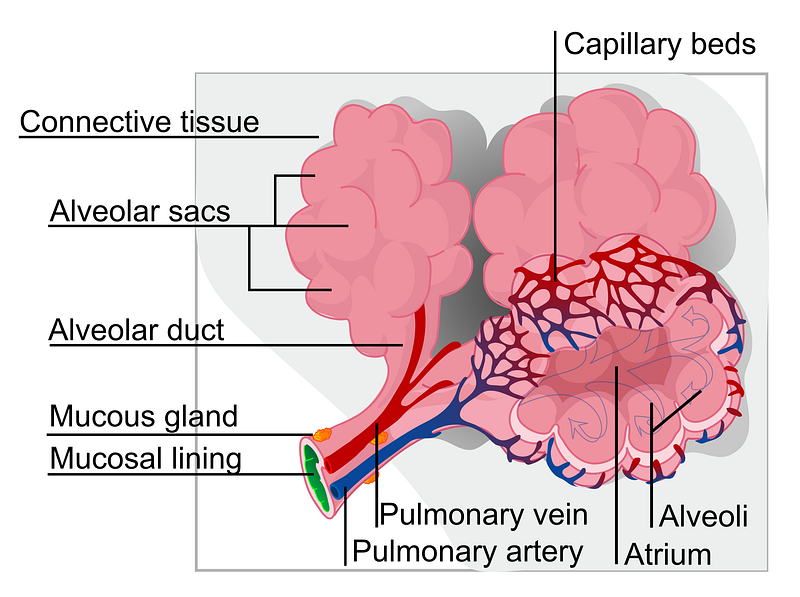
As the professors explained: “Following alveolar-capillary membrane disruption, SARS-CoV-2 enters the pulmonary capillaries and directly infects the pulmonary endothelial cells via ACE-2 protein on the luminal surfaces.”
In a one-liner, SARS-CoV-2 goes from the alveolar epithelial cells to pulmonary endothelial cells — the “epithelial-endothelial crosstalk”.
“As a result, endothelial cells assume a ‘pro-inflammatory’/‘procoagulant’ phenotype,” Professors Jain and Doyle continued. “This accelerates Fas-induced apoptosis of alveolar epithelial and endothelial cells and orchestrates the cytokine storm and the progression of COVID-19 to ARDS.”
From hereon, as blood vessels connect all organs, SARS-CoV-2 has the potential to damage multiple organs, as the autopsies have shown.
Autopsies
Published April in Lancet, researchers in Switzerland analyzed the bodies of three deceased Covid-19 patients. Endotheliitis — inflamed blood vessels — were present in the lungs, heart, small intestines, kidney, and liver. As the authors wrote:
“Although the virus uses ACE2 receptor expressed by pneumocytes in the epithelial alveolar lining to infect the host, thereby causing lung injury, the ACE2 receptor is also widely expressed on endothelial cells, which traverse multiple organs.”
Later on May 21st, the New England Journal of Medicine published an autopsy report on seven Covid-19 victims. Alongside extensive alveoli damage, the lungs also had “distinctive vascular features,” they noted, “consisting of severe endothelial injury associated with the presence of intracellular virus and disrupted cell membranes.” Clotting of alveolar capillaries were also 9x more common in Covid-19 cases than influenza pneumonia controls.
The following day, another autopsy study from Brazil was published. They showed that all 10 Covid-19 cases had ruptured alveoli. But eight (80%) had it with coagulated alveoli arteries (or pulmonary endothelium). Blood vessels and tissues of the heart, liver, kidneys, spleen, lymph nodes, skin, skeletal muscle, testes, and brain were also damaged. As per the study conclusion:
“Our findings show that COVID-19 is a systemic disease with major events in the lungs and the involvement of various organs and tissues such as…”
All these autopsy reports had this in common: The “epithelial-endothelial crosstalk”. Alveoli epithelial cells and pulmonary endothelial cells were both inflamed and ruptured. From the lung vessels, SARS-CoV-2 may then transverse to other organs as the vascular system connects all organs.


