How Gastrointestinal Symptoms Affect Covid-19 Outcomes, Meta-analyses Find
And how often diarrhoea, nausea, vomiting, appetite loss, and abdominal pain occur in Covid-19 cases?

The CDC acknowledges gastrointestinal symptoms as part of Covid-19. The question is: Does the appearance of gastrointestinal symptoms means a bad disease outcome?
What Meta-analyses Say
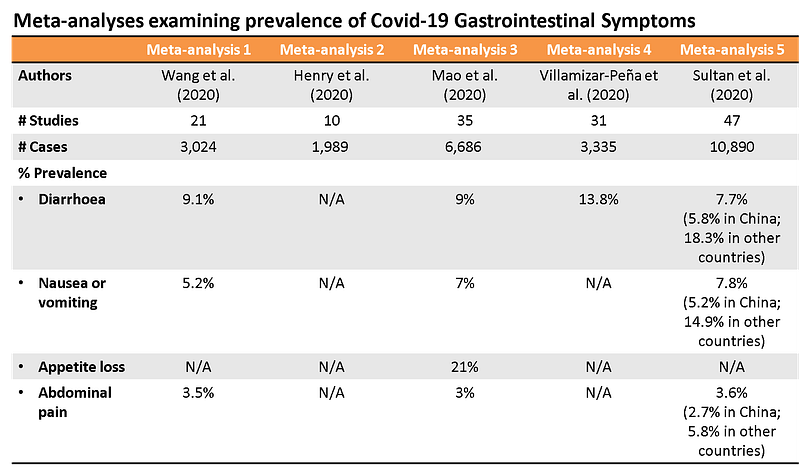
Chinese researchers at the Department of Gastroenterology at Zhongnan Hospital of Wuhan University systematically searched the PubMed database and identified 21 studies for analysis. The pooled sample stands at 3024 Covid-19 patients, of which:
- 9.1% had diarrhoea (based on 19 studies).
- 5.2% had nausea and vomiting (based on 14 studies).
- 3.5% had abdominal pain (based on 4 studies).
Importantly, the prevalence of these symptoms did not differ significantly between mild and severe cases, or between survived and deceased cases of Covid-19. This study implies that gastrointestinal symptoms are not a typical trait of severe Covid-19.
An earlier meta-analysis asking the same question arrived at a similar conclusion. Harmonizing data from 10 studies, the authors found that nausea, vomiting, or diarrhoea was not related to disease severity. But abdominal pain was associated with severe Covid-19, though this result is based on only three studies with near-missed statistical significance (p = 0.45).
A third and most extensive meta-analysis — by eight professors and four medical doctors from China, UK, and Hong Kong — provides conclusive insights on this matter. Their paper — published in the distinguished Lancet Gastroenterology and Hepatology journal — analyzed 6686 Covid-19 patients from 35 studies, of which:
- 9% had diarrhoea (based on 26 studies).
- 7% had nausea and vomiting (based on 18 studies).
- 21% had appetite loss (based on 8 studies).
- 3% had abdominal pain (based on 6 studies).
“Patients with severe disease were more likely to have gastrointestinal symptoms compared with those with non-severe disease” they found. “More specifically, a higher risk of having abdominal pain (OR 7.10) was observed in patients with severe disease than in those with non-severe disease.” An odds ratio (OR) of 7.10 means 7.1 times increased odds of an event. Whereas the loss of appetite, nausea, vomiting, or diarrhoea had nothing to do with Covid-19 severity in this meta-analysis.
Back to the question: Does the appearance of gastrointestinal symptoms means a bad disease outcome?
Only abdominal pain is an indicator of severe Covid-19; fortunately, it’s the rarest gastrointestinal symptom at about 3% prevalence.
So, if a person with Covid-19 experiences appetite loss, nausea, vomiting, or diarrhoea, there’s no need to worry about it being a sign of severe Covid-19, or a sign of an increased risk of disease progression.
Extra: Looking at the Prevalence More Closely
A separate meta-analysis by researchers at the Technological University of Pereira in Colombia calculated how often diarrhoea occurs among Covid-19 patients. Synthesizing data from 3335 patients from 31 studies, they found a higher prevalence of diarrhoea than the meta-analyses discussed above — at 13.8%.
Also, the American Gastroenterological Association conducted a similar but more extensive meta-analysis. They analyzed papers from preprint servers as well — totalling 47 studies with 10,890 different Covid-19 patients, of which:
- 7.7% had diarrhoea (based on 43 studies)
- 7.8% had nausea or vomiting (based on 26 studies).
- 3.6% had abdominal pain (based on 15 studies).
Interestingly, these numbers changed in subgroup analyses excluding China. In countries except for China — that is, South Korea, Japan, the USA, Australia, Germany, Singapore, and Italy — diarrhoea, nausea/vomiting, and abdominal pain prevalence was 18.3%, 14.9%, and 5.8%, respectively. In China alone, these figures were 5.8%, 5.2%, and 2.7%, respectively.
“Gastrointestinal symptoms are associated with COVID-19 in less than 10% of patients. In studies outside of China, estimates are higher,” the study authors wrote in the highly esteemed Gastroenterology journal.