
Why the Collapse of Al-Qaida’s and the Islamic State’s Leaderships Makes the Prevention of Jihadist Violence More Difficult.
Al-Qaida’s and the Islamic State’s central leaderships are in crisis with the killing of al-Qaida chief Ayman al-Zawahiri in July 2022, and the disappearance of the Islamic State caliph in recent months.
Al-Qaida Central
Though one of the founders of al-Qaida, al-Zawahiri was not as authoritative a leader as his predecessor Usama Bin Ladin, and al-Zawahiri’s tenure also saw a marked decline in the prestige of al-Qaida compared to its offshoot-turned-rival, the Islamic State. Jihadist circles saw al-Zawahiri as uninspiring and ineffectual, and when al-Qaida was successful, jihadists gave more credit to al-Qaida’s regional branches than to its central command.
Even so, al-Zawahiri’s presence reminded group adherents of its original raison d’etre of liberating Islam from Western dominance, and al-Zawahiri had continued contributions to the jihadist project. When confronted with the Islamic State, for instance, he outlined a new jihadist program that placed an unprecedented emphasis on blending into local populations, adopting their grievances, and using this newfound solidarity to achieve safe havens for the group. Al-Zawahiri also reminded jihadists that they should focus first and foremost on attacking the US, Israel, and local rulers that support them, rather than targeting fellow Muslim over matters of creed. In stark contrast with the Islamic State’s targeting priorities, furthermore, al-Zawahiri also instructed jihadists not to attack mosques, marketplaces, or other locations where non-combatants gather, and to refrain from killing religious clerics with whom jihadists disagree.
Al-Zawahiri’s guidelines were very helpful to jihadists in several regions of conflict and allowed al-Qaida’s branches to maintain and expand their presence where Islamic State affiliates failed to do so, such as Yemen. Even in Syria, where former al-Qaida affiliate Hay’at Tahrir al-Sham (HTS) has renounced ties with the central group, HTS still tacitly follows these guidelines as it expands its presence in Northern Syria. In showing greater compatibility with more mainstream views about jihad, furthermore, al-Zawahiri’s guidelines might allow al-Qaida better opportunities to win funds and recruits from the larger Muslim world for its localized struggles against corrupt or un-Islamic regimes.
Nonetheless, because these guidelines focused on the local, the future of al-Qaida itself as a global movement remained under-conceptualized, and this bigger lack of purposefulness, furthermore, became even more acute when the US strike that killed al-Zawahiri in the heart of Kabul, the Afghan capital, exposed al-Qaida’s insufficient succession plan.
Al-Qaida’s succession plan
Even before the killing of al-Zawahiri, al-Qaida suffered major leadership losses that rendered it unprepared to find a successor for al-Zawahiri. For instance, two men who could have inherited the leadership — Abu Khayr al-Masri and Abu Muhammad al-Masri — were killed in 2017 and 2020, respectively. Today, both Sayf al-ʿAdl and ʿAbd al-Raḥmān al-Maghribi might be able to claim the leadership of al-Qaida eventually, but lack the necessary organizational backing for now, as jihadists see both men as subject to Iranian influence. A photo taken before 2015 and posted to Twitter after al-Zawahiri’s death, moreover, showed Sayf al-ʿAdl together with Abu Khayr al Masri and Abu Muhammad al-Masri appearing to live freely in Tehran, implying Iranian patronage. This photo received wide attention in Arabic-language media, serving to further discredit Sayf al-ʿAdl as a viable candidate for the Al-Qaida’s leadership.
Going beyond criticizing individual al-Qaida leaders, furthermore, some jihadists on social media and messaging apps have even made unprecedented calls for disbanding al-Qaida’s central organization and empowering the regional branches to act independently. Not surprisingly, HTS led such calls for other branches to imitate what it had already done. A Tunisian HTS operative, ʿAbd al-Raḥmān al-Idrīsī, wrote derisively on his Telegram channel that al-Qaida’s branches are better off operating independently than communicating through “homing pigeons” with leaders whose whereabouts are never known, and called on North Africa-based al-Qaida in the Islamic Maghrib (AQIM) to be the next to leave the al-Qaida umbrella.
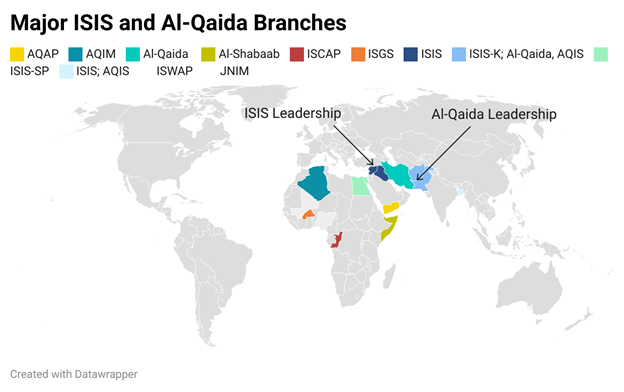
Even with a diminished central command, however, al-Qaida retains very powerful regional branches, such as al-Shabaab in Somalia, al-Qaida in the Arabian Peninsula (AQAP), AQIM, and the Group for the Support of Islam and Muslims (JNIM), which operates in the Sahel region in Africa. The branches have been especially successful when they managed to navigate the local political and tribal landscapes and create local allies. In Yemen, for instance, tribal connections continue to help AQAP persist in its fight against regional and international foes, and severely hamper the activities of its local Islamic State rival.
The strength of the regional branches, then, raises the possibility that al-Qaida might choose one of its regional leaders as the overall chief of al-Qaida. AQAP leader al-Batrafi and AQIM leader al-Anabi, for instance, are the most discussed candidates in jihadist discourses and media speculations. This situation, however, also raises the unsettling possibility of an increase in the tempo of operations of the regional branches as they vie for leadership of al-Qaida, which could also result in an intensified desire to attack international targets.
The Islamic State
In recent years, the senior leadership of the Islamic State has fared no better than that of al-Qaida. In 2019, its first and most authoritative caliph, Abu Bakr al-Baghdadi, detonated a charge that killed him and three of his children when US forces raided a compound in northwest Syria. In February 2022, al-Baghdadi’s successor Abu Ibrahim al-Qurayshi also killed himself and his family to avoid capture in a US raid in Syria, and since then, it has not been clear who currently leads the organization. In May 2022, for instance, Turkey reported that it captured the group’s latest caliph Abu al-Hasan al-Hashimi al-Qurayshi in Istanbul, but other reports allege that the current caliph is not the operative detained in Turkey, but al-Baghdadi’s brother.
Much like al-Qaida, the Islamic State also has very powerful regional branches. Though the group does not currently have a substantial presence in Libya and Yemen, likely because it failed to forge strong alliances with local tribes and armed factions, it is very active in Afghanistan and parts of Africa. Its branch in Afghanistan (Islamic State in the Khurasan Province, or ISIS-K) merits special attention, because it has been consistently present in the country and seems to rely on a solid operational network in Afghanistan.
Composed of seasoned ex-Taliban and al-Qaida forces, ISIS-K has a wide reach within Afghanistan to strike targets across the country and beyond. Locally, it is currently focused on attacking Taliban and Shiite targets, and regionally, it has targeted neighboring Central and South Asian countries. ISIS-K has launched many attacks in Pakistan, and claimed attacks in Iran, Uzbekistan and Tajikistan. Internationally, ISIS-K has recently threatened Russia, which has formulated a deal to sell Russian oil and gas to the Taliban, and China, which is expanding its Road and Belt Initiative in Afghanistan-Pakistan. As the US considers unfreezing Afghan funds that might aid the Taliban regime and resumes talks with the Taliban, ISIS-K will have a greater incentive to launch attacked against the US and might utilize its reach into Central and South Asia for this purpose.
ISIS-K has so far been unable to establish lasting government apparatuses over populations it controls in Afghanistan, which is important because such governance would be a major indicator of ISIS-K’s strength, and potential ability to assume the overall leadership of the Islamic State organization. In this regard, the group might follow the Islamic State’s 5-step strategic plan outlined in the first issue of Dabiq magazine: migration to suitable lands (hijrah), organization (jamāʿah), destabilizing heretical leaders (Ṭāghūt), consolidation of power (tamkīn), and finally establishing governance (Khilāfah). If ISIS-K can establish governance over populations, this would impose considerable risks to the US and its allies in Asia and might warrant a renewed US intervention in Afghanistan.
Examining ISIS-K’s activities also allows us to estimate the conditions in which the Islamic State can entrench its presence. As has been shown in in both Libya and Yemen, the combined factors of weak central governance, local conflict, and sectarian divides are not enough to assure Islamic State’s success to gain influence in a region of conflict. In Afghanistan and Africa, the Islamic State was able to succeed because it co-opted local armed factions who were already active in these regions and shifted their allegiance to the Islamic State. In areas where this co-option cannot happen, the Islamic State’s doctrinal rigidness and inflexibility will usually stand in the way of its ability to gain local allies, protectors, and resources.
What to expect next
Even though al-Qaida seemed to have lost the battle for primacy in jihadist circles with the rise of the Islamic State, its ability to embed itself better in local conflicts remains an advantage over the Islamic State’s brutal and rigid tactics, and this ensures that al-Qaida will remain a threat in multiple regions for the foreseeable future. Even if al-Qaida is unable or unwilling to appoint an overall commander, its jihadist agenda will nevertheless survive through its regional branches, and even proliferate into multiple independent movements that will each require their own security attention.
Regarding the Islamic State, irrespective of the existence or visibility of its caliph, the main question is whether the group will be able to transition back to governing territories like it did in Iraq and Syria between 2014–2017. Because there are several possible locations in Africa or Central Asia, for such a transition to take place, it is of prime importance to follow this issue closely.


