
The Relevance of Yusuf al-Qaradawi’s Writings on Islamic Warfare to the Spread of Terrorist Propaganda.
In late September 2022, Yusuf al-Qaradawi, the most influential Muslim scholar of the 20th century, passed away at 96, leaving behind a legacy of contradictory legal opinions that altered the lives of millions in the Middle East and beyond. An opponent of female circumcision and a critic of the September 11th attacks, Qaradawi nonetheless promulgated extremist ideologies, and with a rhetorical sophistication that calls for a more nuanced effort to identify jihadist content as terrorist propaganda.
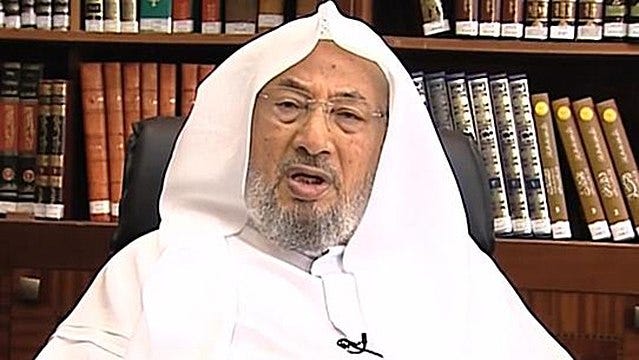
Though reviled by Islamic State and al-Qaida supporters, Qaradawi’s intellectual legacy commands respect in other jihadist circles, and his definition of jihad is influential in multiple regions of conflict. Leaders of Hay’at Tahrir al-Sham (HTS), a jihadist faction in Syria that the US designates as a terrorist group, have mourned Qaradawi’s death, and so did the Taliban. A eulogy issued by HTS’ religious guidance council mentions specifically Qaradawi’s support for the mujahidin in Syria in their struggle against Assad’s regime and Qaradawi’s opposition to Iranian interference in Iraq and Syria. Other rebel groups in Syria have also issued similar announcements mourning Qaradawi’s demise.
Despite Qaradawi’s efforts to combat extremist use of the doctrine of jihad, his own definitions of defensive jihad have provided a cover of legitimacy for local jihadist groups operating in multiple theaters of conflict. Those who try to implement his rulings by aiding local jihadist struggles, furthermore, are in direct violation of U.S. laws that prohibit joining or providing material support to designated terrorist organizations.
Nowhere is Qaradawi’s legacy more complex than in his writings about Islamic warfare, or jihad. In 2009, Qaradawi published a 2-volume book on this subject. With some exceptions, he did away with the notion of offensive jihad (jihad al-talab) by arguing that the emergence of the modern nation state nullifies any duty Muslims had to wage raids against enemies. Muslim countries can now fortify their defenses and dismantle the enemy’s ability to wage attacks against them, without any need for offensive efforts.
Qaradawi also developed a unique notion of “civil jihad” that subsumes all aspects of the normal activities of the state into a jihadist project, if these activities strengthen the state in terms of economic, educational, social, and military capacities, and enable it to deter potential enemies. Even in strict military terms, Qaradawi was committed to progress and technological sophistication. He asserted, for instance, that naval jihad is more meritorious than jihad carried on land and created a new category — airborne jihad (jihad al-jaw). Pilots working in the national air force were to him the most commendable of jihadists.
To some, the notion of “civil jihad” might seem innovative, giving Muslims the approval to focus on the development of their societies while reaping the advantages of religious virtue in their actions. This notion is also a testament to Qaradawi’s independent spirit and his ability to devise new interpretations of religion that align with modernity. In this, he may be a true heir to Muhammad Abduh, the founder of the modern Islamic current of reform.
Qaradawi’s definition of defensive jihad, however, is much more conservative than his definition of offensive jihad and follows classical sources more closely. This definition proved more crucial and formative for the Arab Spring events. Qaradawi defined defensive jihad as a duty imposed on all Muslims when they face an invasion or occupation by foreign or un-Islamic forces. In this paradigm, all able-bodied Muslims must fight, and if the local population fails to fight the invaders and occupiers, their neighbors must join the fight, in widening circles until the obligation encompasses the entire community of Islam. According to Qaradawi, A son might join such a jihad without the consent of his parents, and a woman without the consent of her husband.
Even so, Qaradawi did not want life in Islamic communities to come to a halt if everyone rushed to join the fight. Al-Qaradawi in his 2-volume treatise stated: “the duty of the community here is not that everyone physically moves to the land of warfare. This is not possible nor helpful. The obligation is that everyone helps their brethren, with everything within their ability, and supplies them with weapons, equipment, funds, and men, and answers their requests as quickly as possible.” The flow of recruits and funds from Muslim communities worldwide to jihadists in conflict regions, which reached its zenith while the Islamic State’s “caliphate” held territories in Iraq and Syria between 2014 and 2017, exhibited a remarkable correspondence to what Qaradawi saw as legitimate jihad, and suggests the relevance of his ideas.
Regarding the attitude to non-Muslims, Qaradawi stresses that Islam should not wage wars to spread the faith or fight infidelity, only to counter aggression. He also stresses that the non-Muslim world should be the abode of agreement (dar al-ahd) rather than the abode of war (dar al-harb), with the only exception being Israel, where martyrdom operations (suicide attacks) are permissible. Al-Qaradawi also opposes declaring fellow Muslims as infidels, denying the Islamic State any religious justification for waging its gruesome attacks against Shiites in Iraq, Afghanistan, and beyond.
Qaradawi’s portrayal of defensive jihad as an individual duty, however, subverts his own attempts to cast jihad as a monopoly of the state. For those who wish to be pious, the need to act individually to aid jihadists exerts considerable pressures. The events of the Arab Spring were particularly susceptible to such an interpretation — not only was there a chance to rid Muslims of foreign presence, but there was also a chance to rid Muslims of corrupt and un-Islamic rulers, something that Qaradawi himself encouraged when the revolutions unfolded in multiple Muslim countries.
As the Arab Spring evolved, state-building efforts and attempts to create entities governed by “true” Islamic principles joined ideologies of defensive jihad in the agendas of jihadist groups. After the Islamic State in Syria and Iraq succeeded for a while in establishing governing apparatuses through its “caliphate”, Al-Qaida factions too began to portray an increasing interest in governance. HTS, which broke off from al-Qaida, is currently involved in such a project, which HTS promotes extensively on its government’s official website, and is fighting and co-opting rivals as it solidifies its control in Northern Syria. In this respect, there seems to be very little difference in governance according to al-Qaida or HTS, as they both advocate for conservative Sunni theocratic governance, rather than democratic rule.
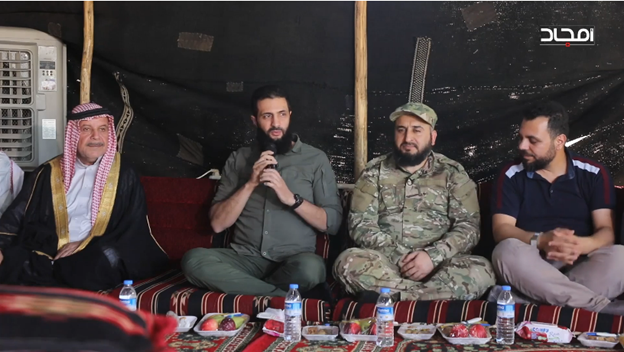
De-platforming content that advocates for jihadist objectives can be exceedingly difficult, since it often lacks the obvious markers of harmful content — such as graphic violence or hate speech — found in the publications of the Islamic State, for instance. Currently, local jihadist groups in Syria and Afghanistan enjoy greater freedom to post on social media than their Islamic State or al-Qaida counterparts, especially regarding their religious and public outreach efforts.

Nevertheless, some of this content can reinforce extremist interpretations of jihad and help these groups in recruitment and raising of funds online, especially considering the multiple social media and messaging apps these groups have at their disposal. HTS’ leaders, for instance, communicate with their supporters through Telegram channels, where they speak more freely without fear of removal, but their propaganda on religious doctrine, defensive jihad, and governance is still on mainstream social media, especially when it does not depict outright violence.
The jihadist project unfolding in Syria and several other regions of conflict is now different than al-Qaida’s initial focus on attacking the West, or the Islamic State’s abhorrent violence against religious minorities. It is now much more embedded in local struggles and aims to introduce theocratic governance gradually while taking advantage of local grievances. Qaradawi contributed to this project by setting the terms under which jihad is permissible from a religious perspective, thus arming jihadists with justifications for their actions, and promoting a fusion between the normal duties of the state and “civil jihad.”