Why the Best Art Isn’t Very Commercial
We live in a world where uncertainty is equated with anxiety instead of with life

Pro-human art and culture question the value of pat narratives. They produce open-ended stories, without clear victors or well-defined conflicts. Everyone is right; everyone is wrong. The works don’t answer questions; they raise them.
These are the “problem plays” of Shakespeare, which defy easy plot analysis, as characters take apparently unmotivated actions. They’re the abstract paintings of Kandinsky or Delaunay, which maintain distance from real-world visual references. These images may represent figures, but only sort of. The observing human mind is the real subject of the work, as it tries and fails to identify objects that correspond perfectly with the images. And this process itself mirrors the way the human brain identifies things in the “real” world by perceiving and assembling fragmented details. Instead of giving us clear representation — this is an apple! — art stretches out the process of seeing and identifying, so that we can revel in the strange phenomenon of human perception.
We experience the same sorts of challenges watching the movies and television of David Lynch, who is likely to leave the camera on a character just sweeping the floor or smoking a cigarette for five minutes or more. Lynch is training us to let go of conventional story expectations so that we can learn to watch for something else — for the behavior of the humans in the scenes, for the activity that emerges out of boredom, and for the relationship of the characters to their world. Lynch is intentionally denying his audience the engagement that comes with tension and release, or even just plot. The various conspiracies in his stories don’t even add up. That’s because we’re not supposed to be looking there.
As novelist Zadie Smith puts it, the writer’s job is not to “tell us how somebody felt about something; it is to tell us how the world works.” Such art no longer focuses on the protagonist and their heroic journey, but on the relationship of the figures to the ground. In doing so, it activates and affirms the uniquely human ability to experience context and make meaning.
Of course, the work of filmmakers, artists, and novelists creating in this way is emphatically countercultural — if for no other reason than that it questions traditional narratives and heroic, individualistic values. Any art that asks its viewers to slow down or, worse, pause and reflect is hurting a market that depends on automatic and accelerating behaviors. Film schools don’t teach anti-plot, studios don’t produce it (knowingly), and audiences don’t commonly reward it. That’s often used as an argument for its inferiority and irrelevance. If this stuff were really more human and deeply rewarding on some level, shouldn’t it do better at the box office?
Commercial work with a central figure, rising tension, and a satisfying resolution succeeds because it plays to our fears of uncertainty, boredom, and ambiguity — fears generated by the market values driving our society in the first place. Moreover, we live in a world where uncertainty is equated with anxiety instead of with life. We ache for closure. That’s why people today are more likely to buy tickets for an unambiguously conclusive blockbuster than for an anticlimactic, thought-provoking art film. It’s because we’ve been trained to fear and reject the possibility that reality is a participatory activity, open to our intervention.
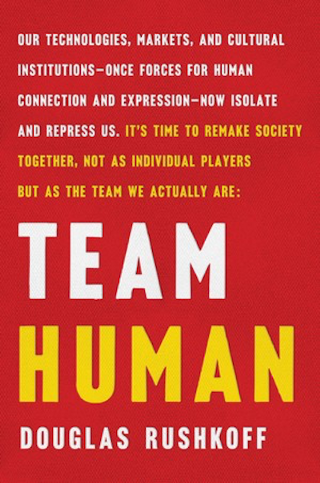
This was section 61 of the new book Team Human by Douglas Rushkoff, which is being serialized weekly on Medium. Read the previous section here and the following section here.