Why St. Faustina Called Suffering One of the Greatest Gifts
St. John Paul: “On the Christian Meaning of Suffering”
Life was normal until “the call.’’ Then, surgery, prayer, wondering what’s next: Death? Weeks of decline? Suffering — and thoughts of suffering?
“If the angels were capable of envy, they would envy us for two things: one is the receiving of Holy Communion, and the other is suffering,” St. Maria Faustina Kowalska (1905–1938) wrote in her famous diary.
To show the children of God can receive the same message at the same time: Half a world away in Canada, Blessed Dina Bélanger (1897–1929) wrote: “If the angels could desire anything, it seems to me that they would envy us our privilege of suffering, as well as the priceless gift of the Eucharist.”
Their words on suffering and the Eucharist leaped out when I first heard Father Frank Pavone quoting Faustina.
The instinctive American response: “Suffering a gift? Why would anyone say that?’’ Americans cherish “the pursuit of happiness’’ and run from or avoid all suffering.
You have to go through the agony of suffering again to be reminded of what these holy people meant. On the Feast of St. John Paul the Great, it also helps to read “On the Christian Meaning of Human Suffering,” aka Salvifici Doloris, John Paul’s important February 1984 Apostolic letter.
Easier to suffer than to watch a close loved one suffer
Many problems, a team of doctors looking at a long list of wounds and health problems at once. “Everything is starting to go to hell: all that smoking is finally killing me, I guess,’’ she sighed in an accepting “it is what it is’’ way.
How did Mary withstand the crucifixion of her only son? It’s easier for me to suffer than to watch a loved one feeling horrible.
Pandemic rules compound this: Patients are allowed one visitor per day so visiting means representing the whole family, doing all the support.
So I asked my friends for prayers, and a dear friend who lost a son the day before his boy turned 21 explained our mission perfectly: “As best you can, let gratitude be the driving force behind your thoughts and lens through which you see every interaction. THAT is the aroma of Christ.’’
That’s easier said than done when you feel the other’s suffering in their words and the mere vision of how they look, how they’ve changed in a few months, and over half a century. Every little pain is magnified.
The nurses come struggling to lift her. The hospital garments don’t preserve modesty, so this becomes embarrassing. Everything seems to be falling apart, and then she says this:
“It’s a beautiful day.’’
And you think, “What?’’ Then you “get it.’’ God gives us near-perfect bodies at birth, and we beat ourselves up, and life beats us up until every part of us seems shot. Similarly, every relationship starts with so much potential, and we mess things up, and life messes things up.
Why do we pray on our knees? To surrender
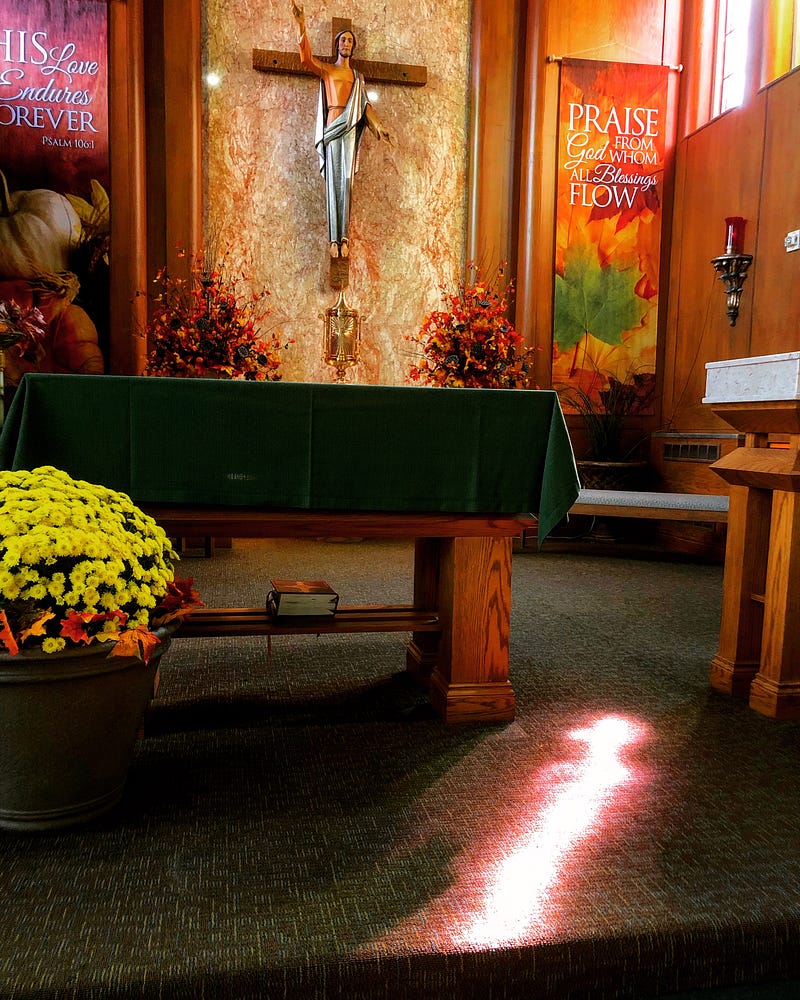
I went to the empty chapel to pray and immediately noticed a ray of light, shaped almost like a man’s shadow.
Except this shadow wasn’t dark: it was light upon the altar in the shape of a human. Immediately, I knew I wasn’t alone.
When we suffer, we surrender, falling upon our knees; the perfect way to pray and listen intently.
Life is still beautiful. When our loved ones are facing suffering or death, everything is reset. The suffering need us, and we know we need to help so all shields and defenses and walls of resistance collapse.
So many dear friends had falling outs with parents or spouses or children, but in the end, they knew they needed to be there, talk with them, see them fragile and in need and love them again, heal those hearts. And their own.
Many of the great saints suffer like St. Faustina, who died of tuberculosis at age 33, suffering greatly in her final years.
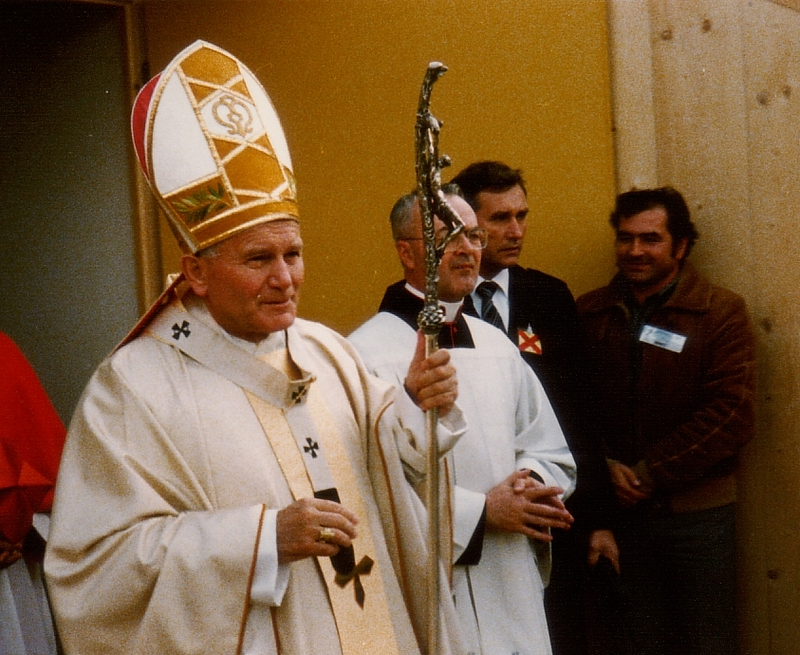
St. John Paul the Great suffered over a long lifetime
St. John Paul the Great was orphaned, losing his entire family by age 20,before facing the evil of Nazi Germany and Soviet communists.
And the sportsman faced an embarrassing, debilitating disease that forced us all to see him decline and whither from the animated man full of life to a grandfather figure barely able to move.
Even in dying and death, he was a father teaching us how to live, how to suffer, and how to begin the final journey home.
“The question: why?’’ John Paul writes. “Man can put this question to God with all the emotion of his heart and with his mind full of dismay and anxiety, and God expects the question and listens to it.’’
Death is a liar. Divorce is a lie. Goodbyes are rarely, if ever, truly final. Eventually, something forces us to meet again, somehow, heal wounds and reconcile, to make things right before truly closing one door to move into the next.
“Suffering must serve for conversion, that is, for rebuilding of goodness… Love is also the fullest source of the answer to the question of the meaning of suffering. This answer has been given by God to man in the Cross of Jesus Christ,’’ St. John Paul wrote.
You face it whenever you lose someone you love or a part of someone you love. The loved one can remain right in front of you when their body is falling apart? The person you thought would always be there reminds you that every moment of life is a gift.
“Suffering is present in the world in order to release love,’’ — St. John Paul the Great.
We begin and end our lives completely helpless: dependent on the love of family to lift us, to feed us, to help us go to the bathroom. In between birth and death, we grow, and we learn and make mistakes. But always, we want more and have a destination in mind.
“If one becomes a sharer in the sufferings of Christ, this happens because Christ has opened his suffering to man, because he himself in his redemptive suffering has become, in a certain sense, a sharer in all human sufferings. Man, discovering through faith the redemptive suffering of Christ, also discovers in it his own sufferings; he rediscovers them, through faith, enriched with a new content and new meaning.’’ — St. John Paul the Great.
A wise priest once asked a haunting question: what would Christianity be like if Jesus and His Apostles had all died of old age? Resurrection changes everything.
When another relative was losing everything, her ability to think and remember, see, hear, and move, one thing remained. She kept trying to get up, saying, “I just want to get home.’’
And so it is with all of us. At the end of his life, John Paul said he just wanted to return to His Father’s House.
As John Paul explained: “It is suffering, more than anything else, which clears the way for the grace which transforms human souls.”
John Paul explains:
“The witnesses of the Cross and Resurrection of Christ have handed on to the Church and to mankind a specific Gospel of suffering. The Redeemer himself wrote this Gospel, above all by his own suffering accepted in love, so that man ‘should not perish but have eternal life’…The parable of the Good Samaritan belongs to the Gospel of suffering. For it indicates what the relationship of each of us must be towards our suffering neighbor.’’