
When John Paul Met Faustina, the First Saint of the New Millenium
“Have mercy on us and on the whole world”
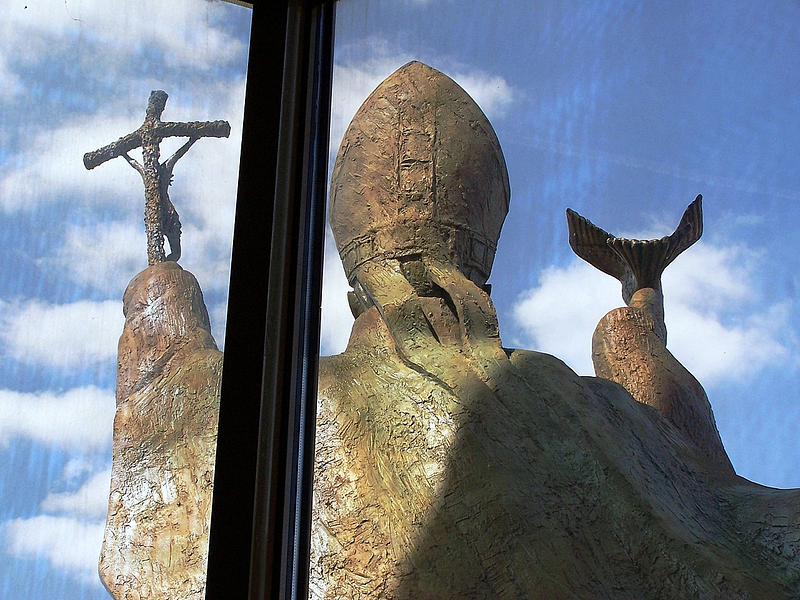
e,_statue_of_John_Paul_II.jpg)
Did St. John Paul the Great and St. Maria Faustina Kowalska meet in Heaven or Poland? The lives of the two Apostles of Divine Mercy are intertwined.
“The Message of Divine Mercy has always been near and dear to me… which I took with me to the See of Peter and which it in a sense forms the image of this Pontificate,” John Paul said.
Faustina seemed to describe visions of St. John Paul’s pontificate twice in her diary written in the 1930s, and John Paul had important spiritual connections with Faustina from the 1940s until the end of his life.
He began the cause for her sainthood as a bishop. Most strikingly, he called her canonization the happiest day of his life and died on the vigil of Divine Mercy Sunday, the important day Jesus called for in her diary.
Her diary twice references the first Polish pope, seeing things few had imagined: globally available television, massive jumbo screens, and the satellite technology allowing crowds in two parts of the world(Poland and Rome) to see each other.
Here’s how she described it on March 23, 1937:
“Suddenly, God’s presence took hold of me, and at once I saw myself in Rome, in the Holy Father’s chapel, and at the same time, I was in our chapel. And the celebration of the Holy Father and the entire Church was closely connected with our chapel and, in a very special way, with our Congregation.
“ And I took part in the solemn celebration simultaneously here and in Rome, for the celebration was so closely connected with Rome that, even as I write, I cannot distinguish the two but I am writing it down as I saw it.
“I saw the Lord Jesus in our chapel, exposed in the monstrance on the high altar. The chapel was adorned as for a feast, and on that day anyone who wanted to come was allowed in. The crowd was so enormous that the eye could not take it all in.
“Everyone was participating in the celebrations with great joy, and many of them obtained what they desired. The same celebration was held in Rome, in a beautiful church, and the Holy Father, with all the clergy, was celebrating this Feast, and then suddenly I saw Saint Peter, who stood between the altar and the Holy Father. I could not hear what Saint Peter said but I saw that the Holy Father understood his words…
“Then suddenly I saw on our altar the living Lord Jesus, just as He is depicted in the image. Yet I felt that the sisters and all the people did not see the Lord Jesus as I saw Him. Jesus looked with great kindness and joy at the Holy Father, at certain priests, at the entire clergy, at the people, and at our Congregation …
“When I came to myself, a profound peace was flooding my soul, and an extraordinary understanding of many things was communicated to my intellect, an understanding that had not been granted me previously” (Diary of St. Faustina, 1044–1048).
The two souls seemed connected for decades and into eternity
Both lived in Krakow at the same time, albeit only for a few months in 1938. St. Faustina died there of tuberculosis at age 33. John Paul, then known as Karol Wojtyla, moved there at age 18.
They both did their work in the Kraków-Łagiewniki neighborhood, and their spirits seemed to connect for decades afterward:
- The young Karol Wojtyla moved to Krakow with his father in summer 1938 to prepare for the Jagiellonian University and knew of her soon after her October 5, 1938 death.
- During his freshman year starting in fall 1938, Wojtyła studied philosophy, Polish language and literature, Russian, Old Church Slavonic, and French.
- On September 1, 1939, less than 11 months after Faustina’s death, Nazi Germany invaded Poland, joined by the communist Soviet Union 17 days later. The Germans quickly occupied Krakow.
- During the occupation, Wojtyla’s professors were arrested or killed. The university was shut down. He had to work in a limestone quarry and later at a chemical factory near Faustina’s convent.
- Wojtyla prayed at her convent (which he passed daily on his way to work), seeing the Divine Mercy Image she inspired. Fragments of her famous diary were copied and passed around, touching his heart.
- As a bishop in 1965, he began the investigation that led to her cause for sainthood.
- He would not read her complete diary until after he was shot in May 1981. His first encyclical, similarly on Divine Mercy, Dives in Misericordia, completed in November 1980, is seen as being “written in the same spirit” as the diary she wrote in the 1930s.
- After two miracles were investigated and confirmed, the pope made her Blessed Faustina in 1993 and St. Maria Faustina Kowalska in 2000, the first saint of the 21st century and New Millenium. He called the day she became a saint “the happiest day of my life.’’
- During the canonization in 2000, John Paul established Divine Mercy Sunday, something Jesus asked of Faustina.
- In 2002, John Paul entrusted the whole world to Divine Mercy while consecrating the International Shrine of The Divine Mercy in Lagiewniki. St. Faustina is buried there, a few meters from the Solvay Quarry where he worked. A John Paul Center is now next door to the Shrine.
- John Paul died in April 2005 on the vigil of Divine Mercy Sunday, receiving a few drops of the precious blood of Jesus in a vigil Mass just before he died.
Weigel: “There was a physical connection’’
“There was a physical connection between the two of them in the sense that he would pray in that chapel,’’ John Paul biographer George Weigel explains.
“Here was a young man who was almost killed on numerous occasions during the occupation. Where does he go to try to make some sense of it all? The chapel where Faustina herself prayed and where the Image of the Divine Mercy is displayed. That’s another seeming coincidence, that, in the Designs of Providence, was not a coincidence’’
Faustina’s most powerful words about John Paul seemed to predict his whole pontificate and role in the collapse of communism. She writes these words from Jesus to her:
“I bear a special love for Poland, and if she will be obedient to My will, I will exalt her in might and holiness. From her will come forth the spark that will prepare the world for My final coming” (Diary, 1732).