
Living in Japan
Why So Many Foreigners Who Move to Japan End Up Hating It
These are five very common reasons why many decide to say sayonara to Japan.

“I’m moving back. I’m fed up with this country.”
An acquaintance announced that she was packing her bags and moving home.
“Done and dusted,” she emphasized, with a certain weariness that spoke to her profound disillusionment. She highlighted that she had lived in six countries, and Japan was the worst that she had lived in.
The oft-heard story of the foreigner who moved to Japan, only to hate life in the country is an exceedingly common one. A YouTube video on this phenomenon has already gotten over six million views at the time of writing!
I’ve lived in Japan for close to six years now. I’ve seen foreigners who were initially excited to move to Japan turn quite bitter and ultimately end up hating Japan and leaving the country.
In this case? She gave the following reasons:
- “There’s no gender equality and the ladies are useless.”
- “I couldn’t save any money!”
- “Insular Japanese salarymen.”
- “People are criminally polite.”
- “I couldn’t express my thoughts.”
In this article, I address these five points. All of them are well-known issues that everyone considering moving to Japan should think carefully about.
#1 “There’s no gender equality and the ladies are useless.”
Please do not misunderstand me — it is neither my intention to claim the above nor to criticize Japanese society.
I am merely citing the reason I was given. Still, at some level, it is not entirely untrue.
This is not the fault of Japanese women.
As Yuko Tamura has written passionately on multiple occasions, Japanese society puts women on a lower level.
Living in this nation as a woman is often tough. Japanese women are still expected to be cute and silent in many cases.
— Finding My Voice as a Japanese Woman — Why Hello Kitty Needs a Mouth
This is where I need to recognize my male privilege. I have never had to suffer the problem of gender inequality, and I am thankful for that. But Japan has voices that are calling for a wider change in how women’s roles in society are valued.
Slowly but surely, I believe the situation is improving for women.
The percentage of women in management increased to 15% in 2020 from just over 10% in 2013. Yes, it is still lagging behind global standards (the global average is around 26%).
It might not be to your expectations. Change doesn’t happen overnight, and certainly not in Japan.
But Japan does change.
#2 “I couldn’t save any money!”
This is a common complaint, made not only by foreigners but by Japanese people as well. When I first moved to Japan, I was shocked at how high the taxes were.
Average salaries have remained stagnant for thirty years. It’s so bad that Prime Ministers have had to resort to asking the Keidanren (a consortium of the big companies) to increase salaries.
This ritual has been going on for quite some time, and one wonders if this actually does anything to address the problem. Abe did it before Kishida. And Kishida is simply repeating what Abe did.
Low salaries are just one part of the problem. Japan is a highly socialistic country. As a good Japanese friend would often say,
「日本は共産主義でからすね。」
Japan is a communist (socialist) country.
Not only do you pay income tax, but you also pay residence tax to your local government. You also need to be enrolled in the mandatory National Health Insurance Program and the National Pension System.
To pay for that, monies will be deducted from your salary every month.
Automatically.
What you are left with every month after all these deductions can be quite shocking.
Japan has some of the highest top marginal income tax rates globally.
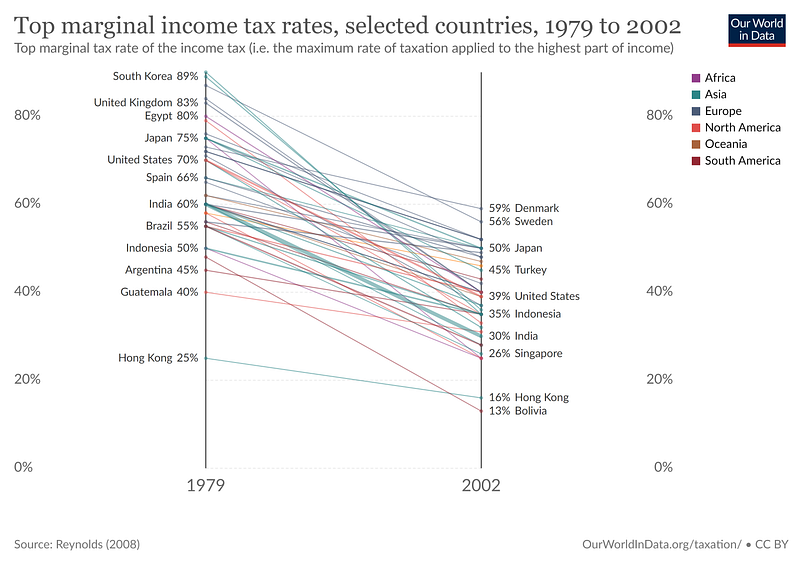
Tip: To calculate how much will be deducted from your income, you can click on this very useful tax simulator.
This is the price you pay for living in a hyper-aged country where nearly 30% of the population is aged above 65.
In Japan, companies are also obliged to pay out overtime pay to non-managers. Caveat — some “black companies” don’t, and some employees don’t report overtime work.
Overtime income is subject to taxes as well. The more one makes, the more one is taxed. It seems like a lose-lose situation if your primary goal is to save money in Japan!
The saving grace?
If you ever need a root canal treatment in Japan, you will be relieved that you will get away with fees that could be much higher somewhere else!
#3 “Insular Japanese salarymen”
Japanese salarymen are often accused of being insular. There is perhaps some truth to the statement, even if I am ambivalent about this sweeping statement.
Still, in my opinion, Japan is not as insular as people like to think.
Japanese people are heavy users of the major social media platforms that most of the world uses. Around half of the Japanese population are on Twitter and Instagram, and 30% are on Facebook.
Yes, although the language barrier exists, there is no artificial, government-erected firewall to block Japan from the rest of the world.
And, although today, Japanese companies are notably absent from the list of the global companies by market capitalization, some of Japan’s major companies and brands remain globally recognized.
Think of Toyota, Sony, or even Nintendo, Uniqlo— all of these companies have remained globally relevant. Softbank’s Vision Fund is a major venture capital investor in many startups in the world.
Still, this is indeed but a handful of companies.
The majority of Japan’s companies — 99.7% — are small-medium enterprises — not global corporations.
Like many things in life, the reality can be quite extreme. Some Japanese people I have met are some of the most global people in the world; at the same time, most Japanese will never have contact with the world outside of Japan.
According to Nikkei Asia, in 2019, despite having the world’s best passport, only 23% of Japanese people owned one.
It’s often said that Japanese business people are not good at English; a lack of proficiency in English — the global lingua franca of business — certainly adds to the perceived insularity of Japanese business people.
When dealing with Japanese businesses, it is common for translators and interpreters to be involved. Poor business English proficiency also leads to diminished global opportunities.
But, one needs to put this into a reasonable context. Japan is the third-largest economy in the world. Until recently, most Japanese business people had no strong incentive to be proficient in the language.
Apart from a few global companies with global operations, most Japanese companies could afford to focus on the domestic market. Most domestic companies had no real need nor reason to reach out to the world.
With the shrinking population and accelerating digitalization, I expect Japan to become less insular over the next decade.
Time will tell.
#4 “People are criminally polite”
Calling politeness “criminal” is an interesting phrase. And to be honest, it is the first time I have heard this kind of expression.
At the risk of sounding insensitive to this complaint, part of this stems from cultural misunderstanding.
People ascribe too much of their own cultural baggage to Japanese politeness.
In Japanese culture, the act of hiding your true feelings (honne) and presenting a certain face — known as “tatemae” to the world is an emotional and social skill.
Being polite in Japan has nothing to do with being nice. Politeness in Japan is simply social decorum. And many people who are not familiar with Japanese culture tend to misunderstand politeness for niceness.
These are two different things.
In Kyoto, it is often said that if a host wants you to leave, the host will ask you if you would like to have another cup of tea. That is the unspoken signal for you to take your leave.
Still, this one baffles me a little. I was always taught to be polite, so I don’t understand what the against politeness.
Even if politeness is feigned.
As Timothy Sullivan writes,
When true harmony cannot be achieved in Japan, surface harmony is the next best option.
— The Secret to Managing Your Japanese Boss
I suppose the motivation comes from preferring everyone to be “authentic” — to “be themselves,” rather than putting on masks in social interaction. This could boil down to both personal and cultural background and is beyond the scope of this article.
In any case, foreigners to Japan can avoid the problem with some language and cultural training — understanding honne and tatemae — for a start, would likely help a lot before moving to Japan.
#5 “I couldn’t express my thoughts”
It is can be challenging to express your thoughts in Japan as a foreigner. This is even more so the case if you cannot speak and understand Japanese.
In business settings, Japanese will most likely be the primary language of communication, and the companies that have adopted English as an official are few and far between.
So, if one is seriously considering moving to Japan, learning Japanese — even minimally — will ease the transition.
If you’re willing to learn Japanese — which is going to demand a lot of time and effort from you, you might be able to circumvent this issue. Still, recognize that you won’t be able to pick up Japanese in under two months, unlike what some ads are claiming. Japanese is one of the most difficult languages in the world to learn.
Part of the problem for foreigners is also cultural. In Japanese companies, decisions are often made outside official meetings — they are often made in informal situations.
Official meetings are usually just formal rituals to officially announce what has already been decided beforehand.
This is the famous “nemawashi” (根回し) in Japanese organizations. Nemawashi literally means “turning the roots.” The term comes from gardening. Before transplanting a tree, a farmer or gardener needs to take special care to dig around the roots and trim carefully, to ensure that the tree will take root properly and effectively.
Timothy Sullivan does a great job of explaining this in his story The Secret to Managing Your Japanese Boss.
Lack of proper nemawashi leads to a failure to manage upwards. One ends up wondering why proposals do not get approved by management, which can accentuate the feeling of failure to communicate.
Summary
In short, the reasons why this acquaintance of mine left Japan are multiple; her story is a common one.
The five reasons may not have been exhaustive, but they are certainly big deal-breakers for some:
- Gender inequality
- Low average salaries and high taxes
- Insularity
- Feigned politeness
- Difficulty in communication
It is not the intention of this article to offend anyone, much less dissuade anyone interested in Japan or Japanese culture from moving to Japan.
It is, however, an invitation to understand what may be in store for the intrepid foreigner brave enough to move to Japan.
In Part II, titled 6 Questions You Must Carefully Consider before Moving to Japan, I share some advice from my own experience for those who are set on moving to Japan. Hopefully, this will help those considering moving to Japan make a better decision.
©Alvin T. 2022
If you like this article, please follow Japonica for daily articles about Japan and Japanese culture.
The author is an editor of Japonica and also writes on a wide variety of topics. His key topics are society, culture, modern work, and cryptocurrency, with the occasional fictional story, creative piece, or reflective essay. Discover his most-read stories here.
If these topics interest you, consider subscribing to receive new stories from the author via e-mail.


