
Why People Born 1955–1964 Aren’t Baby Boomers
Ode to Generation Jones: punks, yuppies, but never hippies

In a documentary on the 1970s punk scene, an interviewee (born in 1959) explained how he didn’t identify with the typical Baby Boomer characteristics and that he was too old to be a Gen X. He felt as though he didn’t belong and just defined himself as a punk.
I often wondered about this group of people. They’re officially classified as Baby Boomers, yet coming of age during “Anarchy in the UK” must have given them a totally different life experience from those who came of age during “Give Peace a Chance”.
Turns out the man in the documentary was a member of Generation Jones. Turns out the 1980s yuppies of the Reganomics era were also Generation Jones.
I’m Generation X and Generation Jones was the cool older sibling I looked up to and relied on for music suggestions. I had way more in common with Generation Jones than I did with my traditional Baby Boomer parents who listened to British Invasion music before growing their hair long.
“Between Woodstock and Lollapalooza, between ‘Turn on, tune in, drop out’ and ‘Just Say No,’ and between Dylan going electric and Nirvana going unplugged, an invisible generation has been silent.” GenerationJones.com
Overlooked even more than Gen X, Generation Jones is the coolest generation you never heard about.
Who is Generation Jones?
Roughly speaking, Generation Jones are born between the mid-50s and the mid-60s. Like the older Boomers, they were born during a period of high birth rates and economic boom.
How did they get their name?
The term Generation Jones was coined by social commentator, Jonathan Pontell. The 1970s slang “keeping up with the Joneses”, or jonesin’ for short, embodied craving or yearning.
The yuppie members of Generation Jones craved big jobs, big money and big shoulder pads, while another cohort of Generation Jones jonesed for something harder. Maybe it’s just my experience in an Australian city, but whenever I meet someone recovering from heroin addiction, they seem to be a member of Generation Jones.
Generation Jones celebrities
Barack Obama (born 1961) is America’s first and only Generation Jones president and proudly identifies as such.
“I identify with this generation between the Baby Boomers and Generation X. My mother was a Baby Boomer, and I’m part of Generation Jones.” Barack Obama
Other members of Generation Jones include early computer pioneers such as Bill Gates, Steve Jobs and Tim Berners Lee.
Most of the musicians who pioneered the punk and new wave sounds of the late 70s and early 80s are Generation Jones. As are the 1980s MTV popstars. And from the movies, most of the Brat Pack, pin-up idols of my generation, Gen X, are members of Generation Jones.
Coming from such high birth rate years, it’s impossible to list all the Generation Jones celebrities. But just think about anyone famous now aged 58–67.
And in a 2018 study, it was found that the average age of CEOs from the top 1000 American companies was 58 — Generation Jones members born around 1960.
Generation Jones attributes and values
Like everyone, Generation Jones can’t be stereotyped. But they did collectively experience world events that would have shaped their formative years.
Pragmatism brought on by a prosperous childhood and austere adolescence
From a prosperous 1960s childhood, Generation Jones lived their early years with optimism and high expectations. But their grand plans took a sobering turn once their 1970s adolescence hit. This was a period of high unemployment and de-industrialisation. Just as they were becoming aware of the world, Generation Jones were met with the likes of Watergate, stagflation, oil embargos and the rise of terrorism.
With high expectations left unfulfilled, is it any wonder Generation Jones became punks and then yuppies once the economy improved in the 80s?
This mixed experience of the 60s and 70s at such key developmental stages in Generation Jones’ lives, meant that they turned out pretty pragmatic.
“Between the personality extremes of the Boomers’ idealism and the Xers’ cynicism lies the more balanced mainstream ‘Jones’ quality.” GenerationJones.com
Generation Jones didn’t moan about their lot, except maybe in a few choice punk songs. Most of them worked hard and waited for things to improve.
Hard-working
With the tight job market during the 1970s, Generation Jones concentrated on working hard. Perhaps yearning, or jonesin’, for the prosperity of their childhood, they dressed for the jobs they wanted (not the jobs they had) and developed methods of standing out from the multitudes of other Joneses. In just a few years, Generation Jones managed to transition from an attitude of “no future” to one of “conspicuous consumption”.
Adaptable
Anyone who can go from being a punk to a yuppie has got to be adaptable.
Generation Jones were also adaptable when it came to politics. Regardless of the party, they vote for the candidate most likely to bring about change. Generation Jones have been known to use their large numbers to swing elections, such as the election and re-election of Republican President George W Bush, and the 2006 election of a Democrat majority in both the Senate and House of Representatives.
Inventive
Perhaps stemming from the DIY attitude of the 1970s punk and new wave scenes, and fed by the consumption and yearnings of their yuppie days, members of Generation Jones are behind many of the advances in technology we enjoy today.
“The quick development of new technology, the latest cell phone, iPod, or computer is Joneser directed and relies on the idea that these formerly conspicuous consumers still want the latest in technological toys.” Tricia Christensen
While I see older Boomers struggling to send a text message that isn’t all in capital letters, Generation Jones are as quick and confident with technology as a Gen X or Millennial.
Even more ignored than Gen X
When we think of Baby Boomers, we tend to think of the older group, with their idyllic post-war childhood and their adolescence bathing in peace, love and understanding. We don’t think about that large group of people who came of age during the 1970s economic downturn.
“It’s a lost or forgotten generation in the sense that a lot of attention is given to the Baby Boom Generation, and then there was a whole Gen X babble-palooza that started in the early 1990s. I would argue that the spotlight passed over a large generation in between.” Jonathan Pontell
So, what is the difference between Boomers and Generation Jones?
While usually lumped in with the Baby Boomers, research shows that members of Generation Jones have altogether different collective personality traits. Sociologists now regard them as a distinct generation.
Perhaps the only thing Generation Jones have in common with the older Boomers is high birth rates.
“Generational personalities stem from shared formative experiences, not headcounts”. Jonathan Pontell
Unlike the older Boomers, Generation Jones were not born immediately after the Second World War. They were not born during those early years of heady, post-war optimism and prosperity. They were the ones who came after. Things were still good during Generation Jones’ birth years, but they were different.
For one thing, Generation Jones have never lived without a television, and it was most likely a colour television.
They were too young to be civil rights protestors or to take part in 1960s counterculture. They can hardly remember the Kennedy assassination and they didn’t go to Woodstock or Vietnam.
By the time Generation Jones came of age, it was no longer possible to “make love, not war”. The sexual revolution was over and the AIDS endemic was looming.
Today most older Boomers are enjoying their retirement and their grandchildren, but many members of Generation Jones are still working, and some still have college-age kids to support.
Generation Jones and popular culture
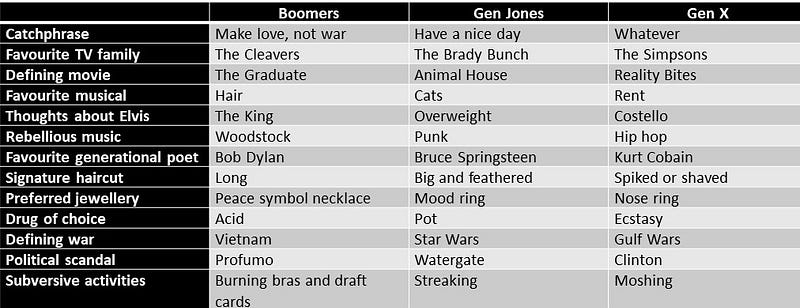
Between the Beatles and Nirvana, lies the popular culture of Generation Jones.
Generation Jones music
The music Generation Jones created in the late 70s was just as groundbreaking as the older Boomers’ music. It was the Generation Jones music scene that saw the advent of punk, new wave, post-punk, disco, electronic music and rap.
Ian Curtis, John Lydon, Sid Vicious, Jello Biafra, Thurston Moore, Henry Rollins, Morrissey, Grandmaster Flash and Afrika Bambaata are all members of Generation Jones.
One of my favourite music scenes, Melbourne’s Little Band Scene, was headed up by Generation Jones musicians. Bands formed for periods as brief as 15 minutes, playing homemade electronic devices and jangly guitars. My favourite Australian film, Dogs in Space, starring the late Gen Joneser Michael Hutchence, is an excellent portrayal of the Little Band Scene.
Then in the 1980s members of Generation Jones became some of the most well-known pop stars played on MTV and beyond — Madonna, Michael Jackson, Prince, Def Leppard, Bon Jovi, Guns N’ Roses, INXS, Whitney Houston, Duran Duran, U2, George Michael, the Bangles, Paula Abdul.
Whether famous on the local gig circuit or the international airwaves, Generation Jones are some of the hardest working musicians around. They slogged away for years without the luxury of being discovered on reality TV. Ok, except for Susan Boyle (born 1961).
Still jonesin’
It makes sense that Generation Jones are swinging votes. They swung from a prosperous childhood to an austere adolescence, from punk to yuppie. This is a group of people who’ve had to adapt and reinvent their entire lives.
I regard Generation Jones as the cool older sibling I always wanted. I devoured the music and films they gave me. Without the indie music of the 70s and 80s, they’d be no 90s indie music. Meaning I, a Gen X, would have no music.
The older Baby Boomers, my parents, were cool too, but being a full generation apart, they were further removed, more unrelatable than Generation Jones.
Like Generation X, I hope Generation Jones gets more of the recognition they deserve.
Well, I’m sure they do. They’re probably your company’s CEO.
Are you a member of Generation Jones? Do you feel separate from the older Baby Boomers or are you happy to be included with them? Let me know in the comments.
Check out my article on Gen X here.
If supporting writers is on your agenda,
Why not become a Medium member?
Nic receives a wee commission,
And your praises soon she’ll be a-whistlin’.


