
Why Not Even Catholic Casuistry Can Hide the Scope of Human Freedom
The Church’s Orwellian propaganda and Pope Francis’s lame attempt to tame secularism
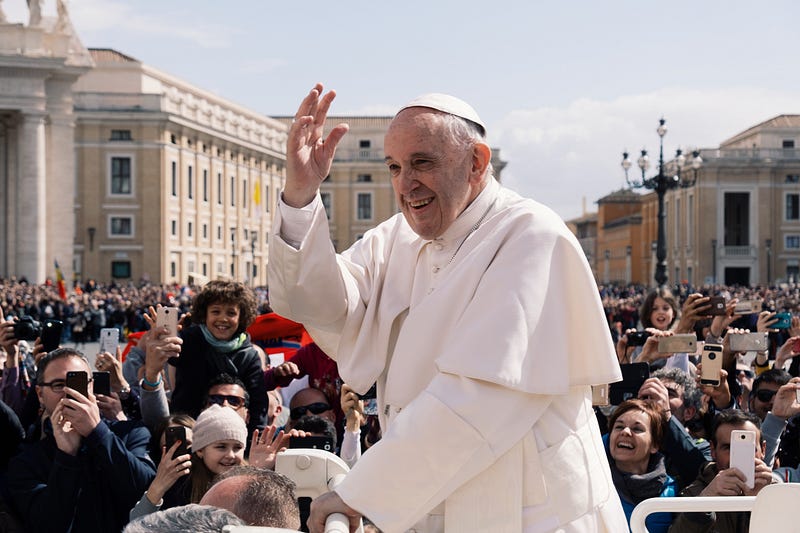
The hallmark of Catholic discourse is casuistry: “specious, deceptive, or oversubtle reasoning, especially in questions of morality; fallacious or dishonest application of general principles; sophistry.”
Catholic casuistry, though, extends far beyond morality, into matters of history and theology. The reason for the Catholic’s resort to specious reasoning is clear: Catholics must rationalize the existence of Christendom and specifically the Catholic Church’s inheritance of the Roman Empire, the one that tortured and killed this religion’s spiritual founder. Rationalization is needed because at least as he’s depicted in the gospels, that founder was plainly a countercultural figure.
The contradictions are obvious, between the origin of Christianity and what the religion became, so the cognitive dissonance is palpable. To avoid crippling feelings of shame, guilt, and sorrow for the absurdity of the Catholic Church’s worldly power, the clergy have excelled in Orwellian tactics of concealing the truth by twisting language and reason. That is, Catholic elites use reason not to promote the truth but to preserve Catholic honour and mystique.
The Catholic Encyclopedia on the Crusades
All of which is apparent, for example, from the Catholic Encyclopedia’s entries which overflow with sanctimonious propaganda. The crusades, it says, were “expeditions undertaken, in fulfilment of a solemn vow, to deliver the Holy Places from Mohammedan tyranny.”
Moreover, “despite his eminent authority the pope could never have persuaded the Western peoples to arm themselves for the conquest of the Holy Land had not the immemorial relations between Syria and the West favoured his design. Europeans listened to the voice of Urban II because their own inclination and historic traditions impelled them towards the Holy Sepulchre.”
From that reference to “immemorial relations,” it might sound as though history and the land itself cried out for the crusades, making those holy wars a matter of destiny.
But contrast that propaganda with a more neutral, historical account of the crusades’ origins, such as Norman Cantor’s in The Civilization of the Middle Ages:
Such a crusade would be an expression of the supreme pontiff’s moral leadership of the western world…and would bring the peoples of the north into closer relations with Rome. Finally, the Latin invasion of the Orient could be expected to take a long step toward the assertion of papal hegemony in Greek Christian lands. The Roman curia was deeply concerned by the continuation of the schism of 1054 and regarded a crusade as an effective instrument for affirming the long-claimed papal supremacy over the Greek church.
Cantor also points to the inconsistency that underlay the crusades, which ought to strike any Christian like a slap in the face: “The doctrinal validity of a holy war and the shedding of blood on behalf of the Lord was a moot question. Apostolic Christianity had exhibited strong pacifistic tendencies, but St. Augustine of Hippo had justified the use of force in the church’s interest…”
Augustine, then, was an early master of the casuistry that was needed to smooth over the bald self-contradictions that persisted throughout the process of Christian syncretism (the synthesis of Jewish and pagan outlooks).
On witches
Or have a look at this statement from the Catholic Encyclopedia’s article on witches:
It will be readily understood from the foregoing that the importance attached by many older writers to the Bull, “Summis desiderantes affectibus”, of Pope Innocent VIII (1484), as though this papal document were responsible for the witch mania of the two succeeding centuries, is altogether illusory. Not only had an active campaign against most forms of sorcery already been going on for a long period, but in the matter of procedure, of punishments, of judges, etc., Innocent’s Bull enacted nothing new…
Indirectly, however, by specifying the evil practices charged against the witches — for example their intercourse with incubi and succubi, their interference with the parturition of women and animals, the damage they did to cattle and the fruits of the earth, their power and malice in the infliction of pain and disease, the hindrance caused to men in their conjugal relations, and the witches’ repudiation of the faith of their baptism — the pope must no doubt be considered to affirm the reality of these alleged phenomena.
For more neutral background, without the onslaught of Catholic minimization, see Britannica, which says, “In 1484 Pope Innocent VIII issued the bull Summis desiderantes affectibus, in which he deplored the spread of witchcraft in Germany and authorized Sprenger and Kraemer to extirpate it.”
Sprenger and Kraemer were the authors of the infamous manual on the conduct of witch hunts, the Malleus Maleficarum. Those authors included the papal bull in their preface, and Britannica points out that “The Malleus went through 28 editions between 1486 and 1600 and was accepted by Roman Catholics and Protestants alike as an authoritative source of information concerning Satanism and as a guide to Christian defense.”
Let’s return, then, to the language used in the Catholic propaganda. That article says the papal bull wasn’t responsible for the later witch mania because it added nothing new and there was already “an active campaign against most forms of sorcery.”
But the “bull” in question was the pope’s decree that submitted to the avid witch hunters’ dubious agenda. The Catholic article concedes this in a most circuitous, passive manner, by saying that “indirectly,” by specifying the witch’s evil practices, as the papal bull did, “the pope must no doubt be considered to affirm the reality of these alleged phenomena.”
The Catholic article adds, “neither does the form suggest that the pope wishes to bind anyone to believe more about the reality of witchcraft than is involved in the utterances of Holy Scripture.” That’s small comfort, though, since the Bible says outright that witches are real and should be killed (Exodus 22:18, Leviticus 20:27).
Or notice the understatement from this part of the Catholic article: “But this confusion between sorcery and a particular form of heresy was unfortunately bound to bring a still larger number of persons under the jealous scrutiny of the inquisitors.”
There the confusion is only “unfortunate,” as though the pope himself had no hand in encouraging such a confusion by not repudiating the biblical passages in question, and by licensing Sprenger and Kraemer to hunt and to destroy witches.
On the Inquisition
Finally, here’s part of the introduction from the Catholic article on the Inquisition:
By this term is usually meant a special ecclesiastical institution for combating or suppressing heresy. Its characteristic mark seems to be the bestowal on special judges of judicial powers in matters of faith, and this by supreme ecclesiastical authority, not temporal or for individual cases, but as a universal and permanent office. Moderns experience difficulty in understanding this institution, because they have, to no small extent, lost sight of two facts.
On the one hand they have ceased to grasp religious belief as something objective, as the gift of God, and therefore outside the realm of free private judgment; on the other they no longer see in the Church a society perfect and sovereign, based substantially on a pure and authentic Revelation, whose first most important duty must naturally be to retain unsullied this original deposit of faith. Before the religious revolution of the sixteenth century these views were still common to all Christians; that orthodoxy should be maintained at any cost seemed self-evident.
Allegedly, moderns fail to “understand” the Inquisition because they don’t credit the Catholic dogma that the Church is charged to protect “authentic Revelation” at all costs. But that just begs the question: if the Inquisition was itself evil, that might be evidence there was no such authentic Revelation in the first place, that the later evil sprouted from a poisonous seed, namely from the betrayal of Jesus’s countercultural, anti-religious standards by creating Christendom and an organized religion out of the Christian synthesis.
Pope Francis on secularization versus secularism
But let’s turn to a more recent example. In 2022 Pope Francis travelled to Canada to apologize for the Church’s role in abusing and killing indigenous Canadians in Catholic schools throughout the twentieth and the later part of the nineteenth centuries. In his vespers homily in Notre-Dame de Québec Cathedral, the Pope made this statement on secularism, distinguishing the latter from secularization:
In order to refine our discernment of the secularized world, let us draw inspiration from the words written by Saint Paul VI in Evangelii Nuntiandi, an Apostolic Exhortation that remains highly relevant today. He understood secularization as “the effort, in itself just and legitimate and in no way incompatible with faith or religion” (Evangelii Nuntiandi, 55) to discover the laws governing reality and human life implanted by the Creator. God does not want us to be slaves, but sons and daughters; he does not want to make decisions for us, or oppress us with a sacral power, exercised in a world governed by religious laws. No! He created us to be free, and he asks us to be mature and responsible persons in life and in society. Saint Paul VI distinguished secularization from secularism, a concept of life that totally separates a link with the Creator, so that God becomes “superfluous and an encumbrance”, and generates subtle and diverse “new forms of atheism”: “consumer society, the pursuit of pleasure set up as the supreme value, a desire for power and domination, and discrimination of every kind” (ibid). As Church, and above all as shepherds of God’s People, as consecrated men and women, seminarians and pastoral workers, it is up to us to make these distinctions, to make this discernment. If we yield to the negative view and judge matters superficially, we risk sending the wrong message, as though the criticism of secularization masks on our part the nostalgia for a sacralized world, a bygone society in which the Church and her ministers had greater power and social relevance. And this is a mistaken way of seeing things.
So, “secularization,” supposedly, is compatible with religion because that endeavor can be interpreted as the attempt “to discover the laws governing reality and human life implanted by the Creator.” Science isn’t forbidden by Christianity because knowledge of nature enhances our freedom, and God “created us to be free.”
Later in the speech, the Pope quotes from the Catholic philosopher Charles Taylor’s A Secular Age, in which Taylor argues that secularization isn’t about reason destroying religious faith, but about the rise of social pluralism. For Taylor and evidently the Pope, the reason that Christianity is no longer the default worldview in Europe or North America isn’t so much that science or philosophy has refuted the religion, but that Christianity is now only one worldview among many others. Taylor attributes this shift largely to early modern deism, but as I’ll show in a moment, liberalism seems like a more central basis for the shift.
In any case, in contrast to secularization, the Pope says that “secularism” is “a concept of life that totally separates a link with the Creator,” since it promotes atheism, consumerism, hedonism, and a desire for power and domination.
The Pope says the Church ought to be drawing such a distinction to reassure the world that the Church is opposed only to the latter, not the former, and isn’t based on “nostalgia for a sacralized world, a bygone society in which the Church and her ministers had greater power and social relevance.”
Liberalism and the burden of freedom
But that Catholic distinction, too, is casuistic. To see this, let’s look at the difference between the Christian and the secular liberal views of human freedom.
In Christianity freewill is a test and a trap. In the Garden of Eden story, for example, God makes Adam and Eve free to disobey his commandments, which they do, but God doesn’t make them immune from the negative consequences. He punishes them for disobeying him and for eating from the Tree of Knowledge, removing them from paradise. And Christians interpret that myth as explaining why God had to incarnate as his son Jesus, to redeem humanity and to provide an escape from the punishment for that “original sin,” the full punishment being spiritual, eternal “death” in Hell.
As recounted in the Book of Job, too, the point of making us free is to test our loyalty to God. Demons tempt us to betray our maker, and when we make the wrong choice, from God’s standpoint, God allows us, in the end, to suffer the consequences. Granted, God creates Christianity to save us, but if we reject that last offer to make the right choice, God will allow us to suffer as a result, according to standard Christian theology.
Our freedom, then, is only a means to an end, a way for God to test our faith. God incentivizes us to be loyal, because he rewards faith and punishes all deviations from his commandments.
That’s far from the modern liberal view of freedom, however. For liberals, our freedom is absolute. We’re condemned existentially to be free in that there’s no self-evident ground of morality, no religious revelation or divine commandment that makes our exercise of freedom a trivial matter of recognizing a foundational truth. If we knew, for instance, that “the Creator” implanted laws throughout the universe, we’d be fools to act against that Supreme Being.
Indeed, having that knowledge is the position not of beclouded mortals but of the angels who are supposed to be certain that God is the supreme reality since they take orders directly from God. And even some angels supposedly rebelled, which testifies to the humanization of those mythic characters.
With the rise of Protestant individualism, Renaissance humanism, science, capitalism, industry, and democracy — in short, with the rise of “modernity” — we could no longer take theism or any myth or institution for granted. That’s the standpoint of liberalism: everyone is condemned to decide what to think, and to never know with absolute confidence what the ultimate truth might be. Hence, the liberal imperative of tolerance for a variety of perspectives and cultures: we’re all struggling to figure things out, with no luxury of knowing at the outset what we ought to be doing.
The modern view, then, is that our freedom is foundational, not just a means to a presupposed, divine end. The reason for the liberal’s harm principle — that we should be free to do what we want if we don’t harm anyone else, interfering with the exercise of that other person’s freedom — is that in the modern world, human freedom is absolute, not God. We discovered the depths of the human self and are so lost in our creations that we suspect God is just another figment, a product of human freedom from the rest of reality.
We’re free not just to disobey the Supreme Being, but to interpret the world as we prefer and to create new worlds.
Catholic sleight of hand
What the popes call “secularization,” therefore, is the pluralist’s tolerance of Christianity as just one of many possible worldviews, there being no more grounds for presupposing the priority of any moral or cultural standpoint. In so far as some religions remain stubbornly exclusive and absolutist in their rhetoric and their sanctimony, the liberal aspect of secularization is bound to lead to what the popes call “secularism” and indeed to atheism or at least to the rejection of those dogmatic religions.
Indeed, as I argue elsewhere, the liberal version of Christianity is just a shell worn over humanistic sensibilities that are implicitly atheistic.
But the point is that by insisting on that sophistical distinction between secularization and secularism, Pope Francis misstates the problem. Secularism isn’t “a concept of life that totally separates a link with the Creator.” To put it that way obviously begs the question of theism’s truth. Secularism, rather, is a questioning not of the Creator but of religions that declare there’s such a link between people and a Creator. And secularism questions them because it questions everything whatsoever in the name of human freedom.
In secular, liberal societies, all ideas and institutions are up for grabs because, if anything, it’s our freedom that’s ontologically primary. Although science takes the objective facts of nature to be discoverable, science feeds into the pursuit of progress and thus into our presumed freedom to replace the wilderness with a humanized, artificial alternative. Thus, the facts of nature aren’t fundamental for liberals since they mean to domesticate the planet and ultimately all manifestations of matter and energy.
That realization of the existential depths of freedom makes for the pluralism or liberalism that’s responsible for secularization, which leads just as swiftly to what Pope Francis calls “secularism,” to doubts about archaic, absolutist, implicitly illiberal ideologies like Catholicism.
In short, Pope Francis’s distinction sets up a false dichotomy, which is just what you might have expected from Catholic casuistry.


