
Why Love Your Enemies: Good to Those Who Hate You? Turn the Other Cheek? Defiance
The difficult but doable Christian way to defy and defeat your enemy — crushing evil
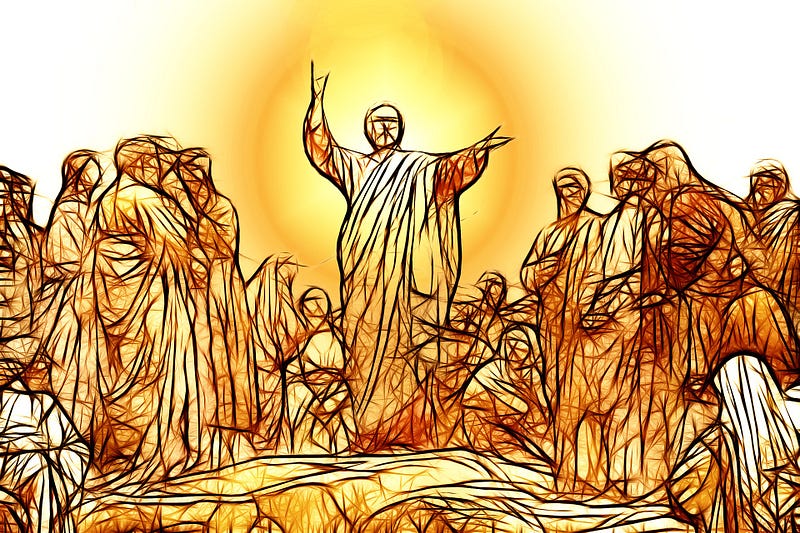
I couldn’t “turn the other cheek” — until learning it wasn’t about meekness. It’s actually defiance: refusing to yield to an enemy’s power.
“Meekness is hard — especially when I’m emotional — but I can totally embrace defying my enemy, refusing to let him beat me,’’ I thought.
Fast forward to the height of ISIS attacks on Christians in 2014: Christians were being lined up and videotaped, told to renounce their faith (so they could live) or to retain their faith and die.
The Christians defied their captors, choosing death. One uncertain man saw the Christians' bravery and decided he, too, would die with them.
Soon after, Ave Maria Radio interviewed people who converted to Catholicism at that very time and place. Why become Christian when doing so could get you executed? The answer was astounding:
“Every religion promises to destroy their enemies, but Christians are the only ones who actually pray for your enemies,’’ one recent convert answered.
Western Civilization provides at least 10 top arguments for why ‘The Way’ makes the most sense
Loving enemies sounds impossible, yet look how often it’s been followed throughout a Western Civilization built upon the roots of Christian culture:
1. Judge actions, not human hearts.
Martin Luther King shared this story about Abraham Lincoln: “through the power of love, Lincoln transformed an enemy into a friend,” saying kind words about Southerners during the Civil War. “Asked by a shocked bystander how he could do this, Lincoln said, ‘Madam, do I not destroy my enemies when I make them my friends?’”
2. Praying to change hearts and actions.
When Ronald Reagan and St. John Paul the Great were shot — 44 days apart — in 1981, both immediately began praying for the men who pulled the triggers.
John Paul met with and blessed the trained assassin who tried to kill him, and Turkish assassin Mehmet Ali Ağca couldn’t fathom why his direct hits hadn’t killed the pope. Ağca eventually fully repented, becoming Catholic.
3. Unforgiveness is like drinking poison, hoping your enemy dies.
A man who had driven 2.5 hours to a healing service at our church told me he was raped when he was 10. He had problems trusting.
We told him about the importance of forgiveness — that every faith wishes revenge on their enemies, but only true Christians pray for their enemies.
He said he actually had coffee with his tormentor and agreed forgiveness was the key. We spoke about Unbound prayer.
“I feel much lighter — like a great weight has been lifted from me,’’ he said.
4. Loving enemies teaches us to tap into Divine Love
“We can know only that we know nothing. And that is the highest degree of human wisdom,’’ Russian hero Leo Tolstoy wrote, in War and Peace.
Tolstoy added, “It’s all God’s will’’ and “Yes — love… To love one’s neighbors; to love one’s enemies. To love everything — to Love God in all His manifestations. Someone dear to one can be loved with human love, but an enemy can only be loved with divine love.’’
5. Loving your enemies? “It’s the smart move.”
In The Godfather, considered one of history’s greatest films, gangster Vito Corleone (who happens to be Catholic) offers a practical explanation for “love your enemies,” teaching his children that attacks are “just business,” and telling his son, Sonny, “Never hate your enemies. It affects your judgment.”
Vito’s youngest son, Michael, eventually destroys his own happiness because of a need to kill his enemies.
6. Walking in your rival’s shoes helps you see the bigger picture.
Two years after losing her son (on the day before his 21st birthday), one of our heroes has agonized over her loss daily.
After all these months, as the responsible parties head to trial, she is now able to pray for the mother of her son’s killer, wondering what she must be going through. Those questions get her closer to loving her enemy.
7. Mercy: Testing and expanding the boundaries of love.
“If love is willing the good of the other as other, this has to be the fullest expression, the final word, of love,” Bishop Robert Barron writes.
“There is another way to test love: the love of enemies, those who cannot or will not pay you back. This also takes place in the cross of Jesus… everyone betrays him, runs from him, denies him, actively arranges for his death. And yet these are the very people that he loves, the very people for whom he gives his life.”
8. The bigger story over time.
“Freedom means breaking out of the limitations of the smaller story to get into the big story,’’ argues Neal Lozano, leader of the Unbound Catholic ministry.
“Demons rest best in places in your heart that are most familiar to them… ugly places… Where did Satan get his power? He got power from us, starting with Adam and Eve. God gave us authority to rule, but we gave it away. We need to take it back…. Unforgiveness blocks God’s love. Forgiveness releases it. If we refuse to forgive, we are rejecting Jesus.’’
9. Why help the person you love least?
“I really only love God as much as the person I love the least,” Dorothy Day said.
Father Larry Richards tells us to pray for our worst enemy, hoping we can sit together in Heaven talking about how we helped each other get there.
If everyone and everything is a gift from God, wouldn’t He want us to love the least of his children? St. Faustina wrote that Jesus taught her “everything that exists on earth is at my service: friends, enemies, success, adversity…”
10. Unanswered prayers? Making new things possible.
Knowing He is being betrayed, Jesus tells Judas, “Friend, do what you have come for.” (Matthew, 26:50).
Blessed Cardinal Stefan Wyszyński said Christ called his betrayer “friend” to show that even our worst enemies become parts of God’s Plan, enabling our own divine power to be released to carry out our destinies.
He called this the way evil destroys itself, “the shortest way to an internal reconciliation with those who wrong us.”
Love your enemy: The one unforgettable way of Christianity
In the Sermon on the Plain, Jesus commands: “love your enemies, do good to those who hate you, bless those who curse you, pray for those who mistreat you.”
“To the person who strikes you on one cheek, offer the other one as well, and from the person who takes your cloak, do not withhold even your tunic. Give to everyone who asks of you, and from the one who takes what is yours, do not demand it back. Do to others as you would have them do to you.” (Luke 6:27–36).
You have to love all of them — even when you don’t like them
Our friend Dave raised every eyebrow with the amazing “stretch goal” of saying he thought it was possible to live a life free of sin with God’s grace. He made us think — and even dream — of what might be possible.
If we think of Catholicism as a big book of rules (see the Catholic Church’s Catechism), it does seem nearly impossible to get so many things right. But what if we instead think daily about a few overriding goals of Christianity?
Like loving your enemies? We discussed this concept over breakfast one morning and young Ryan, a recent convert, started asking about popes who permitted Catholic soldiers to kill to protect Catholics and their faith.
We spoke of Abraham being ready to give up his son Isaac while continuing to love his son and God, the difference between killing and murder, and the fatherly calling to protect your family against all enemies.
We are ready to go “into the breach,’’ to fill the hole in any wall making our family vulnerable, willing to fight any foe who attacks. But even when you don’t like them, you have to love them too?
How can you both love and hate someone? Ask people who have loved each other passionately — because hate isn’t the opposite of love. The opposite of both love and hate is indifference, not caring. Love/hate are intense caring.
How can you possibly avoid sin and love your worst enemy? I woke up remembering something I heard in a homily a decade ago:
Jesus and His apostles were persecuted and killed. John, the only apostle not martyred, lived to old age, surrounded by followers watching him die.
They wanted to know what was the one thing, the most important thing to remember from all that Jesus taught him.
On his death bed, John whispered the one main thing everyone needs to know about Christianity, the most important thing Jesus taught him:
“Love one another. Just love one another.”


