
Cult Book Review
Why JG Ballard’s 1975 Cult Novel High-Rise Is So Good
It starts and ends with the protagonist, Dr Robert Laing, sitting on his balcony eating an Alsatian.
Immediately, you’re blindsided, and you have to reread the first sentence again to make sure you haven’t misread it. You haven’t. Then you check the cover and remember you’re reading a Ballard novel. Anything is possible.
Robert Laing lives on the 25th floor of a luxury 40-storey high-rise on the outskirts of London. It’s a self-contained complex with a supermarket, school, restaurant, hairdresser, bank, and gym. All designed by architect Anthony Royal who lives on the 40th floor.
Apart from going to their jobs in The City, the inhabitants rarely leave the gated community of the high-rise. Perfectly content with all the luxuries it has to offer. What could possibly go wrong?
One evening a bottle crashes onto Laing’s balcony. A champagne bottle from a party on one of the upper floors. Laing doesn’t think much of it. It’s happened before. And everyone knows the people on the higher floors don’t think much of the folk on the lower ones.
Over the next few weeks, however, elevators start to break down, power failures occur, and petty grievances flare up into full-blown arguments. The main gripe among the residents of the higher floors is the fact that the swimming pool is often full of kids. While residents on the lower floors dislike the owners from the higher ones walking their dogs in the car park.
Sound familiar?
Things get worse. One day a dog is found drowned in the pool during a power failure. Then a jeweller from one of the upper floor is murdered. In any other society, the police would be called in. But the residents resist. It’s their domain, and they’ll deal with it in their own way. After all, it’s their reality.
It’s not long before the three striations of British society develop: the lower, middle and upper class. Each denoted by which floor they live on. As the situation deteriorates, the violence deepens. People feel less inclined to leave and go to their jobs, fired up by that ancient urge to protect their families and their property.
Meanwhile, Anthony Royal and his associates are fully aware of the chaos taking place below. And we begin to smell a rat. Was this planned? Did Royal know this would happen, and build the high-rise on purpose. A building with a personality. And by taking up residence on the 40th floor, has a bird's-eye view of the madness unfolding below.
Order slowly starts to collapse, and the old class distinctions disintegrate in favour of small groups, scavenging and hunting for what they can. Apartments are ransacked, residents are beaten, and no one dares to go anywhere without a weapon. Food, alcohol, and medicines are hoarded like gold, and stray dogs are slaughtered for food.
The carnage goes on for months, and by the end only a few residents survive. One of which is Robert Laing, which is where we find him (as we did at the beginning) munching on a thigh of Alsatian as though it’s the most normal thing in the world.
While most of the building’s residents succumbed to their innermost fears, Laing has embraced the new order, welcomed it almost, and is ready to start his life again. He’s even planning to go back to work the next day to see his patients.
After he finishes his meal, he looks at one of the newly built high-rises four hundred yards away (there are five under construction), and notices that there has been a power cut on the 7th floor. Laing can see the residents madly moving around the floor with torches trying to find their way around.
He smiles gleefully at the glowing embers of the fire he cooked the dog on, knowing that the madness is just about to start all over again.
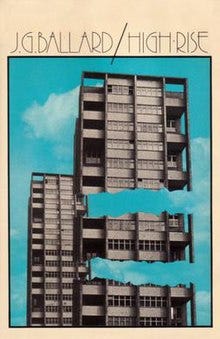
High-Rise was published in 1975 by Jonathan Cape, London.
Thanks for reading. For more pieces:


