
Why is the Freedom Convoy Fighting for Freedom?
How capitalist and far-right imaginaries co-opt working class grievances
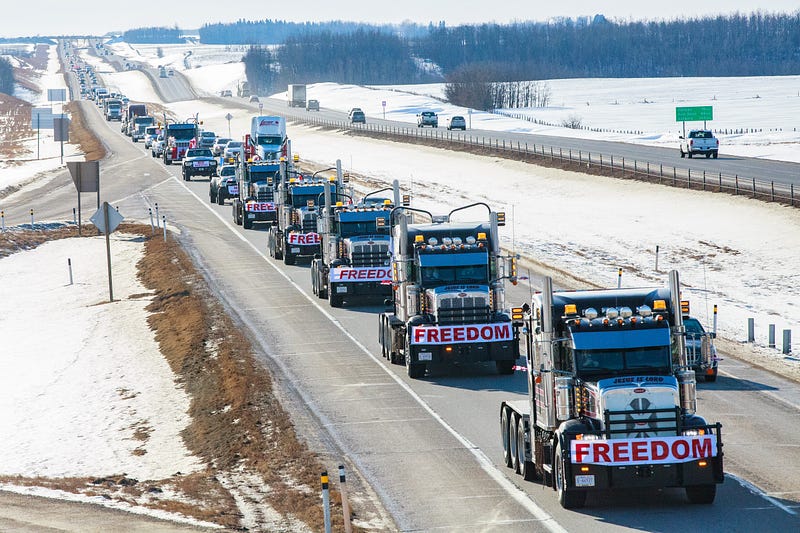
It’s been two weeks since the ‘Freedom Convoy’ reached Canada’s capital, Ottawa, to protest against the federal government’s Jan. 15 vaccine mandate. The convoy was organized by anti-mandate group, Canada Unity, and supported by various anti-vaxx and separatist groups like the Maverick Party. Since then, the movement has spread to other countries around the world like the US, France, and New Zealand, and been openly supported by well known figures like Elon Musk and Donald Trump.
The movement has been criticized for its ties to far-right, white nationalist, separatist, and anti-public-health-measures groups. But these criticisms — though correct — do not tell the full story. Although the convoy may have been organized by members and sympathizers of these groups, the grievances that drove the truckers to protest are nonetheless valid. Since the start of the pandemic, truckers have been hit again and again by supply chain issues, international tensions, job insecurity, and ineffective political leadership by both federal and provincial governments (e.g., slow responses to clear highways affected by B.C. floods).
In this context, it is not unreasonable that Canadian truckers would mobilize so rabidly against more COVID-related state measures. What remains unclear, however, is why these demands have coalesced around a neoliberal rhetoric of ‘freedom’, with its emphasis on individual sovereignty, non-coerced activity, and a general refusal of dependence and shared responsibility when it is in fact forty years of neoliberal globalization that is the root cause of many of the challenges that these truckers have had to face since the start of the pandemic.
The pandemic has converged and intensified already present tensions, inequalities, and vulnerabilities. Unfolding within a context of deeply rooted skepticism toward current democratic institutions and political and economic elites, the pandemic challenges us to put our faith in state-led efforts to contain the spread of the virus and provide both job security and safe work environments. Politically speaking, COVID-19 could not have happened at a worst time.
Our current political climate was already seeing the brewing of an authoritarian turn born of years of neoliberal globalization, job insecurity, unstable market conditions, the erosion of public and democratic institutions, and weak political leadership. Under such conditions, it is not surprising that people from a wide range of backgrounds (especially working-class folks) would feel negatively toward state-sanctioned limits to public and individual liberties. Not only this, but people have also been quick to recognize that many of these changes in our working and living conditions might have permanent or long-lasting effects in our lives, exacerbating the types of grievances and mistrust of authority that are heightening vulnerabilities and social inequalities at every level of society.
All these factors make up a very dangerous recipe for the emergence and popularization of authoritarian sentiments. The far-right knows this well, and the case of the freedom convoy shows this clearly. Reports have shown that members of the far-right are behind much of the organizing and crowdfunding. This should not come as a surprise to any. After all, the truckers’ movement is unfolding in an environment that lends itself well to far-right sensibilities and corresponding imaginaries and demands (e.g., authoritarian white nationalism, scapegoating, a return to conservative values, etc.). In fact, this brand of right-wing populism has already identified the movement’s enemy: the state and centre-Right-to-Left political elites that they think have prioritized the needs of just about everyone but the protesters’.
Interestingly, similarly to other forms of far-right mobilization that we’ve seen around the world in the past few years, the freedom convoy does not seem to question the institutional framework of the Canadian state. Anti-mandate arguments rely heavily on support for and recognition of Canada’s Charter of Rights and Freedoms (ironically, never mentioning those Charter provisions that allow governments and legislative bodies to temporarily override certain rights and freedoms, like saving provisions and the ‘notwithstanding clause’).
Another problem associated with the movement being driven by far-right members and sympathizers is that this has resulted in not only support for authoritarian and fascist forms of political intervention, but also in an inability to produce a credible political project that can meaningfully address the truckers’ immediate needs and concerns. This has been a common theme in 21st century fascist movements, which have proven good at channeling popular grievances into discriminatory, violent, and authoritarian directions, under an obscure and anti-government banner of (neoliberal) freedom, but failed to articulate credible political programmes for addressing the root causes of these grievances.
Though the freedom convoy may have emerged out of legitimate grievances rooted in neoliberal globalization, vulnerable supply chains, job insecurity, and ineffective political leadership, the movement has been articulated along far-right political imaginaries. This means that what could have been a type of working-class movement organized against forty years of neoliberalism and its alienation of workers from social, political, and economic life, has turned instead into an authoritarian battle cry in support of neoliberalism and against the state — demonstrating once again the effectiveness with which the established order is able to present itself as legitimate and beneficial despite the vulnerabilities and inequalities that it generates.
To effectively address these systemic challenges, what is needed on the part of working-class folks is not a cry for (neoliberal) freedom and further support for the system that exposes them to various risks and vulnerabilities, but the articulation of a political project that seeks systemic change, the strengthening of democratic institutions, and a recognition of our mutual interdependence and responsibility for the world around us. In other words, the oppositive of what the freedom convoys appears to stand for.


