
What Drove Canadian Truckers to Form the Freedom Convoy?
On the underlaying causes of trucker grievances
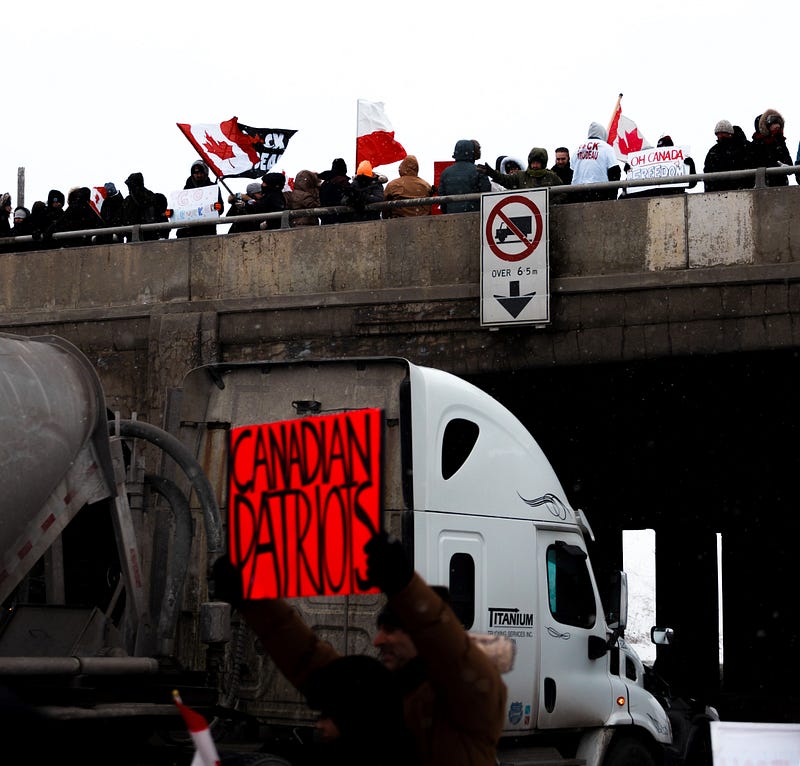
It’s been a couple weeks since the ‘Freedom Convoy’ first began its journey from Delta, BC to Parliament Hill in Ottawa, ON to protest against the federal government’s Jan. 15 vaccine mandate. On its way there, the convoy gained the support of well known figures like Elon Musk and Donald Trump, and was able to secure funds through crowdfunding platforms like GoFundMe and GiveSendGo. Today, the ensuing protests have developed into a movement with supporters from all over Canada and other places around the world such as the US, France, and New Zealand.
Since the start of these protests, questions have been raised about the extent to which the movement represents the interests and stance of Canadian truckers on these mandates. As Prime Minister Justin Trudeau quickly stated, convoy truckers only represent as “small fringe” that holds “unacceptable views” and does not reflect the interests of most Canadians — a conclusion generally supported by findings on Canadians’ support for COVID-19-related health measures by both federal and provincial governments.
The movement has also been criticized for a variety of other reasons, with critics raising important questions about funding, far-right groups, and foreign involvement in Canadian politics; the movement’s narrative of rights, freedoms, and state interference; protestors’ desecration of war memorials and harassment of people living or working near protests; the economic costs of the protests; the policing biases evident in responses to the protest; the threat of authoritarian right-wing populism in Canada. The list goes on.
More recently, supporters of the Freedom Convoy have targeted the Canada-US border, “disrupting the automotive industry, agricultural exports, and causing multimillion-dollar losses” — which has put significant strain on already struggling workers and supply chains, resulting in layoffs on both sides of the border.
Yet, despite wide coverage of the movement, not much has been said about its origins. What drove truckers to mobilize in this way? Are their grievances valid in any meaningful way? Are their demands for freedom capable of addressing the root causes of their grievances?
The truckers’ grievances can be tied to at least three key (related) factors:
- Globalization: COVID-19 has made painfully visible global markets and supply chains’ vulnerability to economic shocks. When the pandemic began, the systemic vulnerabilities of supply chains created new risks for truckers worldwide. With not much to deliver, their livelihoods were immediately affected by the spread of the virus, a lack of international cooperation, and ineffective (or lack of) state, corporate, and institutional measures.
- BC floods: This past November, the southern part of the province of British Columbia was hit by several weeks of record-breaking rains, which flooded highways and farms, putting further strain on the provincial government and industry to keep supply chains open. Because of this, Canadian truckers were once again having to bear the brunt of supply chains issues, as the provincial government struggled to clear and reopen the highways. Truckers’ options during this period were limited: they could either wait for the roads to be reopened, try to clear the roads themselves, travel through them despite poor road conditions, or risk driving through alternative, less-known mountain routes. Many chose the latter.
- Border PCR tests and waiting times: After Jan. 15, unvaccinated or partially vaccinated Canadian truckers were required to provide proof of a negative PCR test before returning to Canada. The test had to be taken 72 hours before entry and be followed by another test upon arrival. For a while now, these measures have raised questions about what happens when a trucker tests positive? What happens to their shipment? And how does this affect their income and ability to work? These are questions that matter to not only Canadian truckers. We are seeing similar problems in other parts of the world, like the Chile-Argentina border, where truckers are finding themselves stranded at customs checkpoints awaiting test results and facing significant economic losses as a result.
Overall, the grievances that have congealed into what is now referred to as the Freedom Convoy are not necessarily invalid. Truckers’ livelihoods have been affected by the pandemic for a wide range of reasons, but the root causes of these issues are not just Trudeau, the Liberal Party, or state-led public-health measures, but a combination of factors that have been reshaping our social and political context since before the pandemic started (e.g., forty years of neoliberal globalization, climate change, economic recession, austerity measures, widespread job insecurity, mistrust of authority, and a general loss of faith in political leaders and democratic institutions).
That being said, why is it that these grievances have been articulated along a rhetoric of and demand for distinctly neoliberal understandings of freedom (with their emphasis on individual sovereignty, non-coerced activity, and a general refusal of dependence and shared responsibility)? Why have these grievances been so easily co-opted by far-right movements and channeled into authoritarian, white nationalist, right-wing populist, and anti-establishment directions? Why is it that these grievances have been associated with loosely articulated political figures and institution as opposed to targeting wider, more concrete processes and realities?
This is because the Freedom Convoy is more than the incoherent movement that it has been described as. It is both a symptom of our times and a call for not just political action, but also for the articulation of a clear political project that can effectively address the accumulated working-class grievances that have led us here today. Although it is hard to tell if the movement will amount to anything more than what it is currently, it is important to recognize and grapple with the social, political, and economic realities in which it is rooted.
The truckers’ grievances are not necessarily invalid. If they feel like the system is in many ways rigged against them, it’s because it is — as it is for everyone else. Yet, the movement does not appear to have a clear understanding of its place within our current socio-historical context, and has chosen instead to organize itself along violent and discriminatory patriarchal, white nationalist, and authoritarian right-wing populist lines — at the expense of other people and in defense of the established (neoliberal) order. The freedom they seek is — quite literally — the freedom to rid themselves of all sense of social responsibility by embodying a heroic, authoritarian, and often hypermasculine brand of individualism that could never properly address the structural challenges they have been facing.
As I argued elsewhere, “To effectively address these systemic challenges, what is needed on the part of working-class folks is not a cry for (neoliberal) freedom and further support for the system that exposes them to various risks and vulnerabilities, but the articulation of a political project that seeks systemic change, the strengthening of democratic institutions, and a recognition of our mutual interdependence and responsibility for the world around us. In other words, the oppositive of what the freedom convoys appears to stand for.”