
Why is LeetCode the Standard in Tech? Learning to Love LeetCode Problems!
How hard could it be to start from scratch???

Well… How did we get here?
So, I’ve been thinking a lot about LeetCode lately. As a Senior Software Engineer @ IBM, one of the things that I have to do from time to time is help with recruiting and interviewing.
That being said, it’s been a long time since I’ve truly been on the other side, in their shoes. Now, I don’t mean since I’ve done a LeetCode problem. I mean, jumping into learning the platform from scratch.
For a little bit of context, I graduated in 2016. Now, luckily for me, or maybe not depending on how you look at it. LeetCode started in 2015 and I had already been in and out of internships and accepted a job offer at that point. Meaning that I missed out on the newer wave of interview prep and interviewing style. That tidbit has me curious.
Why is LeetCode the standard in Tech for interviews?
What’s the Deal With LeetCode?
If you don’t completely know, LeetCode is a company that was created in San Francisco in 2015. The goal behind LeetCode is this as found on their site.
At LeetCode, our mission is to help you improve yourself and land your dream job. We have a sizable repository of interview resources for many companies. In the past few years, our users have landed jobs at top companies around the world.
At this time LeetCode has 945 interview prep questions that are there for you to solve online. These come fully equipped with unit tests so that you can get real-time feedback on how well your code is doing against the given prompt.
This is great but why do you care…?
LeetCode has turned into this phenomenon. This gold standard for Tech interviewing.
LeetCode is prominent at the FAANG (Facebook, Amazon, Apple, Netflix, Google) type companies in their interviewing processes.
Now just because you can solve LeetCode problems doesn't mean that you’re going to get a job at one of these companies. It’s just a means to get your foot in the door.
Now the feasibility and morality of LeetCode and what it’s become, isn’t what I’m here to talk about. Although, I don’t think it’s their fault that it’s ballooned into a border entry site for a bunch of companies. (If you’d like my thoughts on it, leave a comment and maybe I will chat about it!)
LeetCode has become a method to prune out the lower end of talent. If you want to work at a more well-known company nowadays you’ll probably need to grind LeetCode or a platform like it.
That’s where my interest peaked.
Alright, Interviewing Has Changed. Now What?

My goal now is to see this newer perspective. Based on the title, you’ve probably already got an idea of what I want to do. I want to navigate LeetCode and tackle the nuances and concepts surrounding it.
I imagine this is going to be akin to when I was doing Project Euler problems in college prepping for interviews (Just imagine a less eloquent LeetCode). Throughout this personal journey, I want to share some of the things that I learn, have to remember, struggle with, and ultimately get stuck on.
For total transparency’s sake, my account is relatively fresh so I’m not going to make a new account or anything. If you wanna take a look, I’ll link it here!
Also a quick note. I know that LeetCode isn’t the only platform that has interview programming problems (HackerRank, AlgoExpert, CodeChef), but it is the most popular when it comes to studying for interviews. Even at IBM, where I work, we use a site called HackerRank primarily. There are differences between them all, but I won’t get into that here.
Alright, So Here’s The Plan!
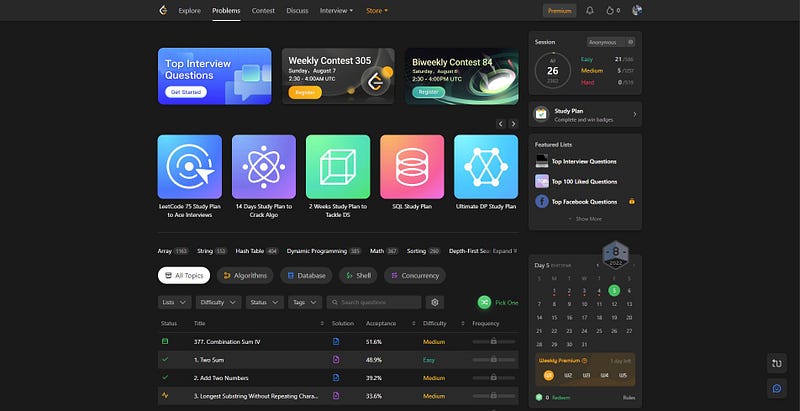
I want to tackle different approaches to solving problems in LeetCode. What I mean by this, is that when I dabble, I’ll usually pick a Dynamic Programming problem, or a Data Structures and Algorithms related problem, etc. For this, I think that I’m going to use something called NeetCode.io
NeetCode brings some structure to LeetCode in the form of an easy-to-follow roadmap! I’d suggest checking them out!
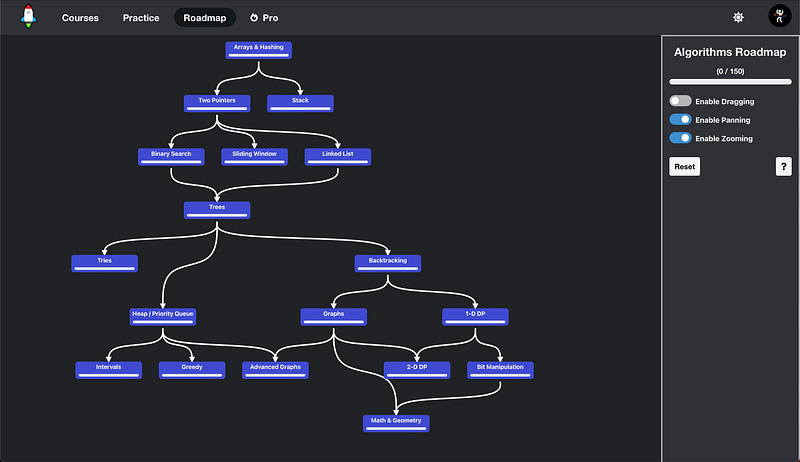
Now, I’d usually choose a topic that I want to be challenged in rather than doing problems all willy-nilly. For this, I’ll be following the roadmap. That way we can look at the problems at a high level and potentially apply the solutions across the board, rather than on a question-by-question basis.
I’ll also try and point out things that I didn’t understand initially, such as the beats percentage (How my code performs against others in terms of speed and memory), ways to break down problems, and maybe learning when I’ll have an easier time doing something in another language.
Primarily, I’ll probably be programming in Python for convenience. It’s my language of choice and the one that I write in the most for work. Maybe at some point, I’ll have some interest in doing some of this in other languages that I know.
I could potentially dabble in Java, something more object-oriented that I already know. Maybe I’ll pick up a new language (looking at you C and C++). For some things, I’ll write some pseudo-code and include it in the posts. Possibly do some diagramming for others! Sometimes, I’ll do both, or whatever comes to me as a good way to get my thoughts across!
Ultimately, I’m hoping to learn a bunch of new skills and gain new insights not only in Programming and Computer Science but in writing content for it!
Wish Me Luck!
I’m by no means expecting this to be a breeze, but I’m hoping that this can be enlightening, not only for me but potentially for someone trying to get through it!
If you’re interested in taking this journey with me, then definitely follow along and hopefully, we can learn together. I’m imagining this article will transform as time goes on to be almost like a nexus hub for the content that will follow!
Cheers! 🍻
Check out another one of my articles if you have the time!
I hope that you enjoyed this article! If you did please hold down the applause button as long as you can 👏🏽 (Really! Hold it! 😉)! Leave a comment to let me know your thoughts! Share with a friend or colleague! If you’d like to hear more from me please follow! Finally, please buy me a beer to keep me motivated! It all means the world to me! Cheers!