
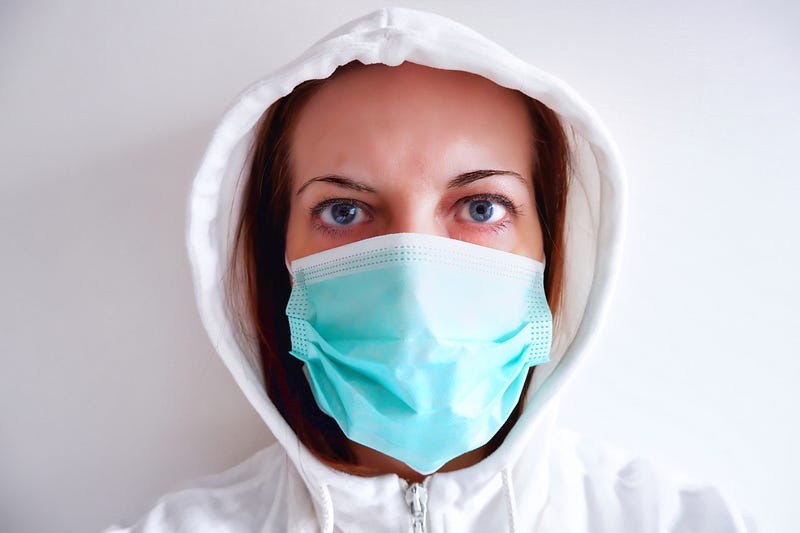
Why I Wear a Mask During the COVID-19 Pandemic
Why I’m a mask-wearer
Someone recently asked me if I’d still be wearing a mask in six months' time if the experts told me to. The nation is up in flames right now over the debate about masks, a debate which shouldn’t even be a debate in the first place. For some bizarre reasons, entirely political, a substantial portion of the American populace has objected to wearing masks during a raging pandemic that’s wreaking havoc upon our population, killing more than 100,000 of our American citizens and many more outside of our borders. People are dead, sick, and dying, and many of our citizens are still not taking this seriously six months in. Nothing stinks of privilege quite like believing you can just wish away a deadly pandemic and the destruction it’s cost thus far and will cost in the future.
Many people have suddenly stopped believing that medical masks can protect people against viruses, turning instead to nonsensical conspiracy theories about masks in order to make a political statement and remain loyal to their conservative leadership — just like they’ve done with climate change and the smoking-lung-cancer link before that. This shouldn’t even be a battle, it should be common sense, the reason doctors wear medical masks is to prevent them from airborne and respiratory pathogens that might infect them and get them sick or killed.
These disbelievers try to poke holes in ancient science that’s been settled for a very long time because they want to distrust authority. They’ll question the Center for Disease Control (CDC) saying the CDC keeps changing their story, they’ll question science and scientists, they’ll look for all of the most conflicting information they can find in order to support their instinctual belief in the president’s destructive rhetoric.
It’s all really just bad, bad thinking, in the end. Then they ask me if I’ll continue to wear masks if the “experts” (their word, not mine) tell me to. Sensationalized media should be viewed with skepticism and vague terms like “experts” are major red flags when reading about science.
What they don’t understand is, I don’t wear a mask because an “expert” or politician tells me to, because I don’t listen to experts unless I’m totally inept at interpreting the facts (as with a subject like quantum mechanics, engineering, or astrophysics).
I’ll never be able to understand those fields and thus I must take an expert’s word on it, but there’s really no debate about the efficacy of masks and there are some amazing science writers, like Microbial Instincts’ Shin Jie Yong, who continue to provide us incredible and honest data about what matters when it comes to this virus in publications like Microbial Instincts (see the link at the bottom for more). From the article Meta-Analysis Determines Efficacy of Face Masks Against Respiratory Viruses:
The pooled results of all the 21 studies showed that face masks lower the odds of contracting respiratory viral infections by 65%.
Subgroup analysis revealed this number to be 80–90% in healthcare workers (HCWs) and about 50% in non-HCWs.
Subgroup analysis revealed this number to be 40% within household settings and 56% in non-household settings.
Subgroup analysis of respiratory virus types calculated that face masks reduced the odds of contracting influenza virus by 45%, SARS-CoV by 74%, and SARS-CoV-2 by 96%.
No significant protective effect was found for H1N1 subtype of influenza virus, which could be explained by prior influenza vaccination or the delayed preventive measures (after exposure) during the outbreak.
That’s right, studies have shown that, “face masks reduced the odds of contracting influenza virus by 45%, SARS-Cov by 74%, and SARS-CoV-2 by 96%.”
Ninety-Six percent!
Personally, I don’t wear a mask because some guy in a white lab coat tells me to and I especially don’t wear a mask just because politicians tell me to, I wear a mask because the scientific facts as we know them right now have demonstrated thoroughly that masks reduce transmission by a significant amount. I pay attention to the facts, not “experts” or anyone who so much as uses that word.
The idea that the laws of physics can be suspended and that somehow masks don’t prevent communicable diseases from spreading when they have literally all the time for all other diseases is just ludicrous on its face and it’s telling of how far people are willing to go, the crazy things they’re willing to say and do to not engage with information that makes them experience cognitive dissonance. They either can’t read the science or don’t want to, in which case they should listen to the science and the officially established experts (the CDC, WHO).
I cannot emphasize enough the importance of learning about scientific literacy and becoming scientifically literate as a population. We desperately need it. And we can’t afford to get the mask-wearing equation wrong. The Center for Disease Control, the CDC, in the United States has called on us all to wear masks to reduce the spread and transmission of the virus, the CDC director remarking:
“We are not defenseless against COVID-19. Cloth face coverings are one of the most powerful weapons we have to slow and stop the spread of the virus — particularly when used universally within a community setting. All Americans have a responsibility to protect themselves, their families, and their communities.”
I’ve also noticed that non-mask-wearers typically judge the quality of information purely on its source, which is logically fallacious. We should judge information based on the information itself, not who says it, credible sources are more of a guide as to where we should invest our time. It’s an argument from authority (bad thinking) to say that we should trust or distrust what we see and hear, not for the information that it contains therein, but based solely on how we feel about who presents it. We shouldn’t. If we can interpret the information, we should judge the data on their merits and the data always have confirmed that wearing masks reduces the chances of catching a virus or other infection from someone who’s infected.
With all that said, to answer that person’s question, it all depends on where the virus is at that point. If it’s raging on, of course, I’ll be draped in a mask that’s snugly fit and protecting me from getting myself and my family sick. And at this point in the United States, with the trajectory on the course, it’s headed toward, it’s not much of an “if” it’s more of a “when.”
For goodness’ sake, please wear a mask, it’s just the most childish thing to “rebel” over and it’s actively going to do harm to those who do and their communities and loved ones. Please stay safe.
For more information on the efficacy of masks, I suggest checking out the work of Shin Jie Yong and Microbial Instincts and have provided the CDC guidelines below for those who aren’t the best at reading scientific jargon:


