
Meta-Analysis Determines Efficacy of Face Masks Against Respiratory Viruses
Many questions if face masks are any good; they probably shouldn’t now.

Face masks have been a controversial topic. Even experts and health authorities are divided in its efficacy in the current pandemic, with one reason being a meta-analysis pre-print showing no differences between face masks and no masks in preventing influenza-like illness cases.
A Better Meta-Analysis
A published meta-analysis in May, however, suggests otherwise — that without face masks, cases of respiratory virus infections throughout history would have been much higher.
Researchers from China, Germany, and the United States collaborated on this paper, “Efficacy of face mask in preventing respiratory virus transmission: A systematic review and meta-analysis.” Herein, they screened 2787 papers and identified 21 high-quality studies for data synthesis.
Among these 21 studies, 11 were conducted in China, 6 in Western countries, and 4 in other Asian countries. In terms of virus type, 4 studies examined respiratory viruses in general, 12 on influenza viruses, 7 on SARS-CoV, and 1 on SARS-CoV-2. Yes, only one study on Covid-19, but there is another relevant study published at a later date (see below) and, thus, was not included in this meta-analysis.
- The pooled results of all the 21 studies showed that face masks lower the odds of contracting respiratory viral infections by 65%.
- Subgroup analysis revealed this number to be 80–90% in healthcare workers (HCWs) and about 50% in non-HCWs.
- Subgroup analysis revealed this number to be 40% within household settings and 56% in non-household settings.
- Subgroup analysis of respiratory virus types calculated that face masks reduced the odds of contracting influenza virus by 45%, SARS-CoV by 74%, and SARS-CoV-2 by 96%.
- No significant protective effect was found for H1N1 subtype of influenza virus, which could be explained by prior influenza vaccination or the delayed preventive measures (after exposure) during the outbreak.
Limitations of this meta-analysis, the authors pointed out, include: (1) Data on viral transmission within closed transportation are rare; (2) Studies mainly focused on Asia and healthcare workers; (3) Types of face masks and duration and frequency of mask-wearing were not taken into consideration.
In light of these caveats, “our data show that the protective effects of masks against respiratory virus infection were not only significant for both HCWs and non-HCWs, but also consistent between Asian and Western populations,” the study concluded.
Input from Other Research
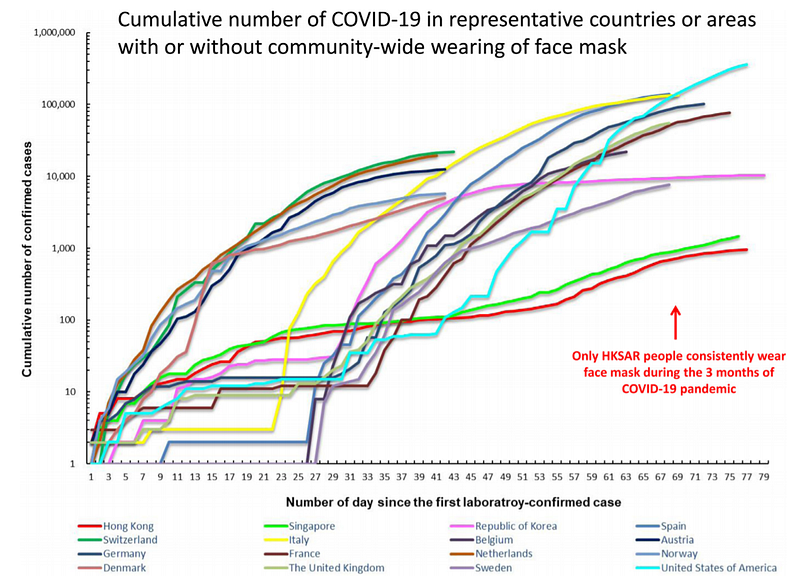
[1] In the current context of Covid-19, this meta-analysis corroborates another observational study showing that cases in Hong Kong were much lower than Spain, Germany, Italy, France, U.S., U.K., Singapore, and South Korea as of 9th April 2020. The public mask-wearing compliance in Hong Kong was 96.6%.
People in Hong Kong had practiced mask-wearing despite the WHO and CDC recommendations that face masks should be reserved for those working in healthcare settings at that time. “This public action was linked to the painful experience of the 2003 SARS outbreak,” the authors wrote.
[2] In a case study, a man with a dry cough on a flight from Wuhan to Guangzhou to Toronto, Canada was tested positive for Covid-19 upon arrival. Twenty-five passengers sitting within 2m from the man did not contract Covid-19 because he wore a mask.
[3] A recent China cohort study that was not included in the meta-analysis also supports the case for face masks. Tracking 124 families with at least one infected family member, researchers found close household contact increased the risk of contracting Covid-19 by 18 times. Fortunately, if at least one family member wore a mask before symptoms appear, virus transmission was reduced by 79%. Daily use of chlorine or ethanol disinfections was also 77% effective in preventing the spread of Covid-19.
“This further supports universal face mask use, and also provides guidance on risk reduction for families living with someone in quarantine or isolation, and families of health workers, who may face ongoing risk,” the Chinese stated. Without face masks, cases of respiratory virus infections throughout history would have been much higher.
For a commentary on this article, and why scientific literacy is important, kindly see Milton Black’s one: