avatarJason Deane

Free AI web copilot to create summaries, insights and extended knowledge, download it at here

3728

Abstract

probably know exactly what I mean and we’ve all read countless stories about how not only how important that first draft is, but also how likely it is to be utter crap. The best writers do it and yet, until recently, I just couldn’t. It seemed there was something stopping me which I worked out boiled down to just two reasons:</p><h2 id="3c04">Fear of someone reading them</h2><p id="aa8d"><b>What?</b> Let’s break that down. The chances of someone reading them (even if they were able to decipher them) are minuscule. And if they did, would they think I was a rubbish writer? Based on that work, probably, but does that even matter? In my mind, sort of, I suppose, so it just seemed an unnecessary risk to take. The bottom line was I simply didn’t want people to see stuff I’d written in it’s ‘naked’ form for fear of ridicule or rejection.</p><p id="6cad">That sounds ridiculous even to me as I wrote it. I made a post it note and stuck it on the side of my screen that reads: “Get over yourself”</p><h2 id="0dc3">Being unable to resist correcting an error</h2><p id="2272">My writing was usually the ‘pushing the car uphill with five people in it’ type. It didn’t come easily. It came word by word, sentence by sentence, often with both being constantly revisited. It was hard, hard, hard work.</p><p id="bfe1">And the reason?</p><p id="0727">Simple. I just couldn’t leave a typo. Or a spelling mistake. Or a grammatical error of ANY sort. Those little red curly underlines just screamed out for attention and I just had to go back, like a marine going back for a fallen comrade. But it also immediately sounded a death knell for anything else I was thinking of writing.</p><p id="60e4">My ‘shitty first draft’ had to be perfect, thereby neatly negating the point of the ‘shitty first draft’. Go figure.</p><figure id="21e5"><img src="https://cdn-images-1.readmedium.com/v2/resize:fit:800/1*gFNnUFdni6evhrt07ooNhA.jpeg"><figcaption>The middle section of this article in ‘first draft’ form. Things seem to have gotten messier! Source: Author</figcaption></figure><p id="1cdf">It didn’t matter that I understood the logic, it didn’t matter that all good writers tell you this is a great technique for making writing work, I just couldn’t get over that fear and obsession.</p><p id="d460">Until I <i>really</i> started reading about it from some of the ‘big writers’ on this platform, but this time with a concerted effort to learn and change. Only then, did I find myself in a position to take a leap of faith and go for it.</p><p id="ee8d">Who cares if someone looked over my shoulder and saw a page of utter rubbish with more red lines than the US government issuing ultimatums? Who cares if some of the analogies were dodgy and it sounded like something a five year old would write? I was going to write it anyway.</p><p id="70ad">And then I’d exorcise my demons by publishing my first draft of this article in it’s pure naked form in an attempt to help other people with the same affliction. Unless it’s just me, in which case perhaps I’m just weird.</p><p id="28c2">In fact, I decided, if I’m going to do it, I may as well do it properly. I decided to write this whole article in one go with no corrections, no stops and no breaks at all, simply letting my fingers dance over the keyboard with no regard for <i>anything</i> except flow. Then, I thought, I’d take a screen shot of the mess I’d created and post it in the finished article to see what the two looked like side by side. If you’re reading this bit, then hopefully it’s worked.</p><p id="c72c">And, at this point having written I-don’t-know-how-many-words-because-I-don’t-want-to-stop-and-check-the-word-counter, I know it’s taken me less than five minutes to

Options

write this much.</p><p id="718b">Five minutes!?</p><p id="c1b2">Normally, it would more than that just for the opening line!</p><p id="58bc">Of course, at this point I have no idea of how long it will take me to go and fix the numerous errors or even if the article will flow correctly, but that’s an astonishing start. I don’t think I’ve ever written anything so fast.</p><figure id="42e7"><img src="https://cdn-images-1.readmedium.com/v2/resize:fit:800/1*7Gem_gdhG_j05DkbpFOvDA.jpeg"><figcaption>Not sure where I was going at the end there, but at the time, it didn’t matter. Source: Author</figcaption></figure><p id="dbcf">So, based on the experience I’ve had as I type this, I can no longer defend my ‘old style’ of squeezing out each line from my brain, forcing myself to try and get back to the point each time and then correcting as I go. This is far more efficient. It’s also far more satisfying and, dare I say it, far more fun.</p><p id="8558">My page is chaos, a red mess, but there’s something raw and passionate about it. There’s also a sense of relief as I’ve successfully managed to empty my brain of my ideas in one streaming gush in the same way you get a sense of relief after emptying your bladder after a long wait. I feel refreshed, rather than drained, energized rather than deflated.</p><p id="30cf">Does this means I will get the same sense of satisfaction at the end? Well, we’ll see. Perhaps the hard work to fix this mess is harder than the ‘old way’ but somehow I doubt it.</p><p id="523a">Whatever the outcome, there’s no question that from now on I should be using the ‘shitty first draft’ technique to extract my ideas and get them down.</p><p id="1f2d">And, for what’s it’s worth, I think you should too.</p><p id="9c0c"><i>If you enjoyed this article, you might find these ones useful too:</i></p><div id="9be5" class="link-block"> <a href="https://readmedium.com/how-to-use-facebook-groups-to-increase-your-readership-ae112680ef59"> <div> <div> <h2>How to Use Facebook Groups To Increase Your Readership</h2> <div><h3>The ‘Fair Use’ Way of Sharing Your Work with Others</h3></div> <div><p>medium.com</p></div> </div> <div> <div style="background-image: url(https://miro.readmedium.com/v2/resize:fit:320/1*HUiXd_ioQ-eL4aUcGAkOxg.jpeg)"></div> </div> </div> </a> </div><div id="8cae" class="link-block"> <a href="https://writingcooperative.com/how-to-cope-with-writers-guilt-5ab4075e0f22"> <div> <div> <h2>How to Cope with Writer’s Guilt</h2> <div><h3>Rejoice! Guilt free writing is possible!</h3></div> <div><p>writingcooperative.com</p></div> </div> <div> <div style="background-image: url(https://miro.readmedium.com/v2/resize:fit:320/1*Mzoz6EX2j6GoutVs1sS2OA.jpeg)"></div> </div> </div> </a> </div><div id="8b30" class="link-block"> <a href="https://readmedium.com/im-in-medium-curation-jail-and-i-m-ok-with-it-9de3c3b30140"> <div> <div> <h2>I’m in Medium Curation Jail (and I’m OK with It)</h2> <div><h3>When curation becomes impossible, what’s the next step?</h3></div> <div><p>medium.com</p></div> </div> <div> <div style="background-image: url(https://miro.readmedium.com/v2/resize:fit:320/1*CuMy2QBxWBeLpwXhYoQd5g.jpeg)"></div> </div> </div> </a> </div></article></body>

Why I Switched to Deliberately Creating a ‘Shitty First Draft’

I was inspired the other day by a story on Medium that all writers can relate to — that of the so-called ‘shitty first draft.’ Yes, this really is a term, it even has it’s own tag.

The concept— and I (now) totally subscribe to it — is that you ‘brain dump’ everything you want to say in one steam-of-consciousness flow to get the ideas out of your head and onto paper with the view that you can go back later and tidy it all up into something readable, coherent and, hopefully, interesting.

You just go for it, as fast as you can. It doesn’t matter if there are typos, extra/missing words or some of it doesn’t make sense. It doesn’t even matter if some words are so badly spelled in your haste to type them that they auto correct to something completely unrecognizable — as long as there’s enough there to remind you of what you were saying in the first place.
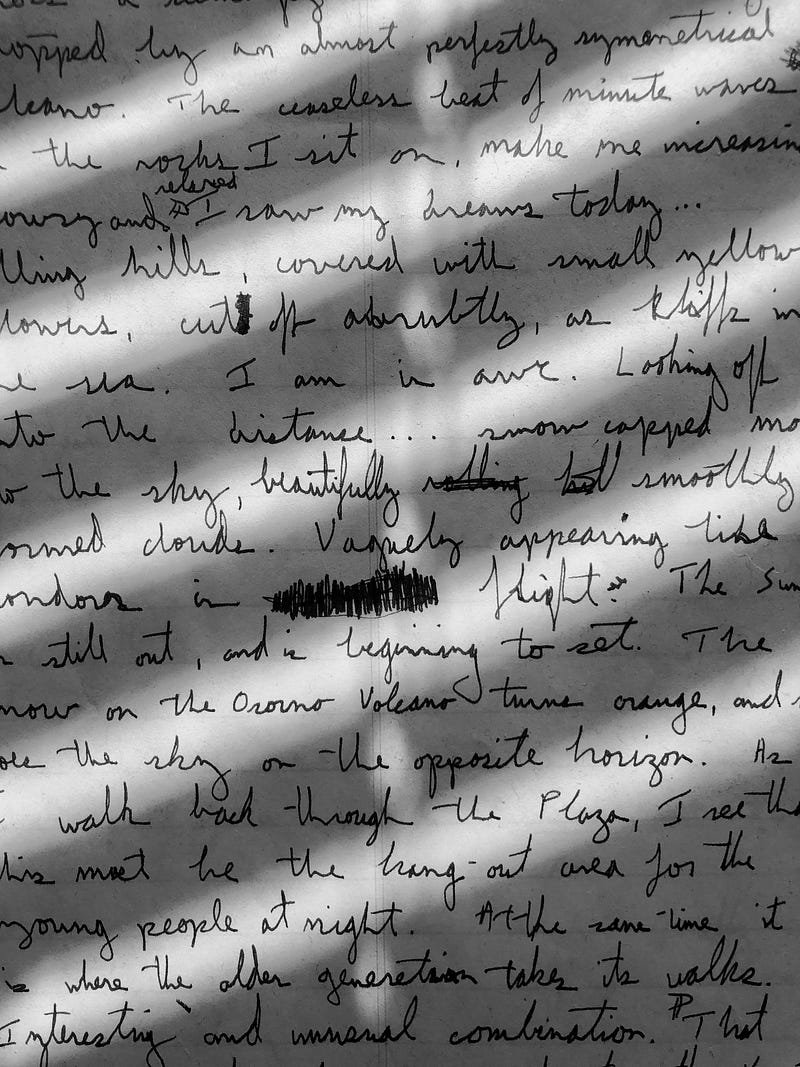
Notes, errors, scrawls, typos, it’s all good. Just get the message down. Photo by micah boswell on Unsplash

And actually, it doesn’t even matter if the idea itself turns out to be load of crap, because no one is going to read it except you. The point is that you just start writing, a bit like a sculptor creating a block of raw material to shape into something beautiful later on. It only matters that the idea is out, down and safe.
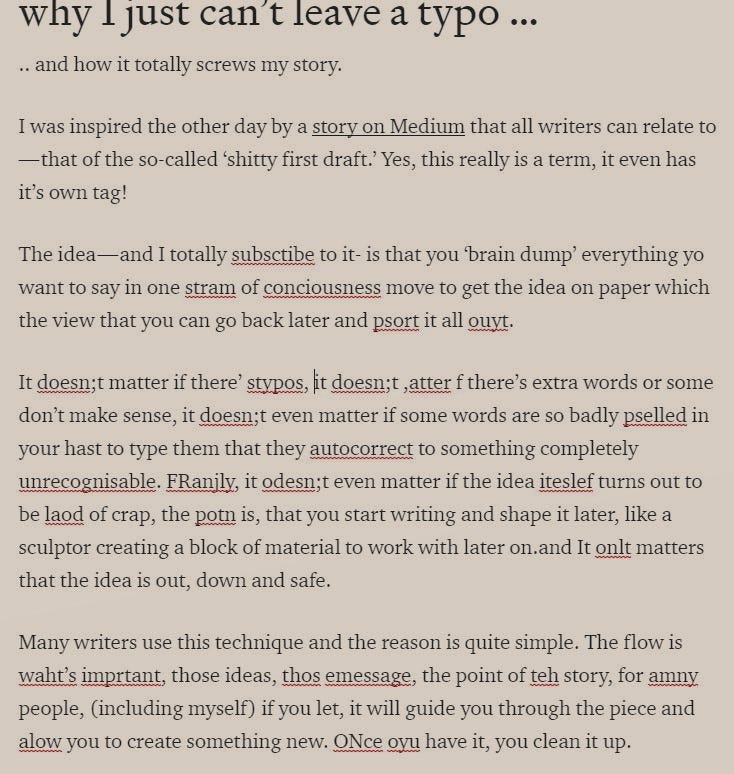
Part 1 of the first draft of this article, completely untouched, warts and all. The title was a brain dump and didn’t work, and the other mistakes speak for themselves. Source: Author.

Many writers use this technique and the reason is quite simple. The flow is what's important. Those ideas, those messages, even the point of the story, for many people (including myself as it turns out) will guide you through the piece and allow you to create something new, if only you simply let it. That detail stuff? That’s for later.

But you have to resist the temptation to start re-reading and tinkering as you go. The second you stop to go back and correct stuff a sort of ’second level’ thinking kicks in as your brain enters a different way of processing that interrupts the flow. Now, instead of creating, you’re looking for errors, better ways to construct things, ways to fix that sentence that not only doesn’t make sense, it’s six lines long.

Where before you were pushing a car down a hill, barely keeping up with it as it freewheeled with just a little guidance from you, now it’s uphill. In mud. With five people inside. But you’ve still got to get to that finish line. You’ll probably still get there, but it’s hard, damn hard.

The words are suddenly resisting being squeezed out of your brain and the ideas that you had neatly lined up for later on in the piece are suddenly lost in the endless ether in your mind, shattered into a million pieces that are impossible to put back together again. And, even if you somehow do manage to recall them, you’re never quite sure if was what you actually thought of to start with.

Of course you probably know exactly what I mean and we’ve all read countless stories about how not only how important that first draft is, but also how likely it is to be utter crap. The best writers do it and yet, until recently, I just couldn’t. It seemed there was something stopping me which I worked out boiled down to just two reasons:

Fear of someone reading them

What? Let’s break that down. The chances of someone reading them (even if they were able to decipher them) are minuscule. And if they did, would they think I was a rubbish writer? Based on that work, probably, but does that even matter? In my mind, sort of, I suppose, so it just seemed an unnecessary risk to take. The bottom line was I simply didn’t want people to see stuff I’d written in it’s ‘naked’ form for fear of ridicule or rejection.

That sounds ridiculous even to me as I wrote it. I made a post it note and stuck it on the side of my screen that reads: “Get over yourself”

Being unable to resist correcting an error

My writing was usually the ‘pushing the car uphill with five people in it’ type. It didn’t come easily. It came word by word, sentence by sentence, often with both being constantly revisited. It was hard, hard, hard work.

And the reason?

Simple. I just couldn’t leave a typo. Or a spelling mistake. Or a grammatical error of ANY sort. Those little red curly underlines just screamed out for attention and I just had to go back, like a marine going back for a fallen comrade. But it also immediately sounded a death knell for anything else I was thinking of writing.

My ‘shitty first draft’ had to be perfect, thereby neatly negating the point of the ‘shitty first draft’. Go figure.
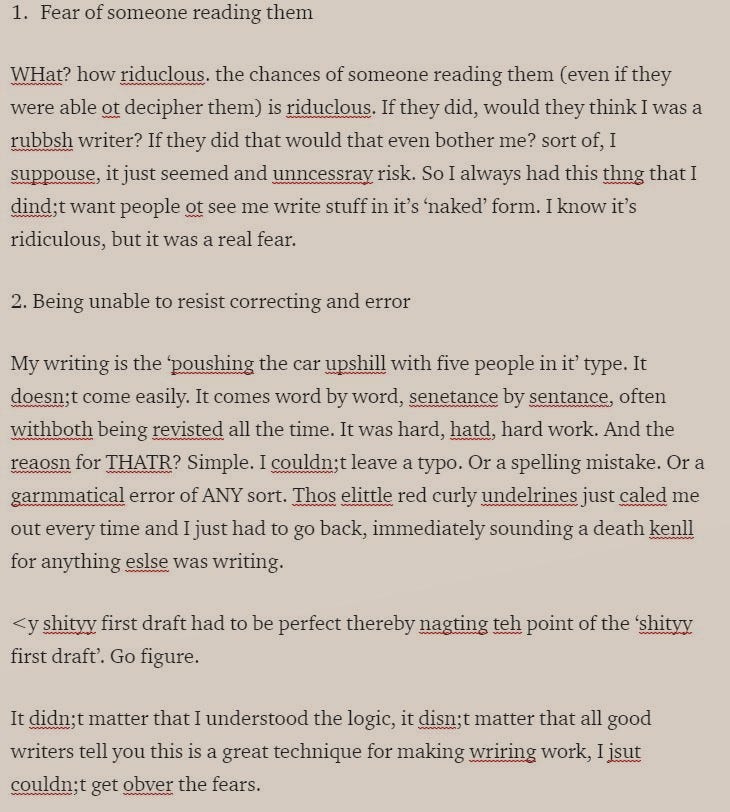
The middle section of this article in ‘first draft’ form. Things seem to have gotten messier! Source: Author

It didn’t matter that I understood the logic, it didn’t matter that all good writers tell you this is a great technique for making writing work, I just couldn’t get over that fear and obsession.

Until I really started reading about it from some of the ‘big writers’ on this platform, but this time with a concerted effort to learn and change. Only then, did I find myself in a position to take a leap of faith and go for it.

Who cares if someone looked over my shoulder and saw a page of utter rubbish with more red lines than the US government issuing ultimatums? Who cares if some of the analogies were dodgy and it sounded like something a five year old would write? I was going to write it anyway.

And then I’d exorcise my demons by publishing my first draft of this article in it’s pure naked form in an attempt to help other people with the same affliction. Unless it’s just me, in which case perhaps I’m just weird.

In fact, I decided, if I’m going to do it, I may as well do it properly. I decided to write this whole article in one go with no corrections, no stops and no breaks at all, simply letting my fingers dance over the keyboard with no regard for anything except flow. Then, I thought, I’d take a screen shot of the mess I’d created and post it in the finished article to see what the two looked like side by side. If you’re reading this bit, then hopefully it’s worked.

And, at this point having written I-don’t-know-how-many-words-because-I-don’t-want-to-stop-and-check-the-word-counter, I know it’s taken me less than five minutes to write this much.

Five minutes!?

Normally, it would more than that just for the opening line!

Of course, at this point I have no idea of how long it will take me to go and fix the numerous errors or even if the article will flow correctly, but that’s an astonishing start. I don’t think I’ve ever written anything so fast.
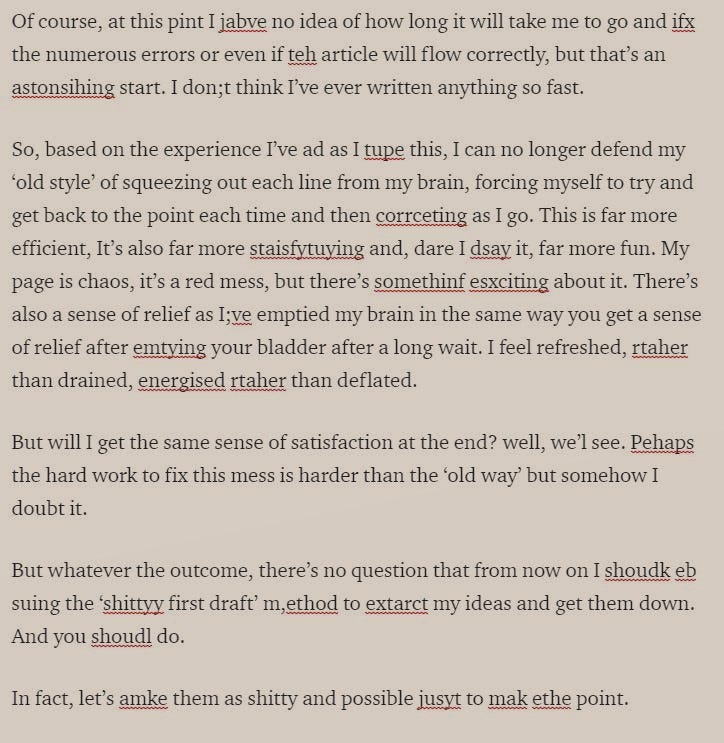
Not sure where I was going at the end there, but at the time, it didn’t matter. Source: Author

So, based on the experience I’ve had as I type this, I can no longer defend my ‘old style’ of squeezing out each line from my brain, forcing myself to try and get back to the point each time and then correcting as I go. This is far more efficient. It’s also far more satisfying and, dare I say it, far more fun.

My page is chaos, a red mess, but there’s something raw and passionate about it. There’s also a sense of relief as I’ve successfully managed to empty my brain of my ideas in one streaming gush in the same way you get a sense of relief after emptying your bladder after a long wait. I feel refreshed, rather than drained, energized rather than deflated.

Does this means I will get the same sense of satisfaction at the end? Well, we’ll see. Perhaps the hard work to fix this mess is harder than the ‘old way’ but somehow I doubt it.

Whatever the outcome, there’s no question that from now on I should be using the ‘shitty first draft’ technique to extract my ideas and get them down.

And, for what’s it’s worth, I think you should too.

If you enjoyed this article, you might find these ones useful too:

Writing
Productivity
Self Improvement
Inspiration
Writing Tips
Recommended from ReadMedium