
Why I Stopped Pursuing Gut Microbiota Research As An Academic
Three problems with the promise of gut microbiota being the holy grail of medicine.
Though I was just a master’s student, I’ve published over 10 papers in reputable scientific journals, mainly as the first author. Neuroscience, infectious diseases, and vaccines are my research interests.
Looking back, the first paper I published was a research review on the potential of different probiotic bacterial strains to treat major depressive disorder in the journal Frontiers of Neuroscience in 2020 (Figure 1).
As with any excited newbie tackling a tough project, I put a lot of effort into this paper, to the point of obsession, honestly. I believe I spent at least 6 hours on this paper every day during the semester break — trying to comprehend the entire literature on the relationship between gut microbiota and the brain and between probiotics and depression.
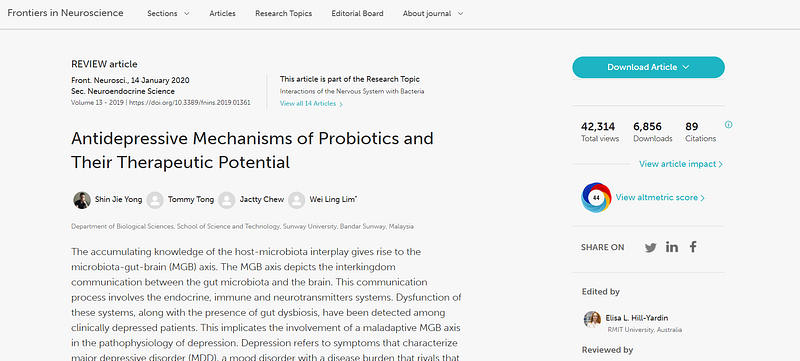
My first scientific paper has over 300 citations — too many for a paper. Whereas my following 10 papers typically have fewer than 150 citations, but none were about gut microbiota anymore.
I stopped doing research about gut microbiota as I realized it’s not the holy grail of medicine like what the media and scientists have implied.
Here’s why.
1. We don’t know what a healthy gut microbiota looks like
Conventional knowledge tells you there are certain ‘good’ and ‘bad’ gut microbes. Those ‘good’ ones are typically the Lactobacillus and Bifidobacterium species, also found in probiotic pills. Whereas Bacteroides species are considered the ‘bad’ gut microbes associated with the high-fat Western Diet.
But extensive gut microbiota profiling of the Hadza hunter-gatherers in northern Tanzania revealed what we thought was a terrible gut microbiota, i.e., one that is:
- Devoid of Bifidobacterium species.
- Enriched in Bacteroides, Prevotella, and Treponema species.
The absence of Bifidobacterium species baffled the researchers as this bacterial group is associated with breastfeeding and rapid colonizing of the gut microbiota after birth. Even in adults, Bifidobacterium species comprise 1–10% of the total gut microbes, at least in non-hunter-gatherers.
As mentioned, Bacteroides species are associated with the high-fat Western Diet and can cause inflammation and infections. Trepenoma species, known to cause diseases like syphilis, are also abundant in the hunter-gatherers’ gut microbiota for unclear reasons.
Yet, Hadza hunter-gatherers have lower rates of infectious diseases, metabolic diseases, and nutritional deficiencies compared to industrialized populations like us.
What do these hunter-gatherers eat, then? Only wild foods, mainly meat, honey, baobab, berries, and tubers. Though simple, at least they are not junk food. But their gut microbiota is what we thought was unhealthy.
Even in obesity, one 2023 perspective paper in Nature Microbiology, one of the world’s most prestigious journals, highlighted that we still don’t know what an obese gut microbiota looks like, stating that:
“There have now been at least three meta-analyses reporting that this finding is inconsistent between human studies, and that there are, in fact, no reproducible microbial taxonomic signatures of obesity in humans.”
There are no healthy or ideal gut microbiota standards we can uphold to. How, then, can we use gut microbiota interventions to treat diseases when we don’t even know what a healthy or non-diseased one looks like?
This is why patients don’t necessarily respond the same to gut microbiota interventions, as I’ll explain in the next section.
2. Gut microbiota intervention lacks specificity
Before venting out the specificity problem in gut microbiota intervention research, I must admit such interventions are not entirely useless.
The only case of clinically proven and Food and Drug Administration (FDA)-approved gut microbiota intervention is fecal microbiota transplant (FMT) for Clostridium difficile infection. This bacterium is notorious for causing severe and potentially fatal diarrhea — a nasty disease affecting about half a million Americans yearly.
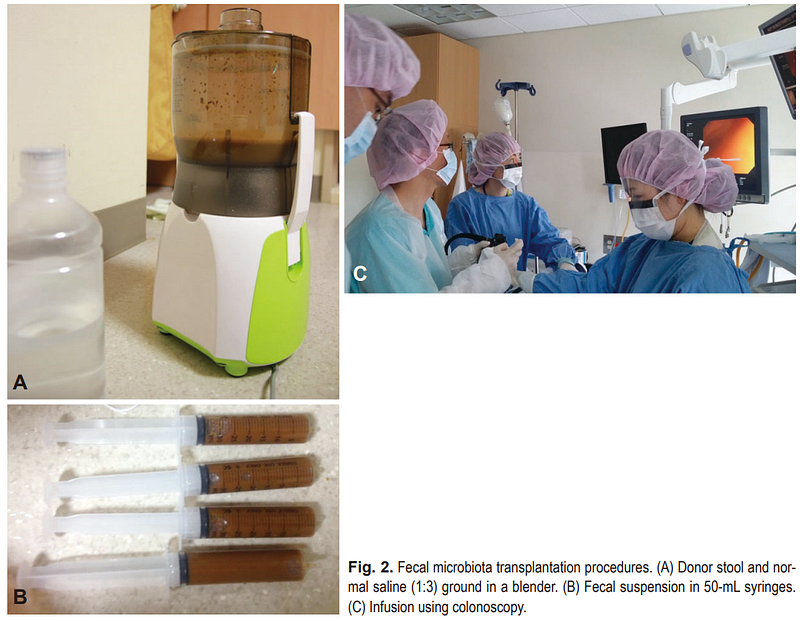
As the name suggests, FMT is the transfer of feces from a healthy donor into the gut of a patient with C. difficile infection. As you'd imagine, they mix the feces with water, milk, or saline solution, blend the mixture, filter them to remove larger impurities, and inject the suspension into the gut, usually via colonoscopy (a tube inserted from the anus) (Figure 2).
But in 2023, the FDA approved the oral pill form of FMT to treat C. difficile infection. Guess FMT isn’t as unappealing anymore.
Although FMT has shown some success in treating other diseases like obesity, diabetes, and even neurodegenerative diseases and cancers, the only disease FMT is approved to treat is still C. difficile infection.
As a 2022 review of research in the Frontiers of Medicine noted:
“Initially tested and used for the treatment of recurrent and refractory CDI [C. difficile infection], the advantages of its use have broadened its applicability…[to] obesity, type 2 diabetes mellitus, metabolic syndrome, neuropsychiatric disorders, inflammatory bowel disease, IBS [irritable bowel syndrome], decompensated cirrhosis, GvHD [graft vs. host disease] and even cancers… Still, there remains a lot that is unknown and missing knowledge gaps that has prevented this therapeutic modality from obtaining FDA approval for treatments beyond CDI.
By the way, probiotics are not approved to treat any diseases at all. This alone is a testament to the clinical unreliability of this intervention. Unlike FMT, probiotics are considered supplements whose formulation and manufacturing are not regulated and whose efficacy is not tested.
I also highlighted this specificity problem in my published review paper, where clinical trials investigating probiotics to treat depression often used different probiotic formulations and often reported mixed results.
I also cited one crucial study showing that the tolerability of individuals’ gut microbiota toward the colonization of probiotics ranges from permissive to resistant, which appears to depend on the baseline gut microbiota profile. For instance, those who were permissive toward the colonization of Lactobacillus species had low levels of Lactobacillus before taking probiotics; otherwise, the probiotics had no health effects.
Most individuals’ gut microbiota appears to be resistant to probiotic colonization. A systematic review found that 6 out of 7 clinical trials did not detect any significant differences between the fecal microbiota of those who took probiotics versus placebo for up to 7 weeks.
Probiotic colonization, however, may not be a good thing. A separate study showed that probiotics better colonized the gut microbiota of individuals who took antibiotics, but it hindered the restoration of the original gut microbiota profile. Even after stopping probiotics, it took at least five months for the original gut microbes to return.
Why are we seeing limited success with gut microbiota interventions like FMT (and probiotics)? I believe it all boils down to specificity.
For a drug or medical intervention to work, it must have a specific mechanism of action. For instance:
- Insulin lowers blood glucose levels in diabetes.
- L-thyroxine restores normal thyroid function in thyroid disorders.
- Antidepressants act on certain brain neurochemical pathways involved in mood and emotion regulation.
- Anti-hypertensives inhibit the angiotensin-converting enzyme (ACE) to lower blood pressure.
- Antibiotics kill bacteria, including disease-causing ones.
But FMT and probiotics act on the gut microbiota for what? To restore a healthy gut microbiota? But remember, there are no healthy gut microbiota standards we can refer to.
Sarkis Mazmanian, Ph.D., a microbiology professor at the California Institute of Technology, explained this concept eloquently:
“There is no way that anyone has enough information to be able to reshape your microbiome in a meaningful and healthy way, that is tailored to you. We have no idea what healthy even is, as far as the microbiome is concerned and, since my microbiome configuration is based on my genetics, diet, and life experiences, healthy for me is totally different from healthy for you.”
3. Diseases don’t always begin in the gut microbiota
One of the promises of gut microbiota being the holy grail of health is the notion that all or most diseases begin in the gut. Therefore, fixing the gut microbiota is the key to treating diseases.
- “All disease begins in the gut.” — Hippocrates Asclepiades, father of medicine (c. 460-c. 370 BC).
- “The majority of diseases begin in the digestive tract when ‘good’ bacteria are no more able to control ‘bad’ bacteria.” — Élie Metchnikoff, father of probiotics and natural immunity (1845–1916).
But is this idea backed by science?
First, let’s understand why this idea is quite convincing. In my review paper, I highlighted studies showing that transplanting the gut microbiota from patients with depression (but not from healthy people) into rats resulted in depressed rats. Such experiments have been replicated for other diseases like Parkinson’s disease, schizophrenia, irritable bowel syndrome, obesity, and others.
But these experiments were done with germ-free mice or rats, bred via cesarean section, and raised in a sterile environment without gut microbiota. So, it’d rather easy for any gut microbes — be it via FMT or probiotics — to colonize the gut of such germ-free rodents.
A 2018 review in the journal Brain argued that experimental results from germ-free animals are not readily generalizable. Because such animals, though they appear outwardly normal, often suffer from serious developmental and immune system defects.
Moreover, over 90% of preclinical, including animal experiments, findings failed to translate to human or clinical significance. And even in the remaining 10% that did, there’s no guarantee the translated clinical significance is meaningful enough to influence medical policy.
While such limitation doesn’t entirely discount the potential influence of gut microbiota in disease development, such experiments are not causative. They don’t prove that diseases begin in the gut microbiota. But the hype in the gut microbiota research field has ignored this.
William Hanage, PhD., an assistant professor of epidemiology at Harvard T.H. Chan School of Public Health, emphasized that changes in gut microbiota in patients with diseases are just a biomarker and “it’s a long way from that to say that the microbiome is causing the disease.”
And Hanage stressed that disease biomarkers are mere correlations, which don’t mean causation. For instance, Hanage argued that a patient with bipolar disorder might have different diets during episodes of mania and depression or may take medications that alter gut microbes, resulting in different gut microbiota than a healthy person.
“All scientists know that correlation is not causation, but for some reason when it comes to the microbiome, people often seem to have forgotten it,” Hanage said. “They just … plain don’t care anymore.”
The abovementioned Nature Microbiology perspective piece in 2023 also argued that one of the myths or misconceptions about gut microbiota is that “Most diseases are characterized by a pathobiome.”
Pathobiome means that there's a specific gut microbiota for a given disease. But as I’ve pointed out with obesity, at least three meta-analyses have failed to characterize a pathobiome for obesity.
As the 2023 perspective piece argued (pardon me for the long quote):
“It has become increasingly common to read claims in the literature that most diseases are caused by a ‘pathobiome’. This is loosely defined as deleterious interactions between microbial communities and their host that lead to disease. This term is unfortunately overly simplistic and inherently flawed.
It is true, however, that numerous human conditions have been shown to correlate with alterations in microbiota composition. This is sometimes referred to as ‘dysbiosis’, which is also a vague term with limited clinical applicability…
Such alterations are rarely consistent and the microbiota is hugely variable between individuals, both in health and disease. This makes it extremely difficult to identify gut microbiota configurations with the required specificity and reproducibility for clinical practice.”
If one of the world’s leading scientific journals in microbiology questions the existence of pathobiome and the notion of gut microbiota causing diseases, it should reflect the uncertainty enshrouding this matter.
To close
Gut microbiota has been one of the hottest research fields over the past decade or two. Believing in a universal cause of disease or the holy grail of health is tempting. Even I did believe at first and dedicated months of work to write a lengthy research review paper about it.
But akin to crypto or artificial intelligence, the promises of gut microbiota research have only scratched the surface and may not be achievable with today’s technology. I could be wrong, but judging from what I’ve observed, gut microbiota is not the game-changer in medicine.
Ultimately, I did not pursue gut microbiota research for my master’s degree in research. And if I am going to do a Ph.D., the gut microbiota isn't one of my top choices either.
Am I being unreasonably harsh in this field? What do you think?
If you have made it this far, thank you. Subscribe to my Medium email list here. You can also tip me here if you are feeling generous today, and I will appreciate any financial support I can get.


